
Two weeks after UK-based autonomous driving company Wayve announced it had secured $1.2 billion in a Series D round — bringing the total committed capital to $1.5 billion and its post-money valuation to $8.6 billion — the deal continues to dominate the conversation about where venture capital is moving in 2026 and why. The investor list alone tells a structural story: not a single social media platform, consumer marketplace, or digital advertising business anywhere in it. Instead, the syndicate spans AI chip infrastructure, global mobility platforms, incumbent automakers, pension funds, and sovereign-adjacent institutions. This is not a bet on an audience. It is a bet on a physical layer of technology that cannot be replicated by a competitor with a larger marketing budget.
The Deal in Its Specifics
Wayve’s Series D, announced February 25, 2026, was led by Eclipse, Balderton, and SoftBank Vision Fund 2, with new institutional investment from Ontario Teachers’ Pension Plan, Baillie Gifford, the British Business Bank, Icehouse Ventures, and Schroders Capital. Returning backers Microsoft, Nvidia, and Uber also participated, alongside automakers Mercedes-Benz, Nissan, and Stellantis.
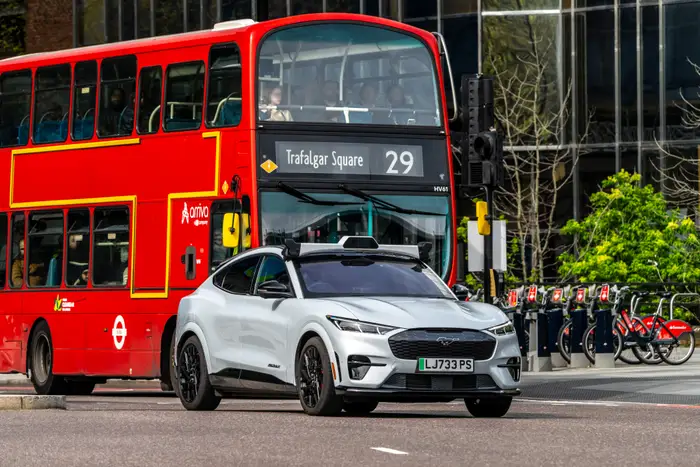
As part of the round, Uber has committed additional milestone-based capital to support multi-year deployments of Wayve-powered robotaxis on the Uber network, with plans to scale to more than ten markets globally. The companies plan to launch their first commercial service in London in 2026, with broader international rollout to follow. Under the partnership, Wayve will deploy its AI Driver in L4-capable vehicles from participating automakers, while Uber will own and operate the fleet — creating a scalable model for autonomous ride-hailing using mass-produced vehicles rather than purpose-built robotaxi hardware. CNBC
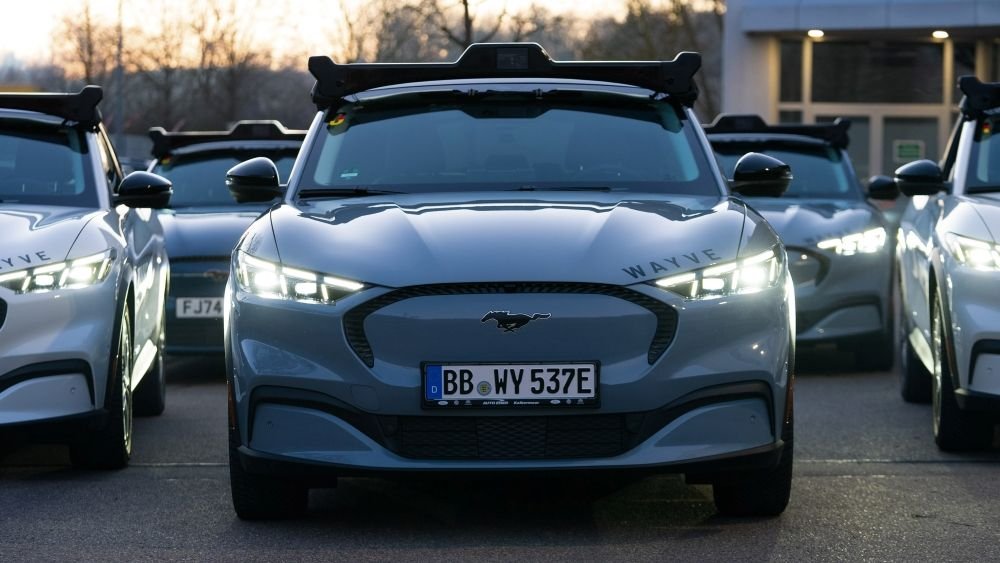
The business model Wayve is pursuing is worth understanding precisely, because it explains why the investor composition looks the way it does. Unlike Waymo, which largely operates its own robotaxi fleet, or Tesla, which bundles its software with its own vehicles, Wayve licenses its AI Driver directly to automakers and mobility platforms. The system runs entirely on onboard vehicle compute and embedded sensors, without reliance on high-definition maps or location-specific engineering. CEO Alex Kendall described this as the “contrarian” option in automated driving — contrarian in both technical approach and business model. CNBC
The practical result of that architecture is that Nissan’s AI-equipped vehicles — which will feature Wayve’s driver assistance system from 2027 — and Uber’s London robotaxi fleet are being built on the same underlying platform. Wayve becomes the software layer that multiple hardware and fleet operators depend on, rather than a vertically integrated operator competing with its own customers.
Why This Deal Signals a Shift, Not an Outlier
The Wayve round is not anomalous. It is the largest and most visible example of a pattern reshaping how institutional capital is being deployed across the venture landscape in early 2026. The defining characteristic of that pattern is a preference for companies that own something that cannot be quickly commoditised: proprietary data, physical infrastructure dependencies, regulatory moats, or hardware-software integration that takes years of real-world testing to validate.
Balderton’s involvement — one of the lead investors — is instructive in this context. The firm’s partner noted in the announcement that what distinguished Wayve was not just its technical achievement but its ability to take cutting-edge research out of the lab and deploy it in complex, real-world driving environments, turning breakthrough science into commercial reality. That transition from research to deployment is precisely what most AI companies have claimed and few have demonstrated.
The contrast with the investment environment of 2021 is structural rather than cyclical. During the high-water mark of growth-at-all-costs funding, the primary metric investors used to justify valuations was top-line revenue growth or, in pre-revenue companies, total addressable market estimates. The downstream consequence — companies that were valued at 30 to 50 times forward revenue on the assumption that monetisation could always be solved later — produced a correction that ran through 2023 and 2024. The Wayve deal reflects a different logic: Nissan is a customer, Uber is a customer, and the $300 million of milestone-based capital from Uber is explicitly contingent on deploying robotaxis — a structure that ties a significant portion of committed capital to the company’s ability to actually execute its product roadmap.
What the VC Landscape Looks Like Now
The structural shift in due diligence priorities is not merely anecdotal. Survey data from McKinsey published in late 2025 found that 23 per cent of organisations had already begun scaling agentic AI capabilities — but the more revealing number was that only 11 per cent of those who said they planned to deploy autonomous AI systems in enterprise workflows had actually done so. The gap between stated intention and executed investment is exactly what informed investors are now pricing: they are backing the companies that have closed that gap, not the ones still trying to close it.
The vocabulary change inside VC firms is itself an indicator. Terms that dominated pitch meetings in 2021 — gross merchandise value, monthly active users, network effects — have been displaced by questions about CAC payback periods, revenue per employee, and gross margin at scale. A founder who arrives at a Series B meeting in early 2026 with a compelling user growth chart and a deteriorating contribution margin is not being offered the same terms as one with a slower growth curve and a clear path to unit economics profitability.
The “compound startup” framing — companies solving integrated problems across a vertical using proprietary data that competitors cannot easily replicate — has become the shorthand for the kind of moat that institutional investors are most willing to price into valuations. Wayve’s nine years of end-to-end AI development data, accumulated across public road testing in over 500 cities across Europe, North America, and Japan, represents the kind of structural advantage that cannot be purchased or replicated quickly regardless of how much capital a late entrant commits.
The Honest Caveat
What the Wayve deal does not prove is that the path to commercialisation for deep tech is straightforward. Autonomous driving has been “two years away” from mass deployment for nearly a decade. The company’s London robotaxi trial in 2026 and Nissan’s vehicle integration from 2027 will be closely watched precisely because the credibility of the entire round depends on execution against those specific commitments. A pension fund like Ontario Teachers’ and an institutional asset manager like Baillie Gifford are not in the business of writing off billion-dollar positions on unproven technology; their presence in the syndicate reflects a conviction that the deployment timeline is credible. Whether that conviction is vindicated will be determined by what happens on the streets of London and in Nissan’s production planning rooms over the next 18 months — not by any investor presentation.
The broader thesis — that capital is flowing toward companies with hard technical moats and validated revenue relationships rather than toward companies with large audiences and unclear monetisation paths — is correct. Whether every specific bet made on that thesis in early 2026 will prove to have been made at the right valuation is a different question. It always is.
All Wayve funding details are sourced from Wayve’s official press release dated February 25, 2026, corroborated by TechCrunch, CNBC, EU-Startups, and Ontario Teachers’ Pension Plan’s official announcement. The deal was announced on February 25, 2026 — not March 10. VC adoption statistics are sourced from McKinsey Global Survey (late 2025) and KPMG via Neurons Lab. This article does not constitute investment advice.


