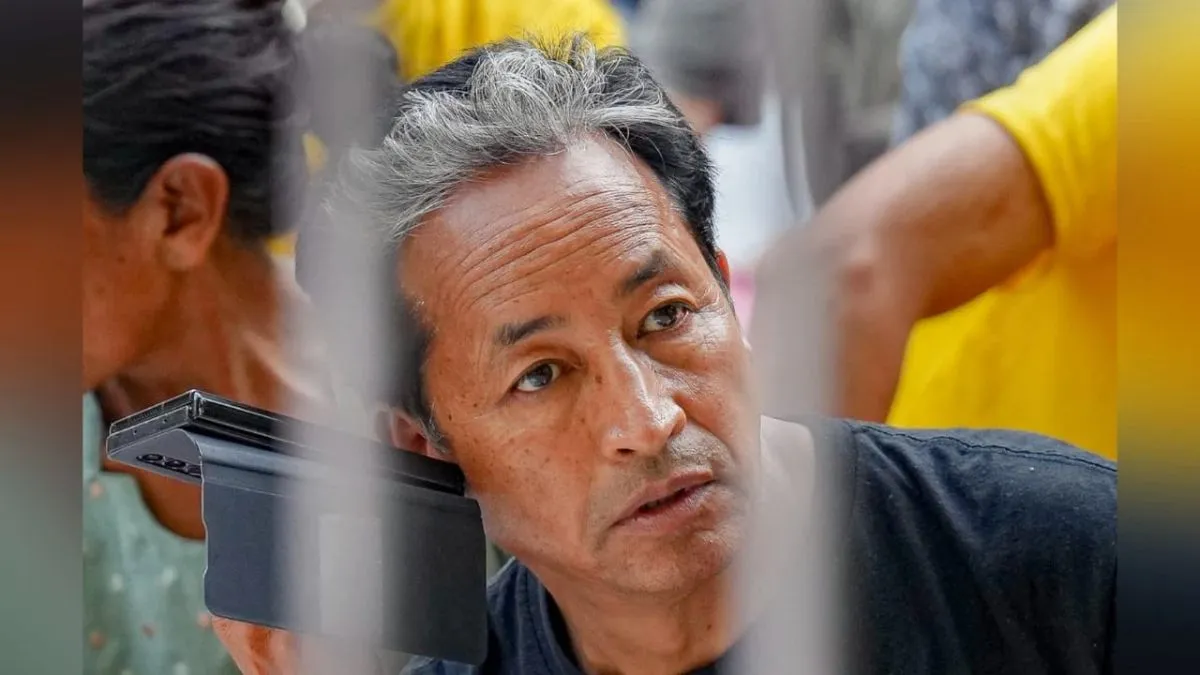


The Ministry of Home Affairs revoked the detention of Ladakhi climate activist and education reformer Sonam Wangchuk under the National Security Act with immediate effect on March 14, 2026, in a move the government characterised as an effort to foster “peace, stability, and mutual trust” for meaningful dialogue. The revocation, however, has not altered the plans of the two principal civil society organisations in the region — the Leh Apex Body and the Kargil Democratic Alliance — who have maintained their call for a territory-wide shutdown on March 16, stating that the broader constitutional demands of Ladakh remain unresolved.
Wangchuk had been in detention for nearly six months, following his arrest in late September 2025 after a protest rally in Leh on September 24 that year, which the Ladakh administration described as having caused a serious law-and-order situation. The administration had identified Wangchuk as the chief provocateur, alleging his speeches carried the potential to incite violence. His detention under the NSA — which permits incarceration without trial for up to 12 months — attracted sustained legal challenge and judicial scrutiny that ultimately created the political conditions for the executive decision to revoke it.
The Legal Trajectory
A habeas corpus petition was filed before the Supreme Court of India by Wangchuk’s wife, Dr. Gitanjali Angmo, challenging the legality of the NSA application on the grounds that it was arbitrary and violated fundamental rights. A bench comprising Justice Aravind Kumar and Justice Prasanna B. Varale questioned the administration’s interpretation of Wangchuk’s speeches during hearings, noting that authorities might be “reading too much” into his remarks, according to reporting by Live Law and the Economic Times. The court also flagged discrepancies in translations of the speeches from Ladakhi to Hindi and English. A next hearing had been scheduled for March 17; the MHA’s March 14 revocation pre-empted that proceeding.
The MHA statement noted that Wangchuk had already served nearly half of the maximum detention period authorised under the NSA, according to reporting by Newslaundry and The News Minute. Legal analysts cited in the research documents interpret the revocation as a discretionary executive gesture aimed at de-escalating tensions in the region ahead of the planned March 16 public mobilisation.
The Unresolved Core: Statehood and the Sixth Schedule
The civil unrest in Ladakh is rooted in a four-point charter presented jointly by the Leh Apex Body and the Kargil Democratic Alliance. The demands are: full statehood for the Union Territory; constitutional safeguards under the Sixth Schedule of the Indian Constitution; separate Lok Sabha constituencies for Leh and Kargil; and an accelerated recruitment process for Ladakhi youth.
The Sixth Schedule provides for the creation of Autonomous District Councils in tribal areas, granting them legislative, judicial, and administrative powers over land, forests, water, and local customs. Ladakhi leaders argue that with over 90% of the region’s population classified as tribal, the Sixth Schedule offers the most constitutionally appropriate mechanism to protect the region’s ecology and cultural identity from unregulated development. This argument has been consistently advanced by the Leh Apex Body in multiple rounds of talks with the Central Government.
The Government’s Proposed Alternative
During a High-Powered Committee meeting on February 4, 2026, the Central Government proposed the creation of a Territorial Council for Ladakh, under which the Chief Executive of the Hill Council would function as an equivalent of a Chief Minister. The Centre has cited concerns over the financial self-sufficiency of the region and its strategic location as a border territory as reasons for declining to grant full statehood.
The Leh Apex Body and Kargil Democratic Alliance rejected this proposal as “inconclusive,” arguing it falls short of the legislative protections offered by the Sixth Schedule. Since 2020, the High-Powered Committee and its sub-committees have met over 15 times without reaching a conclusive agreement, according to the research documents.
March 16: The Stakes
The March 16 shutdown will be the first significant public demonstration since violence in September 2024 that resulted in four deaths and 80 injuries following police firing, according to the research documents. Organisers have called for all businesses to remain closed and for participants to march from Singay Namgyal Chowk to the Polo Ground in Leh.
The Ladakh administration, through Chief Secretary Ashish Kundra and DGP Mukesh Singh, appealed for the rally to be reconsidered, citing concern that protests during the approaching tourist season could damage the local economy. The administration also highlighted the appointment of a new Lieutenant Governor, Vinai Kumar Saxena, described as “keen to engage with all stakeholders,” according to Times of India. The Kargil Democratic Alliance clarified that the struggle continues for the release of other detainees, including former MLA Deldan Namgial and Smanla Dorjey, and for the unconditional withdrawal of all charges related to the September 24, 2025 incident.
Political opposition figures including Akhilesh Yadav and Jairam Ramesh used the occasion to criticise the government’s use of the NSA, characterising the arrests as politically motivated, according to the research documents.