


India’s IPO allotment process is governed by SEBI’s ICDR Regulations and enforced through a fully automated, exchange-run lottery system that has no discretionary human element. The “viral hacks” that circulate on social media around IPO application season largely fall into two categories: things that are already standard SEBI rules, and things that don’t work. Understanding the difference — and the actual mechanics that govern who receives allotment and who does not — matters more than any shortcut.
How the Allotment Lottery Actually Works
SEBI’s regulations mandate that in an oversubscribed retail category, allotment must first ensure that the maximum number of retail applicants receive at least the minimum lot before any applicant is considered for additional lots. The process is computerised and conducted by the IPO registrar through a draw of lots. Each unique PAN number submitted in the retail category constitutes one entry in the lottery, regardless of the number of lots applied for — one applicant applying for one lot has exactly the same probability of receiving allotment as one applicant applying for the maximum retail category value, because both receive one draw. Worldbank
This single rule governs the most widely discussed application strategy. An investor who applies for 14 lots in a retail category IPO does not receive 14 entries in the lottery — they receive one. An investor who applies for 1 lot also receives one entry. The implication is direct: in a heavily oversubscribed IPO, applying for the maximum retail category amount does not improve allotment probability relative to applying for the minimum one lot.
The Cut-Off Price: Non-Negotiable for Serious Applicants
Book-built IPOs offer a price band — for example, ₹500 to ₹520 per share — within which investors bid. The final issue price is determined after the subscription period closes, based on demand discovery across the band. If an investor bids at ₹510 and the final price is set at ₹520, the application is technically rejected because the bid price falls below the final discovered price.
SEBI regulations permit applicants to select “Cut-off Price” rather than specifying a price within the band. A cut-off price selection means the investor is willing to pay whatever the final issue price turns out to be, up to the top of the price band. All retail individual investors are permitted to apply at cut-off price. Selecting cut-off price eliminates the risk of rejection from a price mismatch — the application remains valid regardless of where within the band the final price is discovered.
Not selecting cut-off price and instead manually entering a price below the final discovered price is one of the most common preventable causes of retail application rejection.
Multiple Family Applications: SEBI Rules, Not a Hack
The strategy of applying across multiple family members’ accounts is not a workaround — it is the direct mechanical consequence of how SEBI’s allotment lottery is designed. Since each unique PAN number constitutes one lottery entry, four members of a family with four distinct PAN numbers can each apply for one lot and collectively hold four independent entries in the lottery — quadrupling the household’s probability of receiving at least one allotment.
SEBI’s regulations explicitly prohibit multiple applications from the same PAN number. An investor who submits applications through two different brokers or demat accounts using the same PAN will have all applications rejected — not just the duplicate. Worldbank This is not a technical glitch; it is by design, to prevent any single investor from claiming more than one retail category lottery entry.
The practical guidance therefore is: each applicant must have their own PAN, their own demat account, and their own bank account linked for ASBA blocking. The demat account holder name and the bank account holder name must match, because allotment credits flow to the demat account and refunds return to the linked bank account — a mismatch triggers technical rejection.
The UPI Mandate: An Active Step Most Applicants Miss
For retail investors applying through brokers via UPI-based ASBA rather than bank-based ASBA, the application process has a step that must be completed separately and is frequently missed.
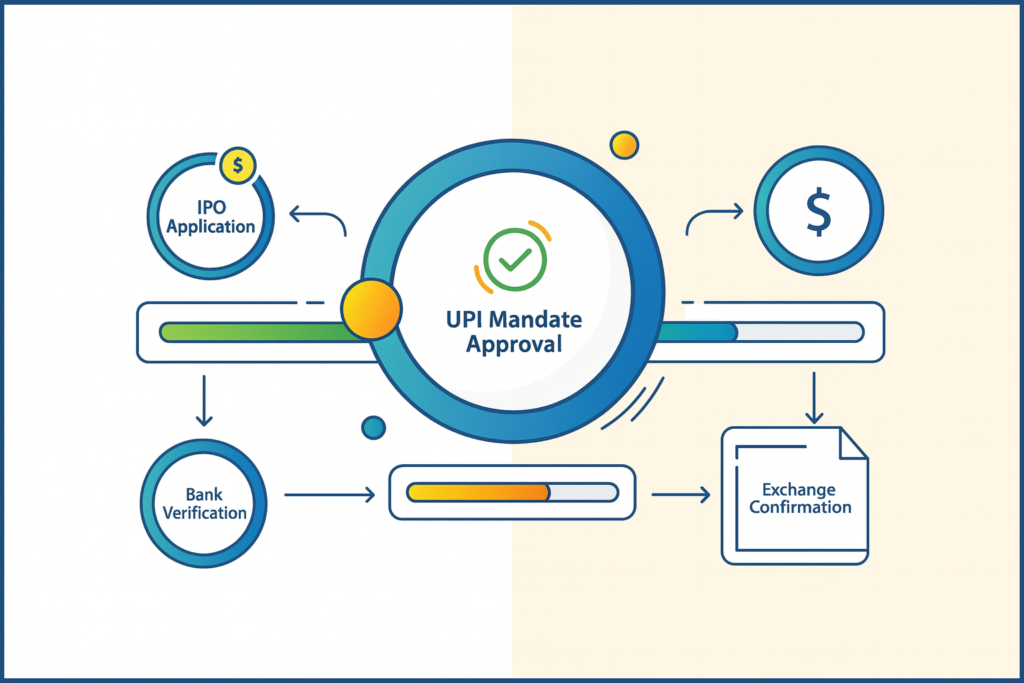
After submitting an IPO application through a broker platform using a UPI ID, the investor must separately open their UPI application — Google Pay, PhonePe, Paytm, BHIM, or any other NPCI-registered UPI app — and approve the mandate request that appears there. The mandate is a request to block the application amount in the investor’s bank account. Until this mandate is approved, the application amount is not blocked, and the application is not considered valid for allotment purposes. The mandate must be approved before 5:00 PM on the day of application. IBEF
The mandate approval step is separate from the broker’s application submission, occurs in a different app, and has a deadline that differs from the overall IPO closing time. A significant proportion of retail application failures occur because investors believe they have applied successfully — their broker platform shows the application submitted — but the UPI mandate was never approved, rendering the entire application invalid.
The Shareholder Category: An Underused Provision
Certain IPOs — typically where the company is a subsidiary of, or associated with, an existing listed entity — reserve a portion of the issue for existing shareholders of the parent or associated company. This is disclosed in the Red Herring Prospectus under the section describing the issue structure. Shareholders of the relevant listed company who hold shares on or before the record date specified in the RHP are eligible to apply in this separate reservation category, which competes only with other shareholders of that company rather than with the entire retail population. ThePrint
The subscription level in the shareholder category is typically lower than in the standard retail category, improving per-applicant allotment probability. Eligibility for this category is not widely advertised and is disclosed only in the offer documents — another reason why reading the RHP before applying has practical financial value beyond regulatory compliance.
The Timing Myth
SEBI regulations and exchange systems assign no priority to the time of application within the subscription window. An application submitted on day one of a three-day IPO window has the same probability of allotment as an application submitted on day three — both enter the same computerised lottery once the subscription closes. The advice to apply on day one for “extra preference” is not supported by any regulatory provision.</value> International Monetary Fund
What does have a practical basis is the advice to avoid the final hours of the last day. UPI and banking systems experience higher transaction volumes as the subscription window closes, and technical failures — failed UPI mandate approvals, server timeouts on broker platforms, banking system congestion — are more common in peak load periods. Applying during day two or early on day three, when load is lower, reduces the probability of a technical failure preventing a valid application from being recorded.
What Cannot Be Changed
The allotment outcome in a heavily oversubscribed IPO is a lottery by regulatory design. In a 50x oversubscribed retail category, statistically one in 50 applicants receives allotment. Applying for more lots does not improve this probability. Applying through multiple brokers under the same PAN eliminates the application entirely. No system manipulation, broker-specific trick, or application timing preference changes a lottery outcome.
The rules discussed in this article — cut-off price selection, UPI mandate approval, PAN-demat-bank account name consistency, shareholder category participation, and family member independent applications — address preventable rejection causes and the mechanical maximisation of legitimate lottery entries. They do not constitute a method for guaranteeing allotment, and any claim to the contrary should be regarded with appropriate scepticism.
Note to readers: This article explains SEBI’s IPO allotment rules and application procedures as they stand in March 2026 for informational and journalistic purposes. It does not constitute investment advice, a recommendation to apply for any specific IPO, or a guarantee of allotment. IPO investments are subject to market risk. Readers should read all offer documents and consult a SEBI-registered investment advisor before investing.