
For three seasons, fans of Mirzapur have operated on a collective act of denial. Munna Tripathi died on screen. It was unambiguous. The blood was real, the silence was devastating, and the show moved on. Yet the character — played with such deranged, mercurial energy by Divyenndu that he became arguably more iconic than the show’s official patriarch — never truly left the conversation. Every season that followed, the question returned: what if he came back?
The answer, as of February 5, 2026, is official. He is back. And the format in which he returns has changed everything about how the Mirzapur universe should now be understood.
What Has Been Officially Confirmed
Amazon MGM Studios and Excel Entertainment announced on February 5, 2026, that Mirzapur: The Movie will release in theatres on September 4, 2026 — marking the first time the franchise, which premiered on Prime Video in 2018, will appear on the cinema screen. The film is directed by Gurmmeet Singh, who has previously directed 17 episodes of the series, with the story written by Puneet Krishna, the franchise’s creator and head writer. It is produced by Ritesh Sidhwani and Farhan Akhtar under the Excel Entertainment banner.
Following its theatrical window, the film will stream globally on Prime Video in over 240 countries and territories approximately eight weeks after its theatrical release.
The confirmed returning cast includes Pankaj Tripathi as Kaleen Bhaiya, Ali Fazal as Guddu Pandit, Divyenndu as Munna Tripathi, Rasika Dugal as Beena Tripathi, Shweta Tripathi as Golu, Shriya Pilgaonkar as Sweety, Abhishek Banerjee as the Compounder, Harshita Gaur as Dimpy, Sushant Singh, Sheeba Chadha, Rajesh Tailang, Kulbhushan Kharbanda, and Anangsha Biswas. New additions to the ensemble include Jitendra Kumar, Ravi Kishan, Sonal Chauhan, and Mohit Malik.
Principal photography wrapped in early February 2026, with the makers sharing a release date announcement poster showing a convoy of SUVs raising dust across a barren landscape — a visual deliberately scaled for theatrical impact rather than the domestic intimacy of a streaming thumbnail. CNBC
The Munna Question: How Does He Return?
The structural challenge of Munna Tripathi’s return is one the makers have not fully addressed in public statements, and that restraint is itself telling. Business Standard noted that while Divyenndu’s return as Munna is confirmed, narrative specifics are being kept tightly under wraps. The film is described as an “untold chapter” of the Mirzapur universe rather than a direct continuation of the Season 3 timeline, a framing that leaves the door open for flashback sequences, a parallel narrative, or a prequel-adjacent structure that allows the original trio — Kaleen Bhaiya, Guddu Pandit, and Munna — to share the screen without requiring the show to resurrect a character whose death was among its most consequential dramatic moments.
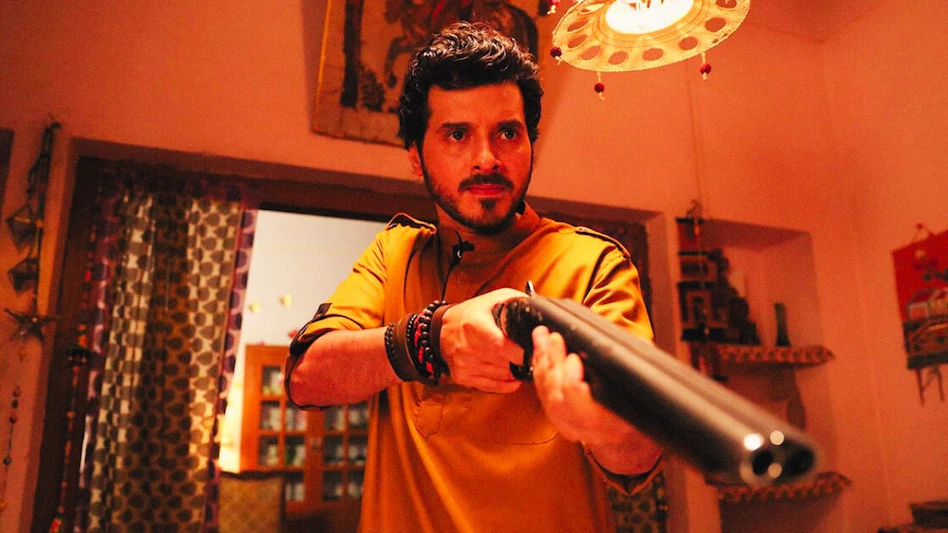
The description of the film as expanding the gang rivalry between Kaleen Bhaiya and Guddu Pandit to a “larger canvas” suggests the central dramatic tension of the post-Season 3 power vacuum remains intact — but the inclusion of Munna in the confirmed cast implies the film is operating in a temporal frame that predates, or runs parallel to, the main timeline that followers of the series know.
The Compounder’s return faces the same structural question. Abhishek Banerjee’s character died in Season 1. His presence in the film’s confirmed cast, alongside Munna’s, indicates the “untold chapter” framing is doing serious narrative work — this is a story set in the spaces the series did not show, not an attempt to undo what the series established.
Why This Move Is Historically Significant
The Mirzapur theatrical adaptation is among the first instances of an Indian streaming series making the transition to a theatrical release at this scale — a reversal of the dominant direction of travel in Indian entertainment, where theatrical properties have increasingly migrated to streaming rather than the other way around.
The commercial logic is straightforward but the creative bet is considerable. Streaming series and theatrical films are formally different objects. The pacing, visual grammar, and narrative density that work across eight to ten episodes of streaming do not automatically translate to a two-hour theatrical experience. The creative team responsible — Gurmmeet Singh directing, Puneet Krishna writing — are the same individuals who built the series, which is the strongest available evidence that the translation will be handled with awareness of what the format demands. But awareness and execution are different things, and September 4 will be the first real test of whether Mirzapur’s particular brand of Purvanchal fury — which has always derived much of its power from sustained character development across multiple episodes — can be distilled into a single cinematic event.
Producers Ritesh Sidhwani and Farhan Akhtar said in their official statement that the film would allow audiences to “immerse themselves in the world of Mirzapur like never before,” a phrase that signals an intent to use the theatrical format not as a compression of what the series does, but as an amplification of it — bigger action, larger stakes, a scope that justifies the move from screen to cinema. CNBC
Whether it justifies that move will be determined by an audience that has spent seven years in this world and knows exactly what it loves about it. The bhaukaal, as the makers put it, is coming to a larger screen on September 4. The only remaining question is whether the screen is big enough.
All production details are sourced from the official announcement by Amazon MGM Studios and Excel Entertainment dated February 5, 2026, as reported by The Hollywood Reporter India, Business Standard, Outlook India, and Amazon India’s official newsroom. Plot specifics and character arc details represent what has been officially confirmed or described in official promotional materials as of March 10, 2026. Story spoilers and narrative speculation are clearly labelled as such.


