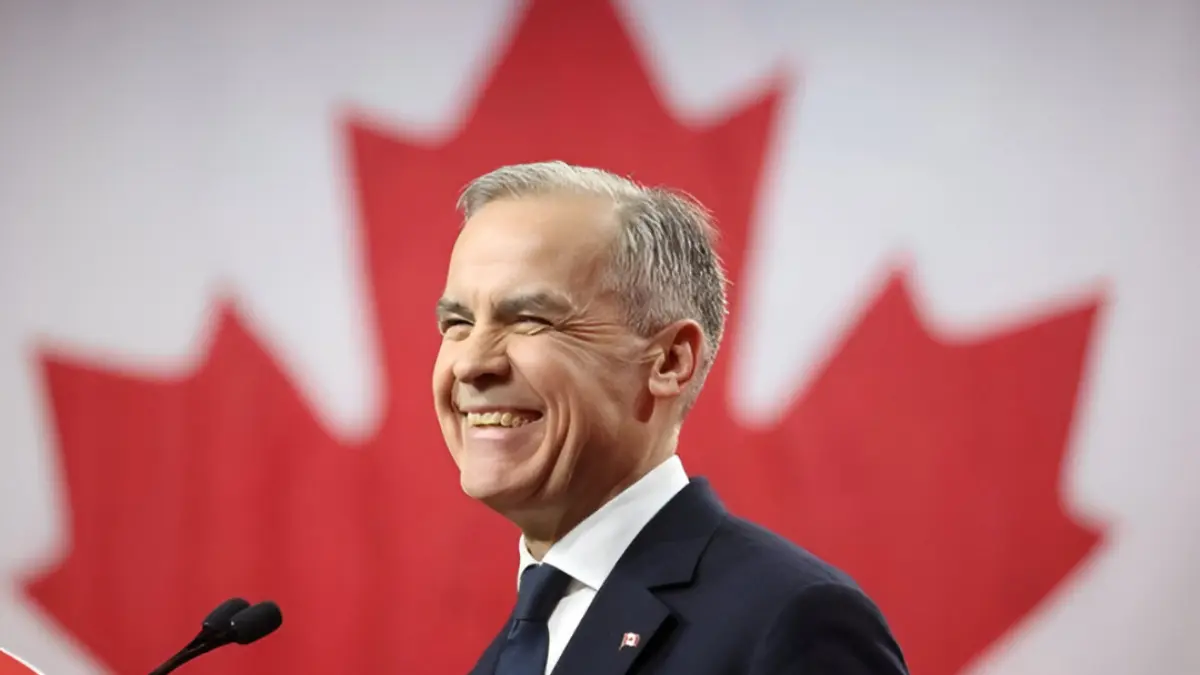


Mark Carney just told the world’s elite what they’ve been avoiding for years. The old rules don’t work anymore.
The Canadian Prime Minister delivered a stark warning at the World Economic Forum on Monday, declaring the rules-based international order has reached a “rupture” and calling on middle powers to unite against great power coercion. Speaking one day before Donald Trump’s appearance at Davos, Carney positioned Canada as a leader in what he termed “values-based realism” amid rising global tensions.
“We’re in a rupture, not a transition,” Carney told the plenary session at the Congress Centre. “The question isn’t whether the old order survives. It won’t. The question is what comes next.”
The 20-30 minute address contrasted sharply with Trump’s boasts about American dominance. Where the US President would later demand territorial concessions and threaten tariffs, Carney advocated strategic autonomy for nations caught between competing superpowers. He warned against forming “fortresses” or subordinating to hegemons through bilateral deals.
Full transcripts released through Global News and CBC spread rapidly across diplomatic channels. YouTube videos of the speech accumulated over 500,000 views within 24 hours, with clips trending under hashtags like #CarneyDavos and “middle powers unite.”
Carney, who served as Bank of England governor before entering politics, brought economic credibility to his geopolitical analysis. He critiqued how major powers weaponize economic integration through tariffs, supply chain manipulation, and financial coercion. The speech didn’t name Trump directly but clearly referenced recent American actions.
“Geography used to determine our security and prosperity,” Carney said. “That’s no longer sufficient. We must build resilience through diversification and collective action.”
The timing amplified the message’s impact. Carney spoke against the backdrop of Trump’s Greenland demands and tariff threats against eight European nations. His call for middle-power solidarity offered an alternative vision to American unilateralism and Chinese sphere-of-influence building.
Canada announced major policy shifts alongside the speech. The government pledged to double defense spending to meet NATO commitments. Officials unveiled plans to eliminate interprovincial trade barriers that fragment the domestic market. A $1 trillion infrastructure investment targeting AI development and energy projects received parliamentary approval.
Tax cuts for businesses and middle-class families accompanied the announcements. Carney framed domestic economic strength as prerequisite for principled foreign policy. Nations dependent on single trading partners or lacking industrial capacity cannot resist coercion, he argued.
“We’re cutting taxes, building infrastructure, and investing in our people,” Carney told the Davos audience. “Not because it’s good politics, which it is. Because strong economies enable strong values.”
The speech invoked Czech dissident Václav Havel’s concept of “living in truth” versus systems built on lies. Carney applied the moral framework to international relations, suggesting institutions like the WTO and UN have lost legitimacy by failing to constrain great power behavior.
That philosophical grounding distinguished the address from typical technocratic policy speeches. Carney positioned Canada’s response as moral imperative, not just strategic calculation. The framing resonated with European leaders seeking language to justify resisting American pressure.
Media analysis the following day contrasted Carney’s multilateral vision with Trump’s zero-sum approach. Al Jazeera and CNN ran segments comparing the speeches side-by-side. Commentators noted Carney advocated building new institutions while Trump dismissed existing ones as ineffective.
Social media reactions split predictably along ideological lines. Pro-Trump accounts dismissed Carney as representing declining nations jealous of American strength. Canadian and European users praised the intellectual depth and moral clarity. LinkedIn discussions focused on economic prescriptions and feasibility.
Reddit’s geopolitics forums debated whether middle powers possess sufficient leverage to reshape global order. Users questioned if countries like Canada, Australia, South Korea, and European nations could coordinate effectively without great power backing. Skeptics noted these nations still depend heavily on US security guarantees.
Carney acknowledged the challenges. He called for diversified security partnerships beyond traditional alliances. The speech suggested middle powers should develop independent defense capabilities rather than relying exclusively on American protection.
Canada’s doubled defense spending backs that rhetoric with resources. The commitment brings Canadian military expenditure to 2% of GDP, meeting NATO’s target after years of falling short. New investments focus on Arctic sovereignty, cybersecurity, and continental defense.
The Arctic emphasis carries particular relevance given Trump’s Greenland push. Canada shares Arctic waters with Denmark and maintains its own territorial claims in the region. Strengthening northern defenses sends signals about Canadian determination to resist great power encroachment.
Carney’s background as central banker informed his economic analysis. He detailed how China’s industrial subsidies and American tariff threats undermine market-based trade. He argued neither the Washington Consensus nor Beijing’s state capitalism offers sustainable models for middle powers.
“We need a third way,” Carney declared. “Market economies with strong social contracts. Open trade with strategic safeguards. Rules that great powers actually follow.”
The infrastructure announcement positions Canada to compete in emerging technologies. The $1 trillion investment over ten years targets artificial intelligence research, clean energy development, and critical mineral processing. Officials said the plan reduces dependence on Chinese supply chains and American technology platforms.
Eliminating interprovincial trade barriers addresses a longstanding Canadian economic weakness. The country’s internal market fragments along provincial lines more than most federations. Removing those obstacles could add percentage points to GDP growth while building the scale needed for industrial competitiveness.
Tax cuts aim to attract business investment and retain talent. Carney’s government reduced corporate rates and expanded credits for research and development. Personal income tax brackets shifted to reduce middle-class burdens. The measures cost federal revenue but prioritize growth over fiscal restraint.
Critics questioned whether Canada can afford both increased defense spending and tax cuts while funding infrastructure. Government projections assume strong economic growth generating revenue despite lower rates. Opposition politicians called the math optimistic and warned about deficit expansion.
Carney defended the approach as necessary investment in Canadian sovereignty. “You can’t defend your values if you’re economically weak,” he told reporters after the speech. “And you can’t build prosperity if you’re strategically vulnerable.”
The October 2025 election that brought Carney to power centered on economic anxiety and national identity. Voters rejected the previous government’s closer alignment with American trade policy. Campaign promises emphasized Canadian autonomy and middle-power leadership.
Carney’s victory came partly from business community support unusual for a center-left politician. His central banking experience reassured markets about fiscal responsibility. His critique of both American capitalism and Chinese state control appealed to voters wanting alternatives.
The Davos speech crystallized those campaign themes into foreign policy doctrine. It positioned Canada as thought leader for nations seeking paths between great power blocs. Whether other middle powers follow remains uncertain.
Australia, South Korea, and several European nations face similar pressures. They benefit from American security while fearing American unpredictability. They profit from Chinese markets while worrying about Chinese coercion. Carney offered a framework for managing those tensions.
“We’re not choosing between Washington and Beijing,” he said. “We’re choosing ourselves. And we’re inviting others to join us.”
The WEF audience included leaders from dozens of middle powers. Reactions during the speech showed strong interest from European delegations. Asian representatives appeared more cautious, perhaps reflecting greater Chinese economic leverage over their economies.
Business leaders expressed mixed responses. Executives from multinational corporations worry that fragmenting globalization into blocs increases costs. CEOs from mid-sized firms in manufacturing and technology welcomed talk of diversified supply chains reducing China dependence.
Financial markets barely reacted to policy announcements. Canadian dollar held steady against major currencies. Bond yields shifted slightly as investors processed infrastructure spending implications. Overall, markets treated the speech as vision statement rather than immediate policy shift.
Implementation challenges loom large. Doubling defense spending requires years of procurement and training. Infrastructure projects face regulatory approvals and construction timelines. Tax cuts take effect faster but revenue impacts accumulate gradually.
Carney acknowledged execution risks while insisting inaction poses greater danger. “The world isn’t waiting for us to get comfortable,” he said. “Either we adapt to the rupture, or the rupture happens to us.”
The contrast with Trump’s Davos appearance dominated subsequent media coverage. Where Carney advocated collective action, Trump demanded bilateral submission. Where Carney called for new institutions, Trump threatened to abandon old ones. Where Carney emphasized legitimacy as power source, Trump relied on economic coercion.
European officials privately expressed preference for the Canadian approach but questioned its viability without American buy-in. Middle powers lack the military and economic weight to reshape global order alone. Success depends on cooperation the old system struggled to achieve.
Carney anticipated that objection. He argued legitimacy itself constitutes power when great powers overreach. Russia’s Ukraine invasion united democracies more effectively than any treaty. Chinese territorial claims pushed Asian nations toward cooperation. American tariff threats might similarly drive middle-power coordination.
“Coercion creates coalitions,” Carney told the Davos crowd. “Not the coalitions the coercers wanted, but coalitions nonetheless.”
The speech concluded with direct appeal to business leaders and political figures in attendance. Carney urged investment in middle-power economies and support for institutions these nations build. He promised Canada would lead by example through domestic reforms and diplomatic initiatives.
Standing ovation followed, notably warmer than Trump would receive a day later. European leaders applauded longest. Asian and African delegates offered polite but measured response. American attendees sat mostly silent, unclear whether to treat the speech as criticism or opportunity.
Carney left the stage having articulated what many thought but few dared say. The rules-based order has ended. Great powers won’t save it. Middle powers must build something new or accept subordination.
Whether that vision proves realistic or wishful thinking depends on choices made in capitals from Canberra to Seoul to Berlin. Canada announced its bet. Others now decide whether to match it.
The rupture is here. What comes next remains unwritten.