
He had played all his cricket at this ground. He knew the pitch, knew its pace, knew that on a surface this flat, in a stadium this large, bowling too fast was the one thing the opposition expected and the one thing he would not give them.
That understanding — refined over years of domestic cricket and international appearances at the Narendra Modi Stadium — was distilled into four overs in the second innings on Sunday night that will be studied by bowling coaches for as long as the sport is taught.

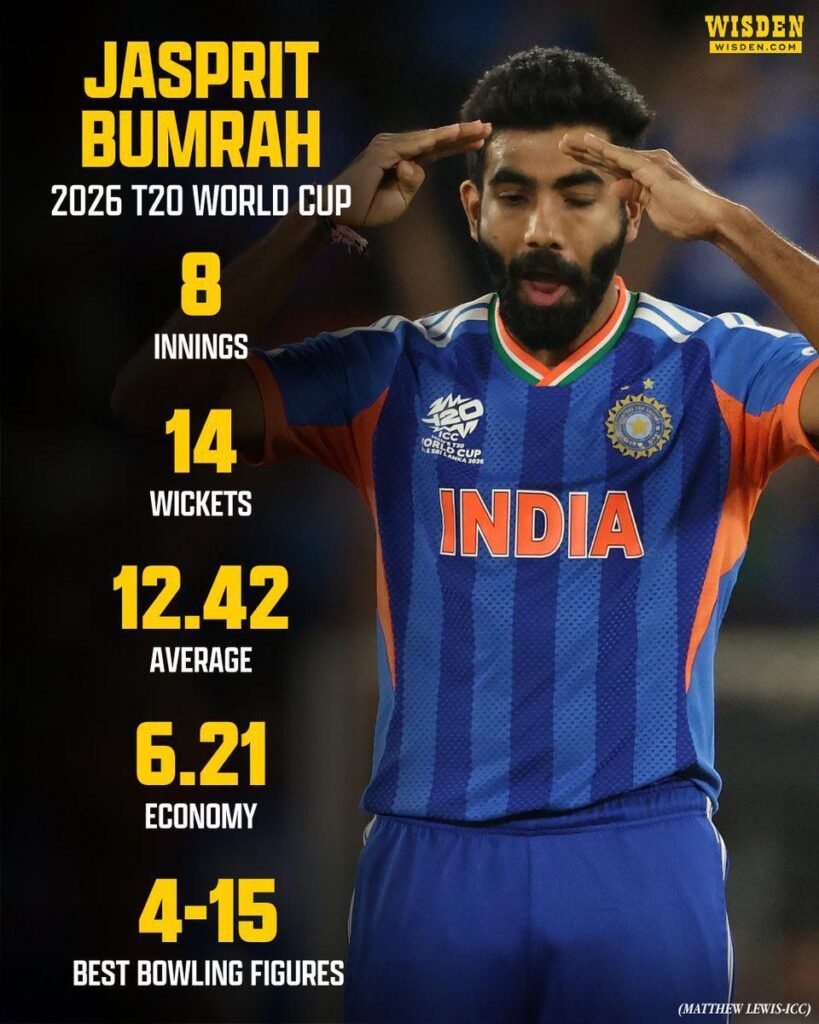
Jasprit Bumrah took 4 for 15 in four overs against New Zealand in the T20 World Cup 2026 Final, earning the Player of the Match award and cementing his legacy as the greatest white-ball bowler of his generation. The spell was not merely effective. It was over before New Zealand’s batters fully understood what had been done to them.
The First Ball: Setting the Tone
Bumrah came into the attack in the third over of New Zealand’s chase, with Rachin Ravindra — the man who had made 130 in the semi-final against South Africa — fresh to the crease. On a flat pitch in Ahmedabad, Bumrah bowled a slower cutter with his first ball, clocked at 121 kilometres per hour, and had Ravindra holing out for 1 — just as he had dismissed England’s captain Harry Brook in the semi-final. Ravindra was searching for pace on the ball, but Bumrah denied him. He mis-hit to deep square leg, where Ishan Kishan pulled off a spectacular catch.
Bumrah afterwards explained the calculation: “Because I’ve played on belters over here, I have also seen the other team, how they were bowling. I have learnt over here when you are trying to bowl too fast, it gets easier for the batter. The wicket was a flat one, so I played all my cricket here, so I used all my experience.”
The Ravindra wicket with the first ball of his first over sent a message through New Zealand’s batting lineup that no team talk could have countermanded. It was Bumrah’s second first-ball wicket in successive knockout matches, and it set the tone for a chase that New Zealand never truly mounted. Business Standard Axar Patel had already removed Finn Allen; with Ravindra gone in the fourth over and Glenn Phillips bowled by Axar in the fifth, New Zealand finished the powerplay at 53 for 3, chasing 256.
The Middle Overs: Control, Not Caution
Bumrah returned for a second powerplay burst — two overs spanning overs six and seven — during which he conceded just five runs. At 52 for 3 after seven overs, New Zealand’s chase was already, in the assessment of ESPNcricinfo’s match report, dead in the water.
Across nine matches in the tournament, Bumrah maintained a remarkable economy rate of 6.21, an extraordinary figure given the batting-friendly conditions, the high-scoring nature of the 2026 edition, and the grounds on which several matches were played. In a tournament defined by assault and counter-assault, Bumrah gave almost nothing away while taking wickets at regular intervals.
Tim Seifert carried New Zealand’s resistance, fighting back with a 23-ball fifty that briefly gave the crowd in Ahmedabad something to consider. A 52-run partnership between Mitchell Santner and Daryl Mitchell briefly extended the chase to a point where New Zealand needed 153 runs from 54 balls — distant but not yet mathematically impossible. Then Axar removed Mitchell. And Bumrah returned.
The Death Overs: Surgical Precision
Bumrah produced a masterclass in deception with back-to-back wickets through his trademark slower deliveries in the death overs. He first outfoxed Matt Henry with a dipping slower ball that sneaked through and crashed into off stump, dismissing him for a golden duck. He then dismantled James Neesham and Mitchell Santner to complete his four-wicket haul.
Bumrah narrowly missed a hat-trick in his final over — the delivery that would have completed the set touching the edge without finding the fielder — before Abhishek Sharma dismissed Jacob Duffy with the final ball of the penultimate over to wrap up New Zealand’s innings for 159.
The final tally was 4-0-15-4 at an economy of 3.75 per over — at a venue where India had just posted 255, on a pitch that had offered batters every assistance. Bumrah became the first pacer in the history of the T20 World Cup to take a four-wicket haul in a knockout match.
The Record That Defines a Career
With Sunday’s figures, Bumrah has officially surpassed Lasith Malinga to become the most successful pacer in T20 World Cup history, finishing the 2026 edition with 40 career wickets across his T20 World Cup appearances, going past Malinga’s 38.
He finished the tournament as the joint-highest wicket-taker with 14 scalps alongside Varun Chakravarthy, across nine matches at a tournament economy rate of 6.21.
The record operates on multiple planes simultaneously. There is the raw number — 40 wickets — which eclipses every pacer who has bowled in the T20 World Cup since its inception in 2007. Then there is the consistency that underpins it: Bumrah’s ability to vary his pace while maintaining a probing line left batters guessing across nine matches in 2026, as it has throughout a T20 World Cup career spanning three editions.
There is also the context of delivery type. Bumrah’s reputation was built on the yorker — the full, straight delivery targeting the base of off stump at 140-plus kilometres per hour that became his signature in the IPL and then internationally. What Sunday’s spell demonstrated, and what the 2026 tournament confirmed, is that Bumrah has evolved beyond the yorker. The slower cutter that dismissed Ravindra was 121 kilometres per hour — nearly 20 kilometres below his maximum pace — and Ravindra, who had played some of the finest innings of the tournament, could not adjust. The deception is the point. The pace is not.
What Suryakumar Said
India captain Suryakumar Yadav called Bumrah a “national treasure” in his post-match remarks, a phrase that prompted widespread agreement and which was already circulating across social media within minutes of the presentation ceremony. The description carries weight not because it is unusual — India has had great fast bowlers before — but because of its timing and its source: a captain who has watched Bumrah up close across a two-year period in which he managed to be India’s most indispensable cricketer while navigating a back injury, rehabilitation, and the physical toll of bowling fast in some of the world’s most demanding conditions.
Bumrah’s own reflection after the match was measured: “We always felt that we will keep our head above the water and try to hold our nerve. Teams that do that win the tournament, and we are very happy that we did it.”
The “we” is characteristic. Bumrah does not personalise. He attributes, deflects, locates himself within a collective. It is a quality that has defined his public manner throughout his career, and it sits in instructive contrast with the individual exceptionalism that his statistics demand.
A Note on the Venue
The subtext of Sunday’s performance for Bumrah was not lost on anyone who watched him bowl. It was at the Narendra Modi Stadium in Ahmedabad that India had lost the 2023 ODI World Cup final to Australia in one of the most devastating results in Indian cricket’s history. Bumrah had bowled in that match. He had been exceptional in it. And it had not been enough.
On Sunday, in the same stadium, against a different opponent, in a different format, with a different team around him, he bowled four overs in a World Cup final and conceded 15 runs while taking four wickets. The redemption was complete. The 40th wicket was the one that mattered most — not for the record it set, but for where it was taken and what it closed.
All bowling figures, wicket sequences, delivery descriptions and records in this article are sourced from ESPNcricinfo’s primary match report, the ICC official match report (icc-cricket.com), Outlook India, Sportskeeda, and Zee News live blog of the ICC Men’s T20 World Cup 2026 Final on March 8, 2026. Bumrah’s direct quotes are drawn from ESPNcricinfo’s post-match interview transcript. Economy rate and tournament wicket tally are as reported by Outlook India and Yardbarker citing ICC data, subject to official ICC ratification.


