
A match that produced a 96-run victory margin will tend to generate superlatives in the immediate aftermath — some accurate, some inflated. The numbers from Sunday’s ICC Men’s T20 World Cup final in Ahmedabad deserve to be examined carefully, because what they reveal is not merely a dominant performance but a set of statistical landmarks that restructure the ceiling of what T20 cricket’s highest occasion can produce.
Here is what the scorebook shows, record by record.
The Scorecard
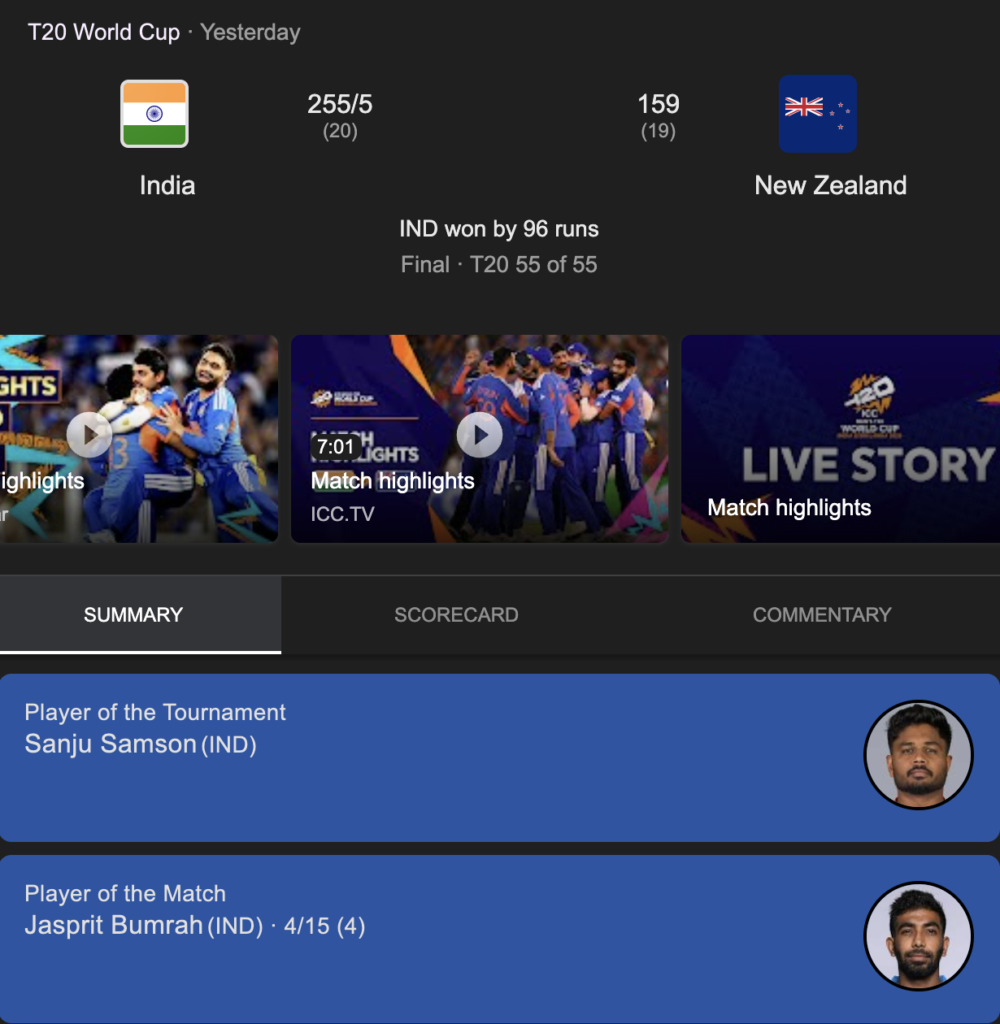
India batted first and posted 255 for 5 in 20 overs. New Zealand were dismissed for 159 in 19 overs. India won by 96 runs.
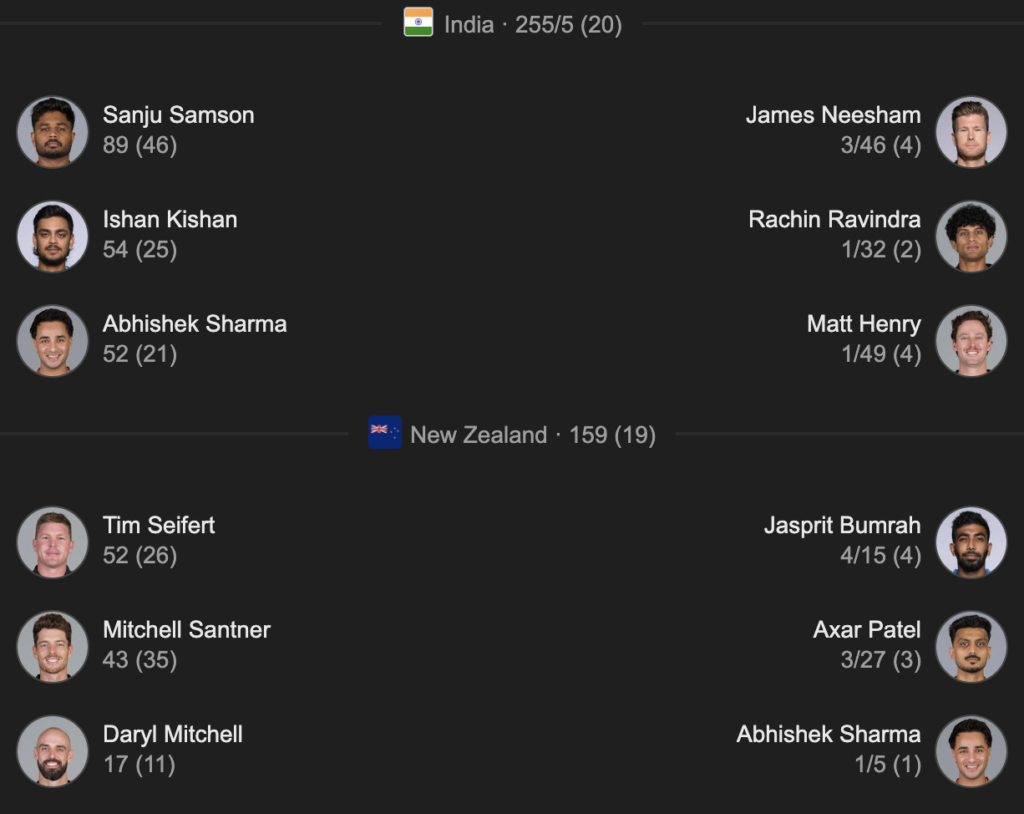
India’s batting: Abhishek Sharma contributed 52 off 21 balls at a strike rate of 247.62, Sanju Samson made 89 off 46 balls including eight sixes, Ishan Kishan scored 54 off 25 balls, and Shivam Dube finished with an unbeaten 26 off 8 balls after arriving at the crease in a crisis — India having slipped from 203 for 1 to 204 for 4 in the space of a single James Neesham over. Extras contributed 15 runs to the total.
New Zealand’s reply: Tim Seifert top-scored with 52 off 26 balls, and Mitchell Santner contributed 43 off 35 balls before India’s bowlers — Bumrah (4/15), Axar Patel (3/27), and Varun Chakravarthy (4/22) — combined to dismiss New Zealand for 159 in their allotted overs.
Record 1: Highest Total in a T20 World Cup Final
India’s 255 for 5 is the highest total ever recorded in a Men’s T20 World Cup final. The previous highest had been Australia’s 173 for 2 against New Zealand in the 2021 final in Dubai, while India’s own 176 for 7 in the 2024 final had been the most recent preceding record. The jump from 176 to 255 is not a gradual evolution. It is a restructuring of what the occasion can produce.
Record 2: Highest Total in Any T20 World Cup Knockout
The 255 for 5 is also the highest total by any team in a Men’s T20 World Cup knockout match, surpassing India’s own 253 for 7 against England in the semi-final three days earlier. India posted the two highest knockout totals in the tournament’s history in consecutive matches.
Record 3: Biggest Winning Margin in a T20 World Cup Final
The 96-run victory is the largest margin of victory by runs in a Men’s T20 World Cup final, more than doubling the previous record of West Indies’ 36-run win over Sri Lanka in 2012.
Record 4: India’s Third Title — Most in Tournament History
India became the first team in the history of the Men’s T20 World Cup to win three titles, taking sole ownership of the record for the most successful nation, surpassing two-time champions West Indies and England.
Record 5: First Title Defence — First Home Win
India became the first team to successfully defend the Men’s T20 World Cup title, and the first host nation to win the tournament. In 19 years of the competition across 11 editions, no host had previously lifted the trophy at home, and no defending champion had retained it.
Varun Chakravarthy: Redemption in Four Overs
No narrative within India’s tournament victory is more compressed or more complete than Varun Chakravarthy’s. The mystery spinner entered the final carrying the weight of a semi-final performance that ESPNcricinfo described as among the most expensive spells in T20 World Cup history. Against England in the semi-final at Wankhede, he conceded 64 runs in four overs for one wicket — figures tied for the second-most expensive bowling spell in T20 World Cup history. His economy rate across the Super 8 and knockout stages before the final had swelled to 11.62 per over, compared to 6.88 in the group stage. Trendlyne
The question of whether Gambhir would persist with him for the final was one of the pre-match conversation’s defining threads. ESPNcricinfo’s pre-final analysis raised it explicitly, noting that while Varun remained the joint-highest wicket-taker in the tournament, his recent form against high-quality opposition had raised genuine selection concerns. India had options — Kuldeep Yadav was on the bench, Washington Sundar could have played against New Zealand’s left-handers — and the conditions in Ahmedabad, where South Africa’s pacers had dominated India’s own batters in the Super 8 stage, added further uncertainty. Business Standard
Gambhir kept faith. Varun Chakravarthy took 4 for 22 in four overs in the final, deploying his full range of variations — the koosu ball, the carrom ball, the top-spinner — against a New Zealand middle order that had been presented with a 256-run target and never found the foothold to challenge it. Along with Axar Patel’s 3 for 27 and Bumrah’s 4 for 15, Varun’s four-wicket haul formed the centrepiece of a bowling performance that dismissed New Zealand for 159.
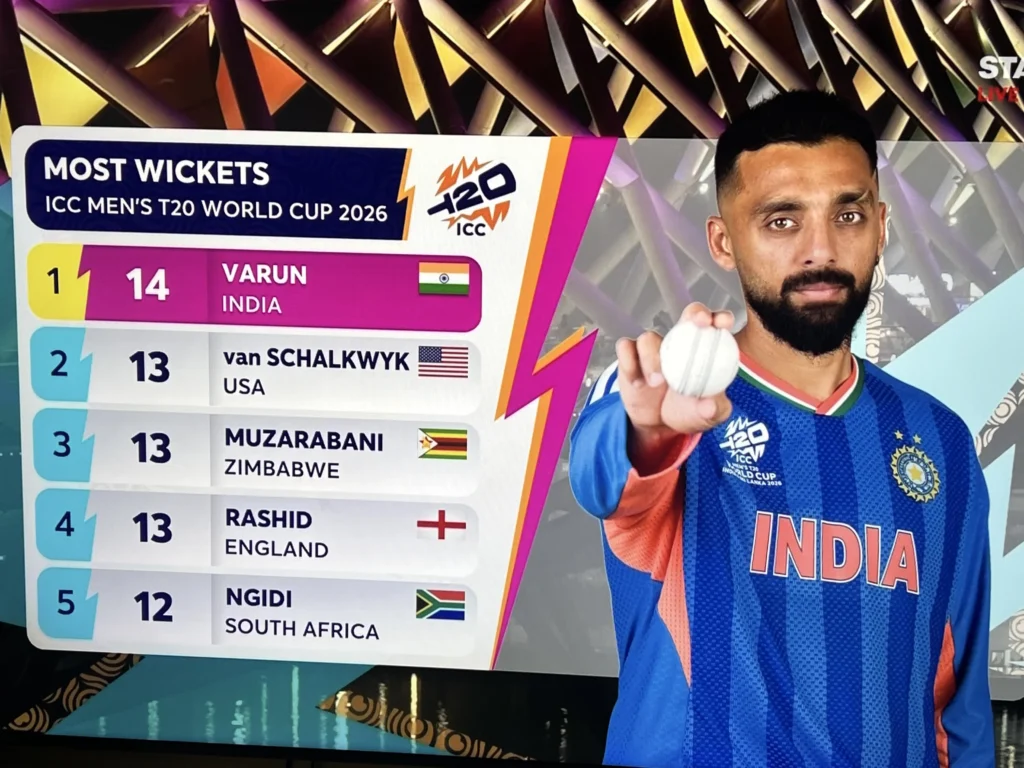
Varun finished the tournament with 14 wickets in 9 matches as joint-highest wicket-taker alongside Jasprit Bumrah, who took 14 wickets in 8 matches at an economy of 6.21. The arc of his tournament — nine wickets and an economy of 6.88 in the group stage, a nightmare spell in the semi-final, and a four-wicket redemption in the final — is the most dramatic bowling narrative the 2026 edition produced.
The Wicket-Takers: Tournament Summary
The full list of the tournament’s leading wicket-takers confirmed Bumrah and Varun as joint leaders on 14 each. USA’s Shadley van Schalkwyk took 13 wickets in 4 matches at an economy of 6.80, while Zimbabwe’s Blessing Muzarabani took 13 in 6 matches, and England’s Adil Rashid finished fifth with 13 wickets in 8 matches.
The presence of a USA bowler in the top three wicket-takers is among the tournament’s quieter revelations: van Schalkwyk’s performances against India and Pakistan in the group stage were among the most sustained spells of pace bowling the 2026 edition produced, even as his team did not advance past the Super 8 stage.
India’s Tournament Record
India won every knockout match they played — the Super 8 virtual quarter-final against the West Indies, the semi-final against England, and the final against New Zealand. Their one loss in the tournament came to South Africa in the Super 8 stage, after India had already secured their knockout qualification. Their knockout record was therefore perfect across three matches, producing totals of 253 for 7, then 255 for 5, in the two highest-scoring knockout innings in the tournament’s history.
The Sixes Record
India became the first team in the history of any ICC limited-overs tournament to hit 100 sixes in a single edition, finishing with 106 maximums across the 2026 campaign — surpassing South Africa’s previous record of 99, set at the 2023 ODI World Cup. The record is a direct statistical expression of the “high-risk, high-reward” approach that coach Gambhir articulated before and after the tournament: it is the footprint left by a team that attacked in the powerplay, attacked in the middle overs, and attacked in the death, in nine consecutive matches.
The Context for These Numbers
Records in T20 cricket are broken more frequently than in any other format, and the inflation of scores over time means that almost every major tournament produces new statistical ceilings. The records from Sunday’s final are different in character from the incremental advances that typically mark T20’s statistical evolution.
A highest final total of 255 is not a boundary being nudged forward. It is the previous record — India’s own 176 in the 2024 final — being exceeded by nearly 80 runs. A winning margin of 96 runs against a side that had beaten South Africa and England in consecutive knockout matches is not a comfortable victory. It is categorical superiority expressed in numerical form.
What the numbers from the Narendra Modi Stadium on the night of March 8, 2026 describe, collectively, is a team at the peak of a format it has decided to dominate on its own terms — and a set of statistical markers that will require a performance of comparable ambition and execution to displace.
All statistics in this article are sourced from ESPNcricinfo (Tier 1), Sunday Guardian Live citing ICC data, ANI (Tier 1 wire service), and CMA Knowledge’s post-final match report, based on events from the ICC Men’s T20 World Cup 2026 Final, March 8, 2026, Narendra Modi Stadium, Ahmedabad. Varun Chakravarthy’s 4/22 final figures are sourced from CMA Knowledge citing post-match data; his semi-final economy figures are sourced from Newsbytes citing ESPNcricinfo. All records are subject to official ICC ratification.


