
India’s equity markets have endured one of the most volatile weeks in recent memory as the intensifying conflict between the United States, Israel, and Iran sends crude oil prices on a historic swing and triggers a sharp rotation in domestic sector positioning. The Nifty 50 shed more than 700 points in early Monday trading before partially recovering, while a handful of upstream energy and defence names emerged as the only hedges functioning in a market otherwise offering nowhere to hide.
The Price Swing That Defined the Past 48 Hours
Brent crude hit a session high of $119.50 per barrel during Monday’s overnight trading — the first time oil had breached $100 since Russia invaded Ukraine in 2022 — before retreating sharply. The benchmark eventually settled Monday’s official session 6.76 per cent higher at $98.96 per barrel. US West Texas Intermediate crude closed Monday 4.26 per cent higher at $94.77 after similarly touching $119.48 intraday.
On Tuesday morning, March 10, both benchmarks pulled back further. Brent was trading at approximately $94.59 per barrel, down sharply from Monday’s intraday peak but still 22.48 per cent higher than its level one week earlier, when it was trading at $77.23 per barrel. The catalyst for Tuesday’s partial relief was a statement by US President Donald Trump to CBS News in which he indicated that ships were moving through the Strait and that he was “thinking about taking it over” — remarks that provided the most significant downward pressure on crude since the conflict began on February 28.
Even with Tuesday’s pullback, Neil Atkinson, former head of oil at the International Energy Agency, described the effective closure of the Strait of Hormuz as something energy markets had never seen before. “Unless something changes very soon, we are in a potentially game-changing and unprecedented energy crisis,” Atkinson told CNBC on Monday. ExxonMobil chief economist Tyler Goodspeed said he saw “many more scenarios, and more probable scenarios, in which the strait remains effectively closed harder for longer than there are scenarios in which normal traffic resumes.” U.S. News & World Report

The structural supply problem forcing prices upward is not shortage of oil in the ground — it is the inability to move it. Gulf Arab states including Iraq and Kuwait have already begun cutting production because they are running out of storage space, with crude piling up and nowhere to go as tankers decline to transit the strait. The Rapidan Energy Group described the closure as the biggest oil supply disruption in history — more than double the percentage disrupted during the Suez Crisis of 1956–57.
India’s Specific Exposure
India is structurally among the most vulnerable major economies to a prolonged Hormuz disruption, and the equity market’s reaction reflects that. India imports over 85 per cent of its crude oil, and Middle Eastern suppliers account for more than half of those imports. An estimated 50 to 55 per cent of India’s crude oil and LNG imports transit through the Strait of Hormuz. Strategic petroleum reserves cover approximately 74 days of crude oil demand, but there are no comparable strategic reserves for natural gas, leaving LNG supply-side stress as an acute near-term vulnerability if the disruption persists.
On Monday, March 9, Indian equity markets opened sharply lower, with the BSE Sensex falling more than 2,300 points and the Nifty 50 shedding over 700 points in early trading. The sell-off erased an estimated ₹13.5 lakh crore in market capitalisation. India VIX, the fear gauge index, spiked more than 21 per cent to cross 24, indicating heightened nervousness among traders and investors. The Nifty PSU Bank index fell nearly 6 per cent in early trade, while the Nifty Auto index was down 4.3 per cent.
The Nifty 50 ultimately closed Monday at 24,028 — down 1.73 per cent or 422 points from Friday’s close of 24,450. NBC News The intraday lows were significantly deeper, with the index touching 23,697.80 at its worst point before a late-session partial recovery.
The Two Stocks the Market Trusted
In a session where IndiGo fell more than 8 per cent, SBI dropped over 5 per cent, and Maruti Suzuki lost more than 5 per cent, only two stocks in the entire Nifty 50 pack were trading in the green: ONGC and Coal India.
The logic for each is distinct. For ONGC and Oil India, upstream exploration and production companies benefit directly from higher crude realisation prices. JM Financial’s analysis confirmed that every $1 per barrel rise in Brent crude boosts ONGC’s and Oil India’s earnings by approximately 1.5 to 2 per cent each. Oil marketing companies such as Indian Oil Corporation, Bharat Petroleum, and Hindustan Petroleum moved in the opposite direction — falling 5 to 9 per cent — as rising crude costs compress their refining margins, a dynamic that reverses the upstream-downstream split cleanly.
Coal India’s resilience reflects a secondary channel: as LNG shipments from Qatar remain disrupted, coal becomes a fallback fuel for power generation, supporting demand expectations for the domestic producer. NTPC, similarly coal-linked in its generation portfolio, showed relative stability during Monday’s session. Defence stocks including Bharat Electronics gained 1 to 2 per cent, reflecting investor logic that heightened geopolitical tensions drive procurement interest — even if actual procurement orders operate on multi-year timelines.
The Sectors Under Pressure
The damage to fuel-intensive and import-dependent businesses is direct and measurable. Paint manufacturers, which depend on crude-linked derivatives for 20 to 25 per cent of total input costs and typically carry two months of input inventory, face a situation comparable to the Russia-Ukraine conflict period. When Brent reached approximately $112 per barrel during that crisis, paint companies experienced input cost inflation of around 8 per cent and a sequential decline of 410 basis points in gross margins in the first half of FY2023. Press Information Bureau
Cement companies face pressure through petcoke and diesel costs, with approximately 4 to 6 lakh tonnes of petcoke transiting the Strait of Hormuz monthly, of which India accounts for a significant share. Aviation is structurally the most exposed sector to sustained high jet fuel prices, with Indian carriers carrying little ability to pass costs to passengers at pace with input cost changes. Press Information Bureau
The Uncertainty That Cannot Be Priced
The Allianz Economic Research team’s scenario analysis, published March 3, offered three frames: in a baseline scenario of a US-Iran deal within four weeks, Brent could spike to $85 per barrel before ending 2026 around $70. In a prolonged disruption scenario, oil could reach $100 but should end the year at approximately $70 as markets adapt. In a tail-risk scenario involving targeted attacks on regional energy infrastructure, Brent could exceed $130 per barrel before consolidating. Seatrade Maritime
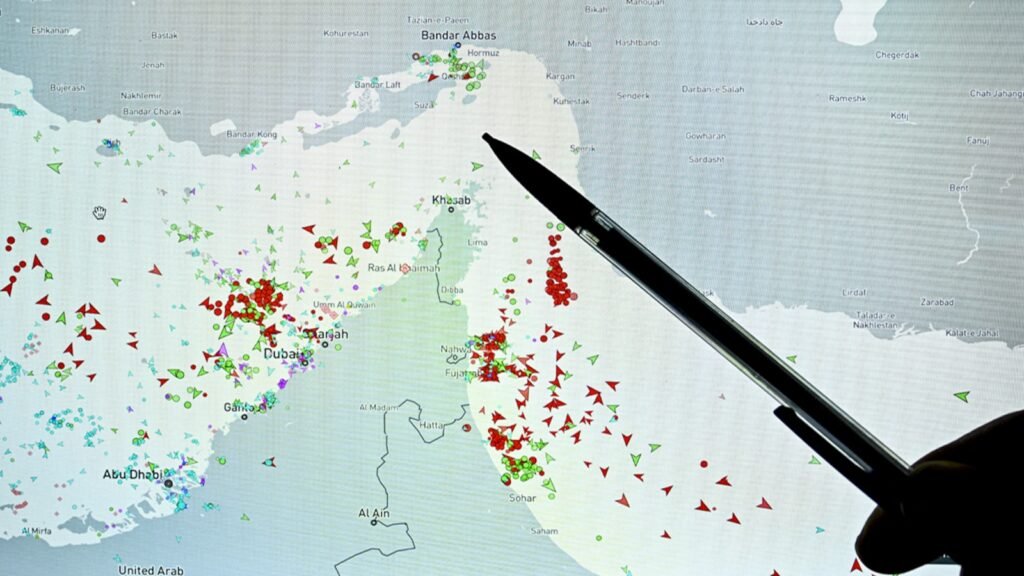
Tuesday’s partial recovery, driven by Trump’s remarks rather than any structural change in the Strait’s operational status, illustrates the central challenge for any portfolio positioned around this crisis: the variable that matters most is a political decision by a small number of actors, with a timeline that no commodity model can predict. Oil analyst Matt Smith of Kpler confirmed on Tuesday that only a handful of commercial vessels are currently moving through the Strait, meaning the physical disruption has not resolved despite the price pullback.
For Indian investors, the arithmetic of the situation is unambiguous. With India’s energy import bill increasing by approximately $1.4 billion for every $1 rise in crude oil prices, the cumulative impact of even a partial, multi-week disruption at current elevated levels would represent a fiscal burden of a scale with direct consequences for the current account deficit, the rupee, and the Reserve Bank of India’s room to manoeuvre on monetary policy. Republic World The market has begun pricing that in. Whether Tuesday’s relief proves durable, or represents a pause before the next escalation headline, remains the only question that matters.
This article is market news journalism and does not constitute investment advice. All index prices are sourced from Yahoo Finance and Business Standard live data as of March 9–10, 2026. Crude oil prices are sourced from CNBC, FilmoGaz, and Bloomberg as of Tuesday, March 10, 2026. Sector analysis and stock-specific observations are sourced from Ventura Securities, JM Financial, ICICI Direct, Business Upturn, and Whalesbook. Readers are advised to consult a registered financial advisor before making investment decisions. Past sector performance during geopolitical crises is not a reliable indicator of future returns.


