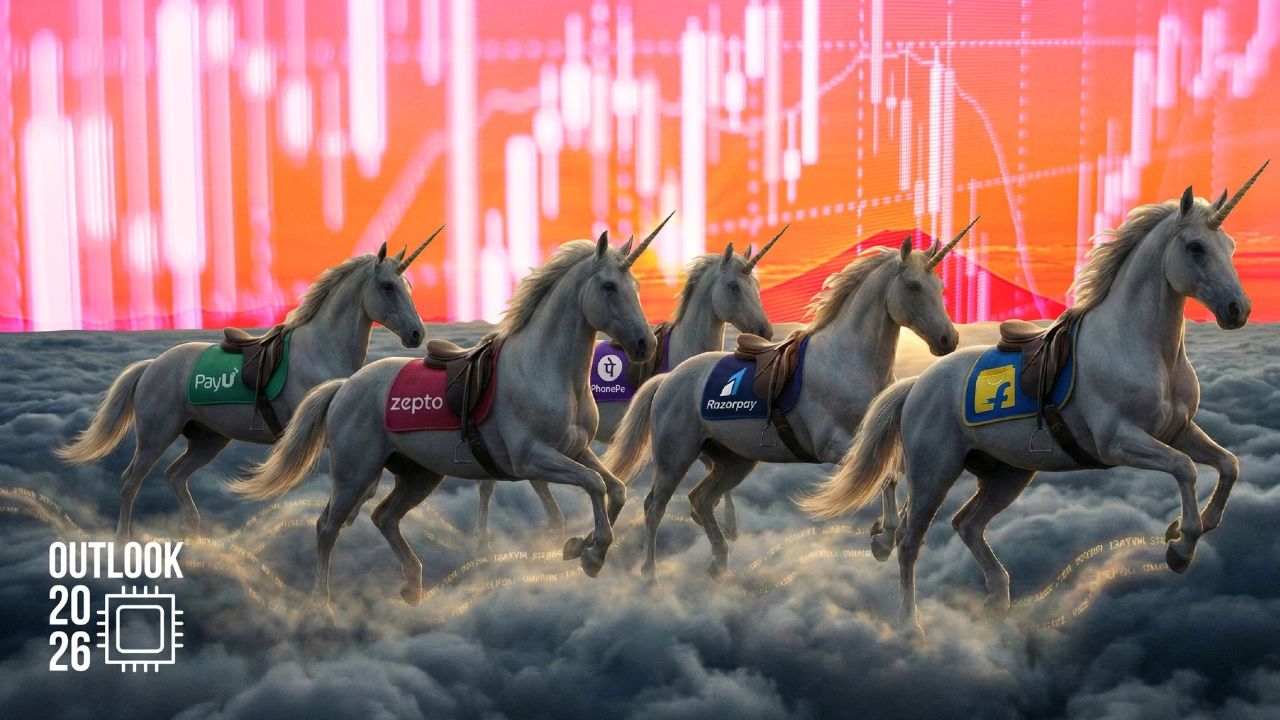


India’s startup ecosystem produced its first new unicorns of 2026 within the initial weeks of the calendar year, continuing a cautious but steady flow of billion-dollar valuations into what has become one of the world’s largest technology startup markets. As of March 15, the country counts 120 unicorns in total — a figure that masks significant variation in the health and trajectory of companies that carry the designation.
Against this backdrop, a set of startups has entered a zone where market analysis and disclosed funding trajectories suggest proximity to the $1 billion valuation threshold. Reaching that threshold depends on specific conditions — a new funding round closing at a sufficient valuation, a strategic transaction at an appropriate price, or a public market listing that discovers a market capitalisation above the mark. None of these outcomes is guaranteed, and the research presented here makes no prediction that any of the companies discussed will achieve unicorn status within a defined timeframe.
The 2026 Unicorn Class So Far
Neysa, an AI cloud infrastructure startup backed by a $600 million equity investment led by Blackstone, crossed the unicorn threshold in early 2026, making it one of the fastest-growing players in India’s AI infrastructure segment. The company is focused on providing GPU-as-a-Service to enterprises and startups seeking to train and deploy custom AI models without the cost burden of hyperscale cloud providers. International Monetary Fund
India’s current total of approximately 120 unicorns includes companies across fintech, logistics, healthtech, edtech, and enterprise SaaS, with the newer entrants heavily weighted toward applied AI, climate tech, and deep tech categories that align with the investor preference for profitability-visible business models documented in 2025 funding data.
BookMyShow: Sustained Profitability, No Confirmed New Funding Round
The company with the most verifiable financial trajectory among near-threshold candidates is BookMyShow’s parent entity, Big Tree Entertainment Private Limited.

Big Tree Entertainment reported a consolidated net profit of ₹192 crore for FY2024-25, a 77 per cent increase from ₹109 crore in FY24. The growth was led by the live events segment, which generated ₹756 crore in revenue — a 66 per cent increase from ₹455 crore in FY24. Total income rose to ₹1,869 crore for the year, a 30.7 per cent increase from ₹1,430 crore in FY24. Worldbank
The company’s profit trajectory has been consistent: ₹85.1 crore in FY23, ₹108.6 crore in FY24, and ₹192 crore in FY25. The live events segment nearly doubled its revenue between FY23 and FY24, and continued to expand sharply into FY25, driven by concerts, comedy shows, and sporting events — categories that have seen a structural demand surge in India’s post-pandemic entertainment market. World Bank
BookMyShow’s last disclosed external funding round was a $205 million raise in 2021, which multiple sources at the time valued the company at approximately $470 million. A reported $300 million investment discussion involving KKR was cited in media reports in January 2024, but no formal announcement or closing was confirmed. No new round has been publicly confirmed as of the date of this report. Whether the company’s improved earnings profile since 2023 has been reflected in a privately negotiated valuation uplift — bringing it closer to or past the $1 billion threshold — is not verifiable from publicly available primary sources.
Turtlemint: Insurtech With a Phygital Model
Turtlemint, a Bengaluru and Mumbai-based insurance distribution platform, has built a network of independent insurance advisors — approximately 300,000 as of its last disclosed figures — through a combination of digital tools and in-person agent support that the company describes as a “phygital” model.
Turtlemint raised $120 million in a Series E round in 2022, led by Jungle Ventures and Amansa Capital, at a post-money valuation of $900 million. The round took the company to the edge of unicorn territory. The company has not announced a subsequent funding round since the 2022 close. Business Standard The valuation implied by that round reflects conditions from four years ago; current valuation in the absence of a new round cannot be confirmed.
The structural case for Turtlemint’s growth rests on India’s insurance penetration — life insurance premiums as a share of GDP stood at approximately 3 per cent in FY24, well below the global average — and the regulatory push by the Insurance Regulatory and Development Authority of India toward greater distribution reach. IRDAI’s “Insurance for All by 2047” initiative and the 2024 amendment to the Insurance Act, which expanded bima vahaks (insurance distribution agents) and introduced new composite licence categories, create a policy environment supportive of platform-led distribution models.
Whether the company closes a Series F round that discovers a valuation above $1 billion remains contingent on investor appetite, revenue growth since FY22, and the company’s profitability trajectory — none of which are publicly available in verified form.
Jupiter: Neobanking Ambitions in a Tightening Regulatory Environment
Jupiter, the digital banking platform founded by Jitendra Gupta — previously a co-founder of CitrusPay — raised $86 million in a Series C round in 2021 at a valuation of approximately $711 million, according to Tracxn and Crunchbase data. The company has not disclosed a subsequent external funding round at a higher valuation.

Jupiter’s business model is premised on acquiring digitally native customers through a high-yield savings account — currently offering up to 3 per cent per annum in partnership with Federal Bank — and cross-selling financial products including credit cards, insurance, and investment instruments. The model faces structural competition from incumbent banks that have aggressively upgraded their digital interfaces, and from regulated payment aggregators and wealth platforms offering comparable or superior product stacks.
The broader neobanking category in India operates under regulatory constraints that do not exist in other markets: neobanks cannot hold banking licences of their own and must operate through partnerships with licensed banks, limiting their ability to independently control product pricing, risk underwriting, and customer funds. The Reserve Bank of India has not issued any new universal bank licences since 2015, and the regulatory pathway for a neobank-style entity to achieve full-stack banking capability remains uncertain.
PayMate: Significant Uncertainty Around Valuation and Operations
The research brief supplied for this article described PayMate as a near-unicorn with a current valuation of approximately $930 million. This figure cannot be verified against available primary or credible secondary sources. Tracxn’s company profile shows total disclosed funding of $58.7 million across eleven rounds — a capital raise history that is inconsistent with a $930 million private valuation. PitchBook’s profile lists total funding at $73 million.
Livemint reported in November 2025 that PayMate halted its Middle East operations after an investor delayed a planned capital infusion, and that the company was seeking $20 million to resume those operations. Business Standard This development is inconsistent with the characterisation of PayMate as a company on the verge of a billion-dollar valuation. The $930 million figure could not be attributed to any disclosed funding round, secondary market transaction, or published analyst estimate in the sources available. It has not been used in this article.
What the Pre-Unicorn Pipeline Reflects
The companies most likely to reach the unicorn threshold in the coming quarters share a set of characteristics visible across the 2025-26 funding data: revenue growth driven by expanding addressable markets rather than subsidised customer acquisition, improving or positive unit economics, regulatory tailwinds in their sectors, and a clear exit pathway — either through IPO or strategic acquisition — that gives late-stage investors a credible return horizon.
The number of Indian startups that have filed draft red herring prospectuses with SEBI or publicly indicated IPO preparation has risen sharply since late 2024, as domestic capital markets have proved capable of absorbing large new-age technology listings at reasonable valuations. For several near-threshold companies, the IPO route — rather than a private funding round — may be the mechanism through which unicorn valuation is formally discovered and confirmed.
The unicorn label itself, while still carrying reputational significance in the startup ecosystem, has become less central to investor and founder conversations in 2026 than it was at the peak of the funding cycle. The questions that now matter more — to investors, to regulators, and to the public markets that will eventually price these companies — are whether the business generates cash, whether its growth is sustainable without continuous capital injection, and whether the unit economics at scale justify the valuation being sought.