
The near-total closure of the Strait of Hormuz following U.S. and Israeli military strikes on Iran has triggered the most severe disruption to Gulf container shipping in decades, putting billions of dollars in Asian automotive exports in limbo and setting the stage for significant imported-vehicle price increases by mid-2026.
The crisis began on February 28, when coordinated U.S.-Israeli strikes on Iran — including the reported killing of Supreme Leader Ali Khamenei — prompted Iran’s Islamic Revolutionary Guard Corps to broadcast warnings to vessels in the strait that passage was “not allowed.” Wikipedia The economic consequences for the global auto industry have been immediate and far-reaching.
A Shipping Lane Effectively Shut
There is no formal legal closure of the strait, but for the vast majority of ships and their owners the waterway is currently shut in a practical sense. Seatrade Maritime Vessel transits have dropped approximately 90% from a historical average of around 138 per day. Container-mag Maersk, MSC, Hapag-Lloyd, and CMA CGM have all suspended operations and rerouted vessels around the southern tip of Africa. CNBC The crisis has left 147 container ships sheltering in the Persian Gulf, according to freight analytics firm Xeneta, prompting delays, port congestion, and freight rate increases rippling across global markets. CNBC
The insurance market has effectively collapsed for the region. At least four ships have been struck, resulting in one seafarer’s death and injuries to four others, and protection and indemnity insurance was withdrawn from 5 March, making the economic risk too high for most ship owners. t least eight commercial vessels have been struck by Iranian missiles or drones since February 28, resulting in multiple fatalities. CMA CGM, Maersk, MSC and other major lines are now invoking force majeure provisions in their bills of lading.
The financial toll on carriers is compounding rapidly. VLSFO has climbed past $650 per metric tonne and marine gasoil has exceeded $1,000 for the first time since October 2023, adding to the burden on carriers already diverting around the Cape of Good Hope.
Asia’s Automakers Face a Billion-Dollar Export Freeze
The Middle East is not a peripheral market for Asian manufacturers — it is a core export destination, and the disruption is striking at the heart of their growth strategies.
Of the 8.32 million cars shipped overseas by Chinese automakers in 2025, 1.39 million — one-sixth of total exports — went to Gulf countries including Saudi Arabia and the United Arab Emirates, according to the China Passenger Car Association. The Middle East is the second-largest overseas market for China-made vehicles, and an increasingly critical region as Chinese automakers seek to offset weak domestic demand.
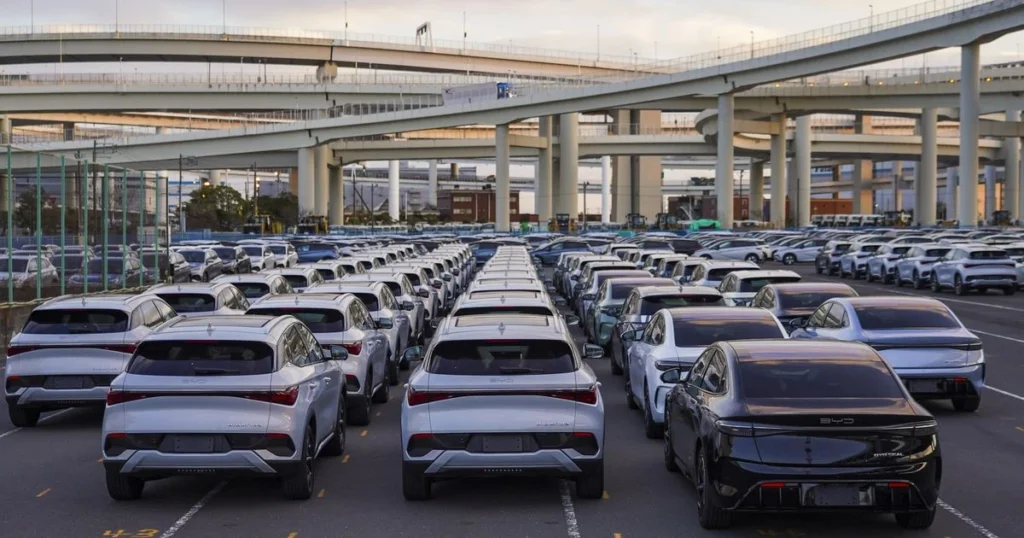
India’s exposure is similarly concentrated. India shipped $8.8 billion worth of cars overseas in 2025, with roughly a quarter of that total bound for Gulf markets, predominantly Saudi Arabia, according to commercially available customs data cited by Reuters. Hyundai Motor’s Indian operations face the greatest exposure: half of the South Korean automaker’s 2025 global shipments originating from India — valued at $1.8 billion in total — went to countries across the Gulf region.
Japanese manufacturers have also recorded direct production cuts. Reuters cited a Nikkei report indicating that Toyota will produce nearly 40,000 fewer vehicles originally intended for Middle East markets, a direct consequence of the logistical disruptions. Toyota exported 320,699 vehicles from its domestic plants to the Middle East in 2025, making the region the destination for just over 15% of the company’s total exports.
A Bernstein analysis identified the companies most at risk among non-domestic players. Toyota holds approximately 17% of Middle East sales, Hyundai 10%, and Chery 5%, together accounting for roughly a third of sales in the region, according to Bernstein. The firm’s analyst Eunice Lee noted in an investor note that the closure adds 10 to 14 days to transit times and that “a prolonged conflict and closure of the strait would hurt sales, increase logistics costs, and delay deliveries.”
The Cost Cascade: Why Prices Will Rise
The mechanism by which the crisis will eventually hit consumer wallets operates through several reinforcing channels simultaneously.
Rerouting around Africa’s Cape of Good Hope is not merely a logistical inconvenience — it is a structural cost escalation. War risk insurance premiums have surged to multi-year highs, and the combination of longer routes, higher insurance, and fuel costs is already feeding into import prices across Asia.
The energy shock is simultaneously inflating the cost of manufacturing the vehicles themselves. The disruption has lifted prices for petrochemical feedstocks, synthetic rubber, and plastic components, creating 15 to 25% raw material cost pressure for automakers and compressing margins. Modern vehicles contain between 150 and 200 kilograms of plastic and polymer components, meaning that feedstock inflation translates directly into per-unit manufacturing costs.
China faces a compounding vulnerability that goes beyond logistics. China is perhaps the most exposed major automotive economy, facing simultaneous supply-side cost inflation and potential demand contraction, given that roughly 84% of Hormuz crude destined for Asian markets flows to China, India, Japan, and South Korea.
A Structural Warning, Not Just a Shock
Several analysts are cautioning against the assumption that this disruption will resolve quickly. Joseph Brusuelas, Chief Economist at RSM US, noted that “history has shown that the price increases are temporary and quickly revert back to near pre-conflict levels.” But the automotive industry’s experience of the past five years counsels against assuming that supply chain disruptions are either brief or predictable. The semiconductor shortage of 2021 began as a 12-week problem and lasted two years. The Red Sea disruptions that emerged from Houthi activity in late 2023 were still constraining service patterns in early 2026.
The bypass infrastructure that exists offers limited relief. Saudi Arabia and the UAE maintain pipelines that can reroute some volumes around the strait, but combined bypass capacity covers only around 2.6 million barrels per day — a fraction of the 20 million that normally transit Hormuz. Iraq, Kuwait, and Qatar have no comparable alternatives, meaning that even in the most optimistic scenario, two-thirds of current Gulf crude exports remain physically dependent on the strait.
For consumers purchasing imported vehicles, the timeline for price visibility is being estimated at three to six months, as automakers and distributors work through existing inventory before passing elevated input costs downstream. Whether that surge proves temporary or entrenched will depend on a single variable that no supply chain model can predict: how long the guns stay aimed at the world’s most consequential 33-kilometre waterway.
This article is based on reporting from Reuters, CNBC, Automotive Manufacturing Solutions, Seatrade Maritime News, Bernstein, and container-mag.com, among others. The military and geopolitical situation remains active and developing as of March 9, 2026. Key figures cited, including production cut estimates and cost projections, reflect analyst forecasts and should not be construed as confirmed outcomes.


