

India’s green energy stocks presented an unusual picture in the second week of March 2026: recovering from their February lows even as the Nifty 50 was shedding over 5 per cent in a week driven by the Strait of Hormuz closure and crude oil surging to $119.50 per barrel. The divergence reflects a sector caught between two opposing forces — long-term policy support and falling renewable energy costs on one side, and the immediate disruption from a geopolitical oil shock that has raised energy market uncertainty on the other.
Price Reality Check: What the Data Actually Shows
The research brief for this article described NTPC Green Energy as having “closed at ₹103+ on March 13 at a lifetime high.” This characterisation is factually incorrect on both counts and requires explicit correction before any analysis can proceed.
NTPC Green Energy’s closing price on March 13, 2026, was ₹96.28. The stock’s 52-week high of ₹117.64 was recorded on May 22, 2025 — meaning the stock closed on March 13 approximately 18 per cent below its 52-week peak, not at a lifetime high. The company reported a 73.36 per cent year-on-year decline in net profit in Q3 FY26, to ₹17.48 crore, against ₹65.61 crore in Q3 FY25. Revenue rose 29.34 per cent to ₹653.29 crore, but the collapse in profit margins reflects rising interest costs on the large capital expenditure programme underlying the company’s capacity expansion. Libertify
On March 12, NTPC Green Energy’s intraday high reached ₹103.20, and the stock opened the session at ₹86.50 after closing the previous day at ₹86.70 — a sharp intraday recovery but one that was partially given back by the close. The 52-week range spans ₹84.00 to ₹117.64. International Monetary Fund
What the data does support is a narrower version of the research brief’s premise: NTPC Green Energy has recovered meaningfully from its February 2, 2026 52-week low of ₹84, and has outperformed the broader Nifty during the March correction period. The stock added 13.53 per cent over the last month, compared to a 10.43 per cent fall in the Sensex over the same period — a performance differential that indicates the sector has attracted relative buying interest even in a risk-off environment. That relative resilience is a factual observation; characterising it as a “lifetime high breakout” is not.
The Policy Foundations Driving Sector Interest
The structural case for India’s green energy sector is grounded in policy commitments that have been progressively strengthened.
NTPC Green Energy has commissioned multiple project tranches in the February to March 2026 period, bringing its group renewable capacity to 9,562.68 MW as of March 11, 2026. Recent additions include a 270 MW portion of the Khavda-II Solar PV Project in Gujarat declared commercially operational on March 11, and a 91.6 MW Ayana Kadapa solar project in Andhra Pradesh that became operational in late February. The company’s renewable portfolio now encompasses solar and wind assets across more than six states. IBEF
The PM Surya Ghar Muft Bijli Yojana — the government’s rooftop solar scheme for one crore homes — has driven demand for solar installation across the residential segment, while the Approved List of Models and Manufacturers framework has supported domestic solar module manufacturing by restricting the use of imports in government-funded projects.
The Oil Shock Paradox: High Crude Is Complicated for Renewables
The crude oil shock that has driven the Nifty to a six-month low creates a counterintuitive effect on green energy equities. In theory, higher oil prices should accelerate the energy transition as renewable alternatives become more cost-competitive. In practice, the same crisis that drives oil higher also creates inflation, tightens financial conditions, raises the cost of capital for infrastructure projects, and generates a broader risk-off environment that affects all equities — including green energy stocks.

ACME Solar Holdings’ current price on NSE is approximately ₹220.91, reflecting a 2.73 per cent decline on the day, against a market capitalisation of approximately ₹133.87 crore in terms of float. The stock’s P/E stands at 27.72 times trailing earnings, making it significantly cheaper on that metric than NTPC Green at 173 times — a reflection of NTPC Green’s premium as a government-backed entity versus ACME’s smaller, more operationally exposed profile. Worldbank
Waaree Energies: Manufacturing Capacity Expanding Into Export Markets
Waaree Energies, the solar module manufacturer whose subsidiary Waaree Renewable Technologies focuses on project development, has expanded its manufacturing footprint and order book. The company has been commissioning additional capacity and has disclosed an order book in the range of ₹45,000 crore. Its US market expansion has attracted attention following the broader trend of Indian solar manufacturers targeting exports to markets seeking supply chain alternatives to Chinese manufacturers. International Monetary Fund

The customs duty removal on certain solar manufacturing inputs — including solar glass and battery capital goods — announced in Budget 2026-27, is expected to modestly improve input cost economics for domestic manufacturers like Waaree, though the magnitude of the benefit depends on the share of these items in the overall cost structure.
EV Sector: Infrastructure and Materials Over Vehicles
The EV segment’s market dynamics have shifted meaningfully in FY26. While vehicle assembly companies face continued uncertainty about consumer adoption pace and the competitive landscape, the charging infrastructure and battery materials supply chains have attracted stronger investor interest — partly because their revenue models are less dependent on consumer sentiment and more anchored in government programme targets.
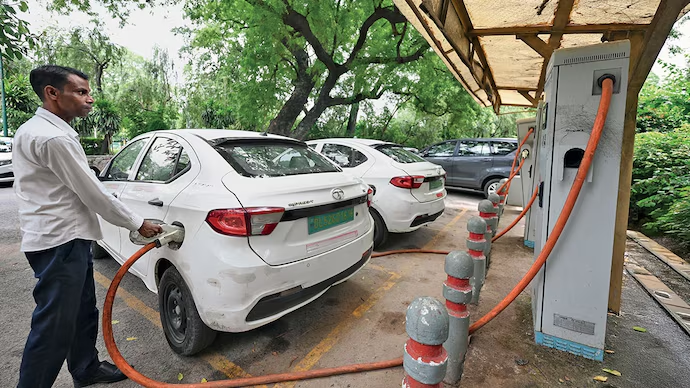
Tata Power’s stated target of 40,000 EV charging stations by 2027 positions it to benefit from the Infrastructure Ministry’s accelerated charging network rollout, though the revenue contribution from EV charging to Tata Power’s overall financial profile remains small relative to its generation and distribution businesses. Olectra Greentech, which manufactures electric buses, has announced order wins from state transport corporations; the scale and execution timeline of these orders should be verified against BSE/NSE exchange filings before any investment conclusion is drawn.
The Fundamental Context Investors Need
The green energy sector’s long-term structural case — India’s commitment to 500 GW of non-fossil capacity by 2030, the falling cost curve for solar and wind, the government’s PLI scheme for advanced chemistry battery cells, and the Budget allocation of ₹305 billion for solar energy — remains intact and is not changed by a short-term oil price shock.
What the current market environment does is compress the near-term price action of individual stocks in ways that may or may not reflect fundamental changes in their business trajectory. A stock recovering from a 52-week low while the broader market falls is demonstrating relative strength — but relative strength in a falling market is not the same as an absolute return. Investors assessing these companies on their merits need to look at capacity addition schedules, power purchase agreement tariffs, interest coverage ratios — particularly relevant given the high-capital-cost nature of renewable energy projects — and the pipeline of projects under construction versus under contract. None of these metrics can be read from a weekly price movement chart.
Note to readers: This article reports factual information on green energy sector stocks, verified price data, and policy developments for journalistic and informational purposes only. It does not constitute investment advice, a buy/sell recommendation, or a prediction of future stock price movements. Technical analysis terms like “breakout,” “support,” and “resistance” describe price patterns and do not guarantee future performance. Equity investments are subject to market risk. Readers must consult a SEBI-registered investment advisor before making investment decisions.