

The rivalry between OpenAI’s ChatGPT and Google’s Gemini has defined the generative AI era since 2023. In 2026, both platforms have released model generations that represent genuine frontier capability — and for the first time since ChatGPT’s launch in late 2022, the question of which is better does not have a simple answer. The honest assessment, supported by independent benchmark data and real-world testing, is that each model leads in specific domains, each carries specific weaknesses, and the correct choice depends entirely on what you need it to do.
The Models: What Is Actually Available in 2026
The AI chatbot landscape shifted dramatically in 2026, with ChatGPT losing 19 percentage points of market share while Google Gemini surged from 5.4% to 18.2% — the most significant market share movement in generative AI history. ChatGPT still maintains the largest user base, with 800 million weekly active users and 68% of the market. The duopoly of ChatGPT and Gemini now controls 86.2% of the total market.
The model powering ChatGPT in 2026 is GPT-5.2 on premium plans, with GPT-4.1 on the free tier. Google’s flagship is Gemini 3 Pro, with the faster and cheaper Gemini 2.5 Flash available on the free tier. Both models are considered “frontier” AI systems — GPT-5.2 builds on OpenAI’s tradition of strong conversational ability and deep logical reasoning, while Gemini 3 Pro is designed as a multimodal powerhouse tightly integrated with Google’s ecosystem.
Reasoning and Benchmark Performance
The benchmark data provides the clearest picture of where each model leads — with important nuances. GPT-5.2 leads in abstract reasoning with 52.9% on ARC-AGI-2 compared to Gemini 3 Pro’s 31.1%, achieved a perfect score on AIME 2025 math competition problems without using any tools, and scored 80.0% on SWE-Bench Verified for coding — versus Gemini 3 Pro’s 76.2%. GPT-5.2 also achieved 70.9% expert-level performance on the GDPval benchmark, which covers professional task simulation across 44 occupations.
Gemini 3 Pro edges out in factuality — scoring 68.8% on the FACTS benchmark — and in long-term planning: in simulated business scenarios, it generated 272% more value through sustained decision-making over extended periods. Gemini 3 Pro also holds a higher overall Elo rating on several leaderboards.
Gemini often edges out in raw reasoning and factual recall, particularly in multimodal benchmarks where it processes images and text simultaneously. However, ChatGPT 5.2 dominates in professional task simulations, tying or beating human experts across the 44 occupations covered by GDPval.
The practical translation of these numbers: GPT-5.2 is the stronger choice for structured problem-solving, complex multi-step coding, and creative writing. Gemini 3 Pro is the stronger choice for fact-sensitive queries, real-time information retrieval, and tasks that require processing large volumes of text or mixed media simultaneously.
Context Window: A Critical Practical Difference
Gemini 3 Pro supports a 1 million input token context window, compared to ChatGPT 5.2’s 256,000 tokens. This difference is practically significant for users working with entire codebases, lengthy research documents, legal contracts, or large datasets that need to be analyzed in a single session.
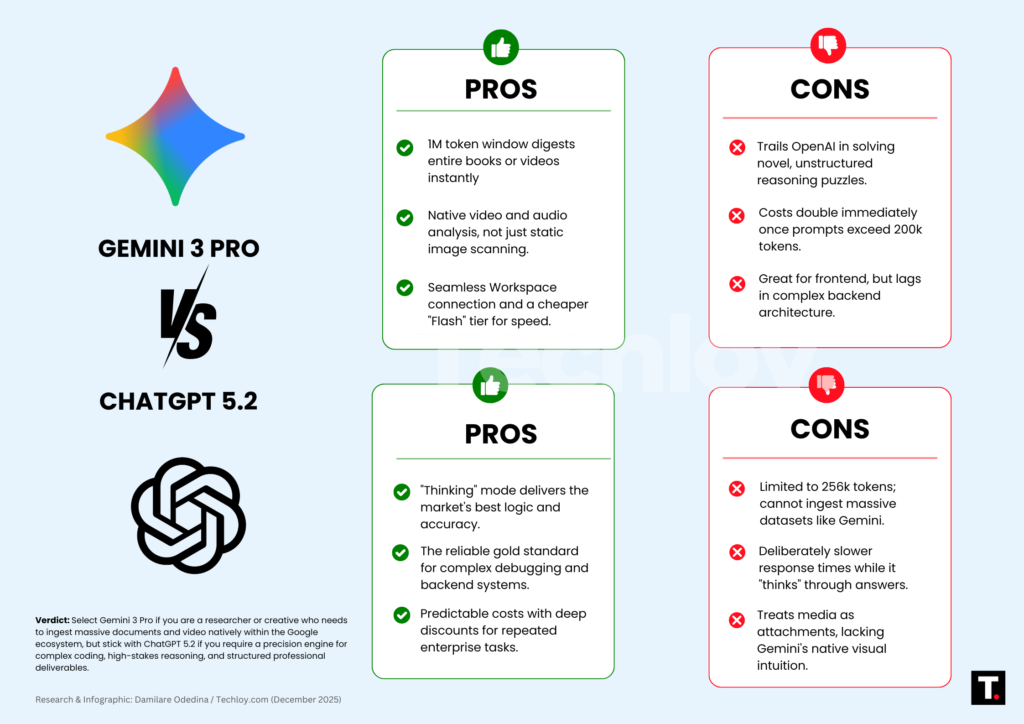
GPT-5.2 maintains higher fidelity over long reasoning chains — its context window is smaller but it processes long texts more accurately. Gemini’s raw window is larger, but ChatGPT maintains stronger reasoning quality across extended logical discussions. For most individual users and routine business tasks, neither window size represents a binding constraint. For enterprise use cases involving large document analysis, Gemini’s 1 million token context is a material advantage.
Coding: ChatGPT Leads, With Caveats
ChatGPT is more consistent across programming languages including Python, JavaScript, SQL, and Rust. Gemini is strong at explaining code errors but less reliable at complex multi-file tasks. ChatGPT integrates smoothly with tools like Zapier, Notion, Replit, and VS Code, while Gemini is better suited for Google Apps Script and Workspace macros. For multi-file repository work, ChatGPT outperforms Gemini due to better chain-of-thought stability.
On SWE-Bench Verified, which tests real-world software engineering tasks, ChatGPT 5.2 in thinking mode scored 80.0% compared to Gemini 3 Pro’s 76.2% — a measurable gap, though both represent strong performance relative to earlier generations. Press Information Bureau
Real-Time Information: Gemini’s Structural Advantage
The most significant structural difference between the two platforms is Gemini’s deep integration with Google’s search index. Gemini tends to hallucinate less on factual, time-sensitive prompts because it leans heavily on Google’s index. GPT-5.2 hallucinates more often on real-time queries but is more consistent on timeless concepts, general knowledge, and explanatory writing.
Gemini is woven directly into Google Workspace — users can pull emails from Gmail, extract data from Drive, check routes in Maps, review documents in Docs, and draft messages that instantly sync across their Google account. This ecosystem integration is the decisive factor for users whose professional workflows are built on Google’s productivity suite.
Multimodal Capabilities
Gemini Ultra 2.0 was designed from the ground up as a natively multimodal system, meaning it can understand and reason across text, images, audio, and video simultaneously without requiring separate model invocations. GPT-5.2 excels across multimodal benchmarks including visual, video, spatial, and scientific reasoning, meaning ChatGPT can interpret images and other non-text inputs more accurately — but it requires external tools like Sora for video generation, while Gemini 3 handles audio and video natively.
Gemini supports much larger context windows and is more effective for long documents and datasets. ChatGPT excels in structured, multi-turn conversations. Both are capable at creative work, but ChatGPT generates more coherent long-form narratives while Gemini offers surprising bursts of originality but can struggle with maintaining consistent arcs over extended generation.
Pricing: Gemini Is Substantially Cheaper at Scale
GPT-5.2’s output price is four times higher than Gemini 2.5 Flash. For individual users, both platforms offer comparable flat-rate subscriptions: ChatGPT Plus at $20 per month, Gemini Advanced bundled with Google One AI Premium. The pricing difference becomes decisive at API scale for developers and businesses processing high volumes of requests.
For raw API usage, Google’s pricing is substantially lower than OpenAI’s: approximately $0.50 per million input tokens and $3 per million output tokens for Gemini 3’s standard model, compared to higher rates for GPT-5.2. Businesses paying for quality at scale are often willing to accept OpenAI’s premium due to brand reliability and ecosystem maturity.
User Experience: What Real Users Report
Users consistently describe Gemini as fast, search-aware, and convenient, while ChatGPT is viewed as more consistent, trustworthy, and better for complex reasoning. The phrase that most accurately captures the consensus from real-user feedback across platforms is this: “Gemini feels smart. ChatGPT feels dependable.”
Some Reddit users have criticized GPT-5.2 as feeling “too corporate” and “too safe,” describing it as boring compared to earlier versions, while others praise its improved instruction-following. Gemini 3 Pro’s perceived intelligence may come from its thinner alignment layer — which produces more direct answers but can increase hallucination risk on complex factual queries.
The Verdict: A Decision Framework
No benchmark resolves the comparison into a single winner because the two models are optimized for genuinely different use cases. Choose GPT-5.2 if your primary needs are complex coding across multiple files, structured long-form writing, professional document production, multi-step analytical reasoning, or reliable conversational AI that maintains coherence across complex discussions. Choose Gemini 3 Pro if your workflow is built around Google Workspace, your use case requires current real-time information, you regularly work with very large documents requiring a million-token context window, or you need native audio and video processing without external tool integration.
The “best AI” answer in 2026 is not universal — each platform now excels in different scenarios. The capability gaps that once made ChatGPT the obvious default have narrowed substantially, driven by Google’s aggressive 2025 model releases, ending OpenAI’s near-monopolistic technical advantage. For users willing to manage two tools, the most effective approach is to use both for their respective strengths — a genuinely viable option given that both offer capable free tiers.