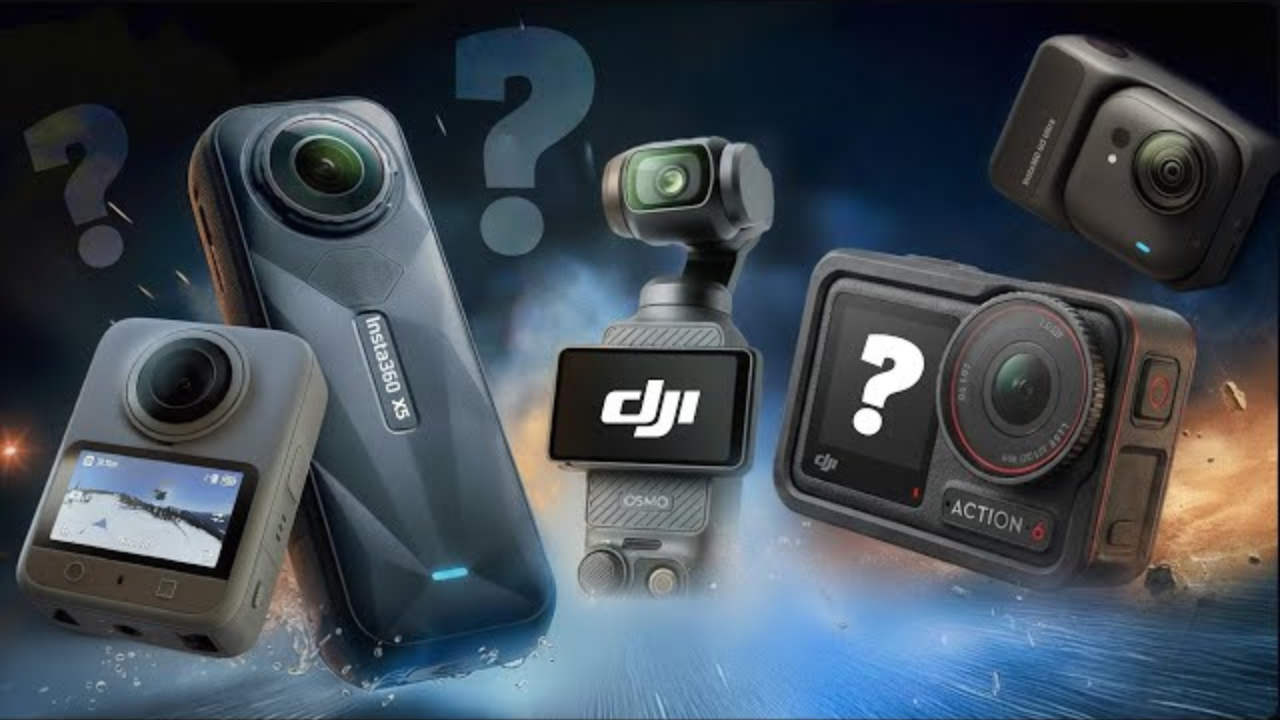


For nearly a decade, action camera selection for moto vlogging was a relatively simple decision. GoPro dominated the segment so thoroughly that choosing an alternative required active effort. That era is over. GoPro’s headroom has been cut to its thinnest-ever point, with the Hero13 Black now facing its strongest rivals yet from Insta360 and DJI — a shift so significant that for most people, including casual creators, vloggers, and those for whom waterproofing is paramount, alternative cameras now present compelling arguments.
For moto vloggers specifically, the competition among GoPro’s Hero13 Black, the Insta360 Ace Pro 2, the Insta360 X5, and the DJI Osmo Action 5 Pro maps onto a set of use-case decisions that are more consequential than raw specification comparisons suggest. Battery life matters differently on a bike than it does in a backyard. Wind noise management determines whether footage is usable or discarded. Mounting speed — the time between stopping a bike and having a camera recording — affects how much content is actually captured. And the post-production workflow a rider is willing to accept shapes which camera architecture makes sense. This comparison addresses each of those dimensions with verified performance data.
The Four Cameras: Verified Specifications
Before the use-case analysis, the core technical specifications from manufacturer documentation and independent review testing.
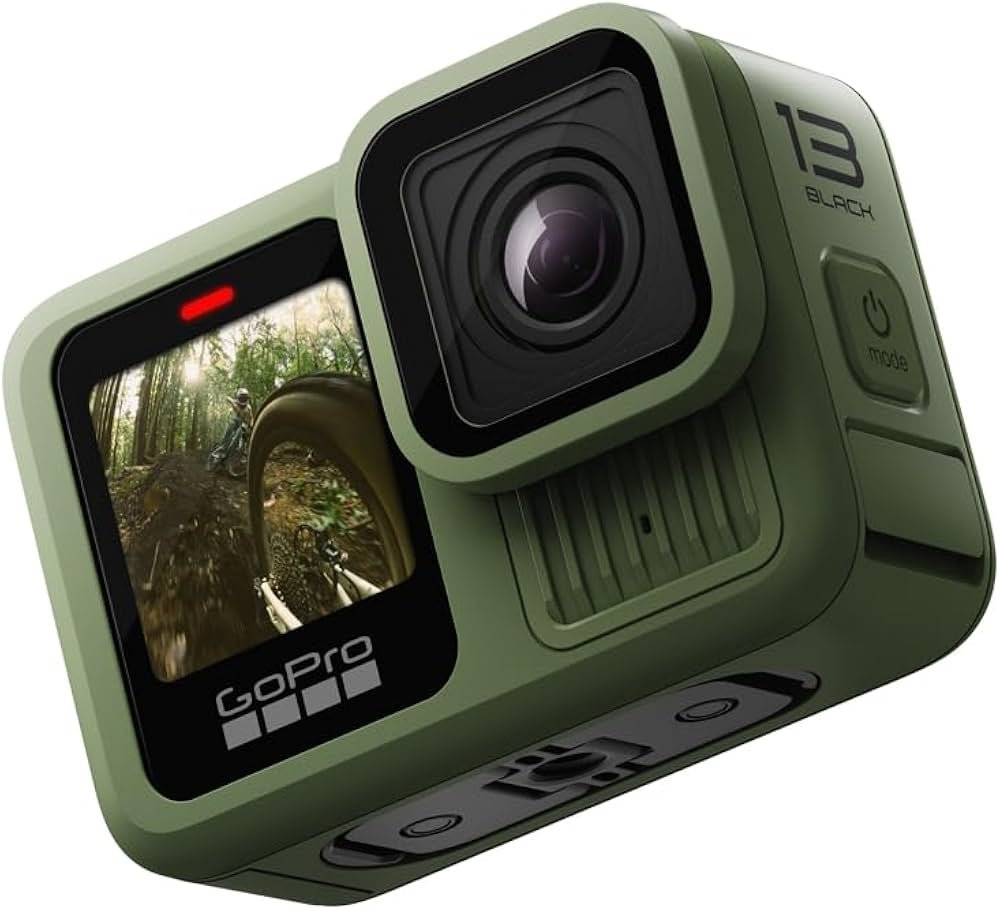
The GoPro Hero13 Black retails at approximately $399. It shoots 5.3K video at 60fps, captures 27-megapixel photos, and features HyperSmooth 6.0 stabilization with 360-degree Horizon Lock. The 1,900mAh Enduro battery provides up to 2.5 hours of continuous recording at 1080p, or over 1.5 hours at 4K30 and 5.3K30. It is waterproof to 10 meters without a case. The Hero13 introduced GoPro’s first magnetic mounting system alongside its traditional folding-finger mount, and launched an HB-Series modular lens system accepting macro, ultra-wide, anamorphic, and ND filter attachments that auto-detect when installed. Bluetooth audio connectivity allows direct wireless pairing with external microphones or Bluetooth headsets, including Apple AirPods — though wind noise in the built-in microphone remains a documented limitation.
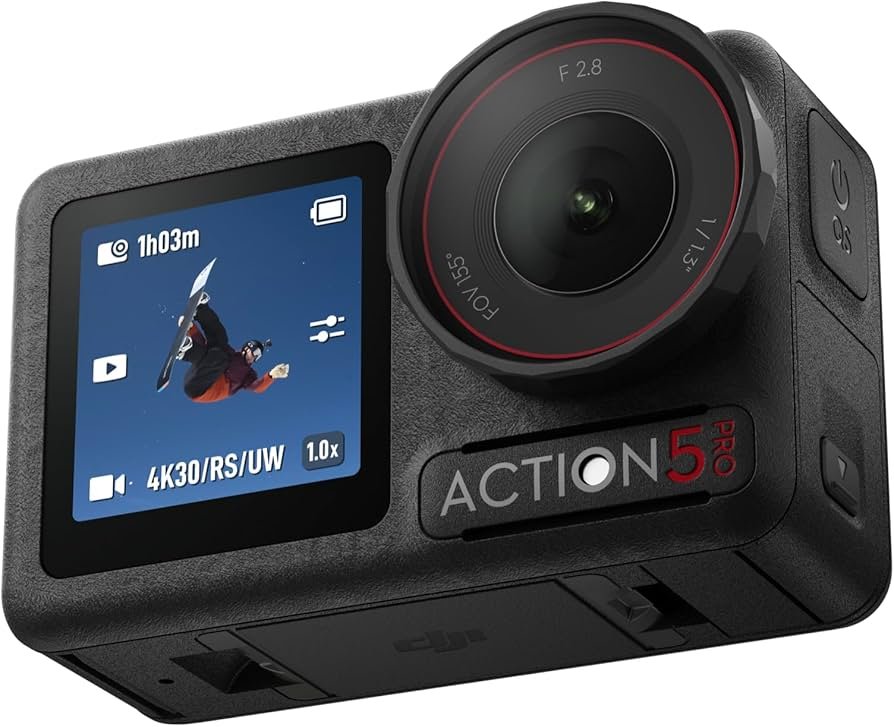
The DJI Osmo Action 5 Pro retails at $349 for the standard configuration — approximately $50 less than the Hero13 Black. It is built around a 40-megapixel 1/1.3-inch sensor — substantially larger than the GoPro Hero13’s 1/1.9-inch sensor — with DJI claiming up to 13.5 stops of dynamic range. Maximum video resolution is 4K at 120fps in 16:9, or 4K at 120fps in 4:3 open gate format. Both front and rear displays use OLED technology. The Osmo Action 5 Pro records for up to four hours on a single charge — one and a half hours longer than the GoPro Hero13 and one hour longer than the Insta360 Ace Pro 2. It is waterproof to 20 meters without a case, double the depth rating of GoPro and Insta360 competitors. Internal storage of 47GB allows recording without an SD card.
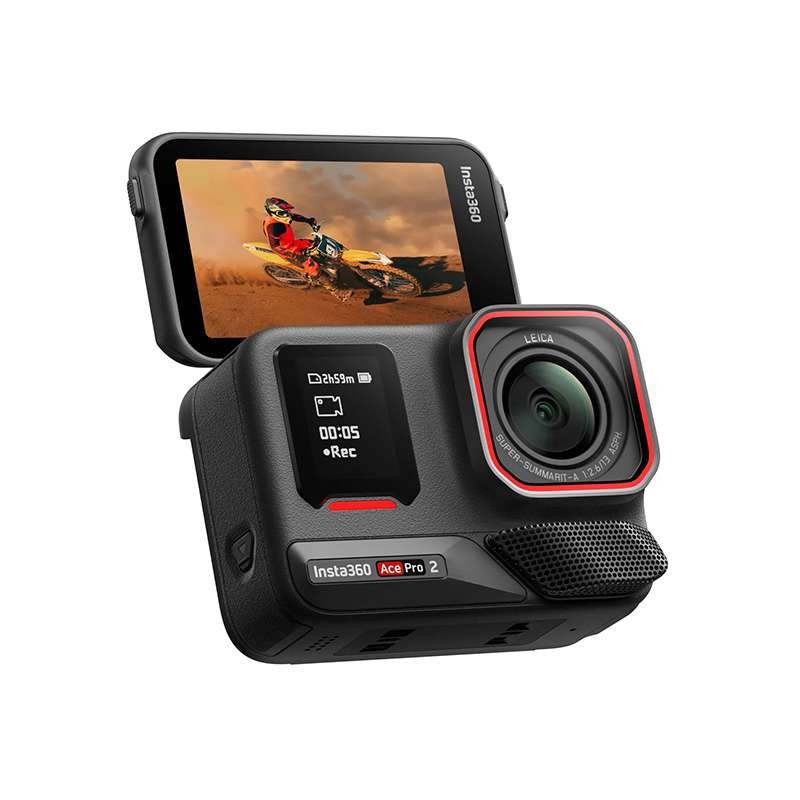
The Insta360 Ace Pro 2 retails at approximately $400. Its Leica-co-engineered 1/1.3-inch sensor captures 8K video at 30fps with 13.5 stops of dynamic range and an F2.6 aperture. The camera weighs 177 grams and features a 2.5-inch flip-up touchscreen. Voice and gesture controls allow hands-free operation — a meaningful practical advantage for a rider wearing gloves. FlowState stabilization produces smooth footage even in full motion. The Ace Pro 2 supports external microphones and Bluetooth headsets for audio improvement over its built-in microphone.
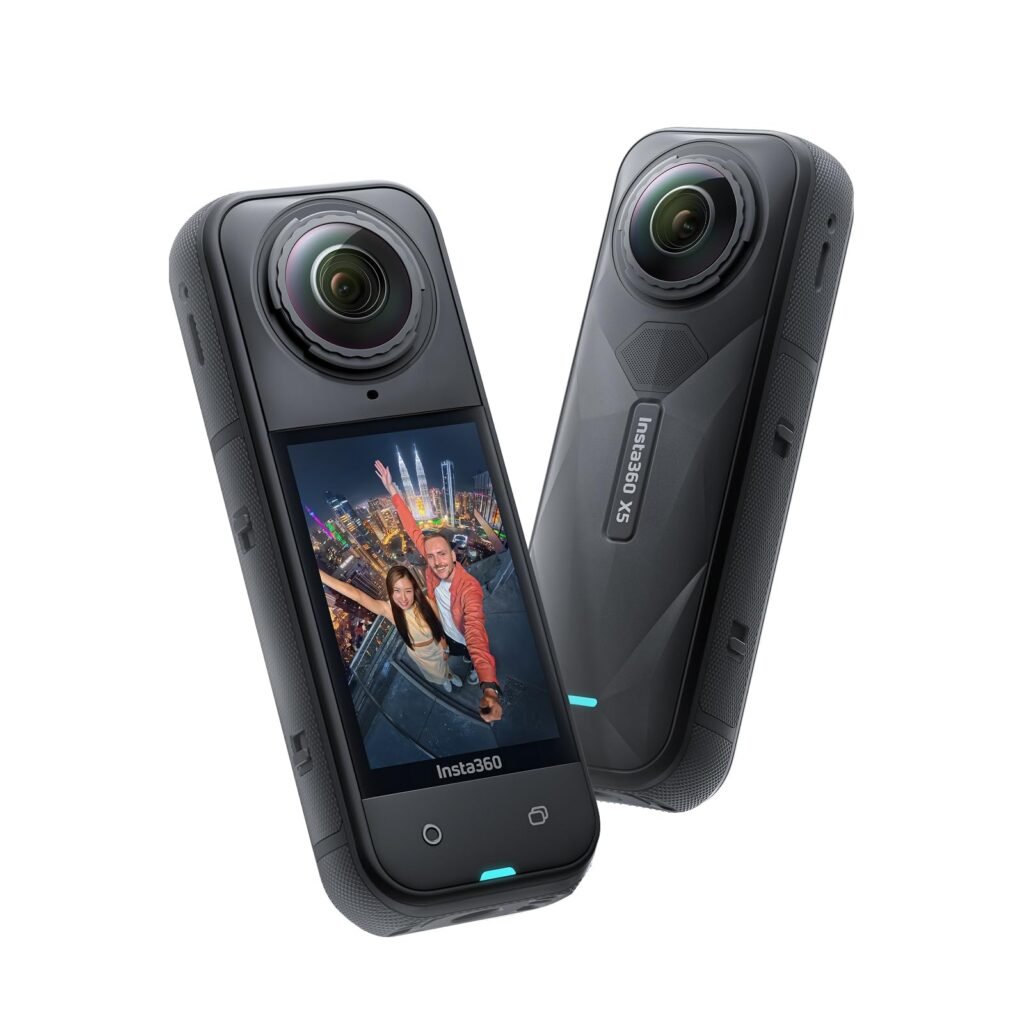
The Insta360 X5 occupies a fundamentally different category. It is a 360-degree powerhouse with dual 1/1.28-inch sensors capturing 8K 360-degree video. It records everything around the rider simultaneously — no framing decisions are required before the ride. InstaFrame Mode delivers a flat video ready for posting while still capturing the full 360-degree version for post-production editing. The X5 is IP68-rated to 15 meters, features replaceable lenses, and uses a magnetic quick-release mount.
The Core Differentiator: Sensor Size and What It Means at Dawn and Dusk
For moto vloggers, the sensor size difference between the GoPro Hero13 and its two primary rivals is not an abstract specification — it determines whether footage captured during the hours when most scenic rides actually occur is usable or not.
DJI’s larger 1/1.3-inch sensor captures more light than the GoPro Hero13’s 1/1.9-inch sensor, providing better low-light image quality and greater native dynamic range. The DJI’s SuperNight mode pushes ISO to 51,200 for sharp images in very dark environments. The GoPro excels in daylight, with colors and contrasts that appeal to experienced GoPro users. The DJI clearly outperforms its competitor in low light, with its larger, brighter sensor providing cleaner footage as ambient light drops.
The Insta360 Ace Pro 2 matches DJI’s sensor size at 1/1.3 inches. In direct comparison, the Ace Pro 2’s Leica-co-engineered sensor produces razor-crisp footage with no resolution lost at the edges of the frame in good light. In low light, it competes with DJI’s performance at a similar sensor size.
The practical implication for moto vloggers is direct: a rider planning sunrise mountain passes, golden-hour canyon roads, or tunnel transitions should weight sensor size heavily in their decision. A rider who primarily documents daytime rides in good light gives up less by staying with the GoPro’s class-leading 5.3K resolution and proven color science.
Battery Life: The Parameter That Changes Behavior on Long Rides
Battery anxiety — the practice of stopping a ride to change camera batteries rather than continuing — is a real behavioral constraint that specifications address differently across platforms.
In extended field testing, DJI’s four-hour battery life delivered approximately 2.8 hours in extreme cold, compared to GoPro’s 1.4 hours in equivalent conditions. On a standard day-long ride, the DJI required one battery swap compared to three for the GoPro to maintain continuous recording. DJI’s extended battery life is attributable to its industry-first 4nm processor chip, which delivers significantly more efficient power management than competing processors.
For moto vloggers covering long-distance routes — where stopping to change batteries interrupts momentum and risks missing footage during the brief windows when the best light and landscape coincide — the DJI’s battery advantage is operationally significant rather than merely theoretical. The Insta360 Ace Pro 2 sits between the two at approximately three hours, with the X5 offering the strongest battery performance in the Insta360 lineup.
Stabilization: The Floor Has Risen Across All Platforms
GoPro’s HyperSmooth stabilization system remains excellent, producing very smooth footage even on slow-speed motorcycle footage over extremely bumpy ground. In direct comparison testing, GoPro’s HyperSmooth remains a marginal lead over competitors, though Insta360’s FlowState has significantly closed the gap.
DJI tends to prioritize natural colors and improved low-light accuracy, while GoPro targets maximum detail and immersive HDR footage. Both brands’ stabilization systems are now capable enough that hard-mounted cameras on handlebars or helmets produce usable footage on most paved surfaces. The meaningful stabilization distinction for moto vlogging in 2026 is not which camera is smoothest — all three platforms achieve adequate stabilization for standard riding content — but which handles the specific vibration profile of a given motorcycle type and road surface combination. Adventure bikes on unpaved roads present a different stabilization demand than sport bikes on smooth tarmac, and real-world testing on the specific surface type matters more than manufacturer comparison claims.
The Mounting and Workflow Dimension
DJI’s magnetic mounting system allows instant clip-on attachment to nearly any accessory including car, bike, helmet, and chest mounts without the need to fiddle with screws or clumsy brackets. GoPro implemented its own magnetic mount system on the Hero13, and the Insta360 Ace Pro 2 has a similar magnetic system — a convergence that means all three platforms now offer fast mounting. The Points Guy GoPro’s magnetic system proves more versatile than DJI’s, with a mechanism that works in both orientations, where DJI’s offers only one orientation — a detail that can matter when mounting in constrained positions. NerdWallet
The post-production workflow difference between the Insta360 X5 and the three traditional action cameras is the most consequential platform-level distinction in the comparison. The Insta360 X5 captures footage in all directions simultaneously, allowing framing decisions to be made in post-production rather than before the ride. This eliminates the decision-making friction of choosing a camera angle before departure, at the cost of a mandatory reframing step in editing before footage can be used in a standard video timeline. Most moto vloggers who use both a 360 camera and a traditional action camera report that the combination covers every narrative requirement — the 360 camera handles unexpected moments and multi-angle storytelling, while the traditional camera delivers clean, sharp POV footage for primary use.
Audio: The Persistent Limitation and Platform-Specific Solutions
Wind noise management remains the defining audio challenge across all platforms, and the solutions differ meaningfully between cameras. GoPro’s built-in microphone picks up some wind noise when riding, though less than previous generations. Connecting AirPods via Bluetooth provides a dedicated microphone and voice pickup, though this does not eliminate wind noise — DJI’s dedicated microphone clip-on solution performs better at wind noise elimination.
DJI’s Bluetooth connectivity with the DJI Mic 2 represents an effortless pairing that TechRadar described as analogous to the relationship between an iPhone and AirPods — a seamless integration that GoPro’s third-party mic support does not fully replicate in terms of ease of use. Insta360’s GPS Preview Remote with built-in microphone pairs with both the Ace Pro 2 and X5, allowing high-quality audio capture with two adjustable noise reduction modes — a purpose-built moto vlogging audio solution that includes handlebar mounting, real-time video preview, and GPS speed logging in a single accessory.
The Honest Verdict by Rider Profile
The data does not produce a single winner — it produces a decision matrix mapped to rider priorities.
The GoPro Hero13 Black is the correct choice for content creators and professional moto vloggers who need maximum video resolution for cropping flexibility in post-production, the modular HB-Series lens system for creative variation, and the largest third-party accessory ecosystem available. Its 5.3K resolution and proven daylight color science remain unmatched in the segment.
The DJI Osmo Action 5 Pro is the correct choice for riders who frequently film in low-light conditions, need all-day recording without battery management interruptions, ride in cold weather where OLED screens and lower temperature ratings matter, or prioritize waterproofing depth beyond 10 meters. At $50 less than its two primary competitors, it also presents the strongest value proposition for riders who weight battery life and low-light performance above resolution.
The Insta360 Ace Pro 2 is the correct choice for riders who want an immediately usable, out-of-the-box camera with Leica-quality color rendering, effective voice and gesture controls for gloved hands, and a flip screen for self-facing vlogging segments.
The Insta360 X5 is the correct choice for riders who want to film in all directions simultaneously, make framing decisions in post-production, and access creative formats — tiny planet effects, bullet-time slow motion, virtual follow-cam shots using the invisible selfie stick — that no traditional action camera can produce. It is also the camera that most professional moto vloggers pair with a second traditional camera rather than using exclusively, precisely because the 360 workflow complements rather than replaces conventional POV footage.
The era of defaulting to GoPro by habit is over. The era of choosing the right camera for the specific way a rider films has replaced it.