

Running a small business in 2026 without AI assistance is the operational equivalent of running a manufacturing operation without machinery. The tools exist, they work, most of them have capable free tiers, and the competitive disadvantage of not using them is measurable. The more important question is no longer whether small businesses should use AI — it is which tools to prioritize for which functions, and how to evaluate them honestly before committing time and workflow to any platform. This guide covers the verified free AI tools making the most practical difference for small business operations across six core categories: content and writing, design and visuals, automation, customer communication, meetings and productivity, and research and intelligence.
Category 1: Content and Writing — ChatGPT Free Tier
ChatGPT is the Swiss Army knife of AI for small businesses. The free version gives access to GPT-4o, which is capable of drafting emails, brainstorming ideas, summarizing long documents, and answering complex questions. It can write job descriptions, create social media posts, analyze customer feedback, and explain complex regulations in plain English. What makes it practically valuable is not that it gives perfect answers — it is that it gives a starting point fast. Writer’s block disappears. Research that used to take an hour takes five minutes.
The key limitation is equally important to understand: ChatGPT is generic. It does not know your business unless you teach it. The free version does not retain memory between sessions. To get consistently useful outputs, invest 15 minutes in a business context prompt — a paragraph describing your business, audience, tone, and common content needs — and paste it at the start of any content session. This single practice closes most of the gap between generic and brand-specific output.
For AI writing optimized specifically for marketing copy and blog content, Rytr’s free plan generates up to 10,000 characters per month — enough for several blog posts, a week of social media captions, or a complete email campaign. The paid plan at $9/month makes Rytr one of the most cost-effective AI writing tools available when free limits are exceeded.
Category 2: Design and Visuals — Canva AI
The best free options for creating professional social media graphics without a designer start with Canva. Canva’s free tier includes AI-powered design features including Magic Write for copy suggestions, Magic Design for automated layout generation from uploaded images or a brief description, and a library of templates across every social media format. For small businesses producing regular content — product posts, promotional graphics, event announcements — Canva’s free tier handles the majority of needs without cost.
Tome revolutionized presentation creation in 2026 with AI that generates complete slide decks from simple prompts. The free tier allows unlimited presentations with basic features. Creating presentations typically consumes 4 to 8 hours for small business owners — Tome reduces this to 30 minutes, with professional results that rival designer-created decks. For pitch decks, client presentations, and team updates, Tome is the fastest starting point available at zero cost.
Category 3: Automation — Zapier Free Plan
Zapier connects apps and automates repetitive work. A typical example workflow: form filled → contact added to email list → welcome email sent → CRM updated — all automatically, with no manual steps. The free plan provides 100 tasks per month with access to basic two-step Zaps, sufficient for testing and light automation before committing to a paid plan. For small businesses handling fewer than 100 triggered events per month — lead forms, appointment bookings, social media cross-posting — the free tier is genuinely functional.
Category 4: Customer Communication — Tidio and HubSpot CRM
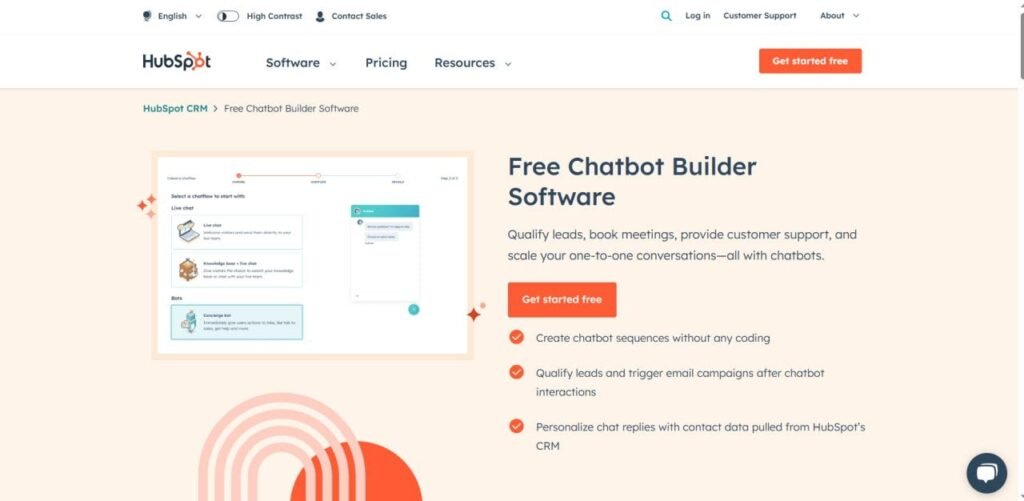
For customer communication, Tidio offers a free tier that includes live chat and a basic AI chatbot that can handle frequently asked questions 24 hours a day without staff involvement. The chatbot is customizable with your own answers and routes complex queries to a human agent. HubSpot’s free CRM tier is one of the most generous in the market: it includes contact management for up to one million contacts, email tracking, deal pipeline visualization, and basic reporting — replacing dedicated CRM software that would cost hundreds of dollars per month at equivalent functionality.
Category 5: Meetings and Productivity — Otter.ai and Google NotebookLM
Otter.ai offers 300 free monthly transcription minutes, with AI-powered summaries and action item extraction. Key features include real-time transcription, speaker identification, automated summaries, action item detection, and integration with Zoom and Google Meet. Small business owners spend an average of 12 hours weekly in meetings — Otter.ai eliminates manual note-taking and ensures nothing is missed.
Google’s NotebookLM allows creation of a personalized AI assistant that surfaces insights and provides audio overviews from data you upload, including text, video, and audio. It is available on a free plan with usage limits. For small business owners who want to analyze industry reports, extract insights from contracts, or build a searchable knowledge base from their own documents, NotebookLM provides a capable free entry point.
Category 6: Research and Intelligence — Perplexity AI
Perplexity AI serves best use cases including competitive intelligence, market trend analysis, customer research, and industry news monitoring. It provides cited, real-time answers to research queries, significantly reducing the time required to gather competitive and market intelligence. The free tier provides unlimited searches with standard AI responses; the Pro tier at $20 per month adds faster models and more complex query handling. For small businesses conducting regular market research, Perplexity’s cited-source approach reduces the verification burden compared to uncited AI outputs.
The Critical Evaluation Framework
Before adopting any AI tool, three questions should be answered clearly. First: what happens to your data? Some AI tools train their models on your customer data, your emails, and your conversations — meaning your proprietary information is teaching their AI to serve your competitors. Ask explicitly about data usage and export options before committing. Second: does the tool actually learn your business, or does it give everyone the same generic answers? Third: what does support look like when the tool gives wrong answers? AI tools hallucinate. When that happens, can you reach a real human who understands the product?
The cost of this technology has plummeted. Small businesses no longer need an enterprise budget to access tools capable of reasoning or deep research. A business owner who selects the right tools can run a complete AI-powered marketing, content, and customer service operation for well under $100 per month — or even for free. The decision is not whether to use AI. It is which problems to solve first.