


India’s agricultural technology sector is in the middle of a transition from isolated farm-level pilots to system-wide infrastructure, with platforms connecting farmers to input markets, credit, storage, and buyers beginning to achieve scale across states and crop categories. The contours of this transition are now visible in market valuations, government scheme deployment, and the emerging architecture of a national digital agriculture stack.
The Market: Where It Stands and Where It Is Headed
India’s agritech market was valued at approximately $9 billion in 2025 and is projected to grow to $28 billion by 2030, expanding at a compound annual growth rate of approximately 25 per cent, according to the Inc42 and StarAgri Indian Agritech Market Landscape Report 2025. Despite strong growth, agritech accounts for approximately 2 per cent of India’s overall agriculture market — a share expected to reach only 5 per cent by 2030. This is not because technology lacks relevance on the farm, but because Indian agriculture is structurally difficult to digitise at scale: nearly 69 per cent of Indian farmers operate on less than one hectare of land, farm incomes are seasonal and volatile, and digital literacy varies sharply across regions. Press Information Bureau
An earlier estimate — the EY 2020 report projection of a $24 billion opportunity by 2025 — is widely cited across industry literature but reflects conditions and penetration assumptions from 2020 that have not materialised at that scale. The current $9 billion valuation from the 2025 primary source is used here as the more accurate reference.
Tracxn’s database as of early 2026 lists approximately 4,990 agritech companies in India, of which 735 have secured external funding and 152 have reached Series A or above. Total venture capital and private equity invested in Indian agritech over the past decade exceeds $6.4 billion, with the single largest funding year being 2021 at over $1.2 billion. In 2025, the sector raised approximately $157 million across the year, with early 2026 showing a sharp slowdown to $8.5 million through January. Business Standard The funding trend reflects broader startup market discipline rather than a loss of interest in the sector’s potential.
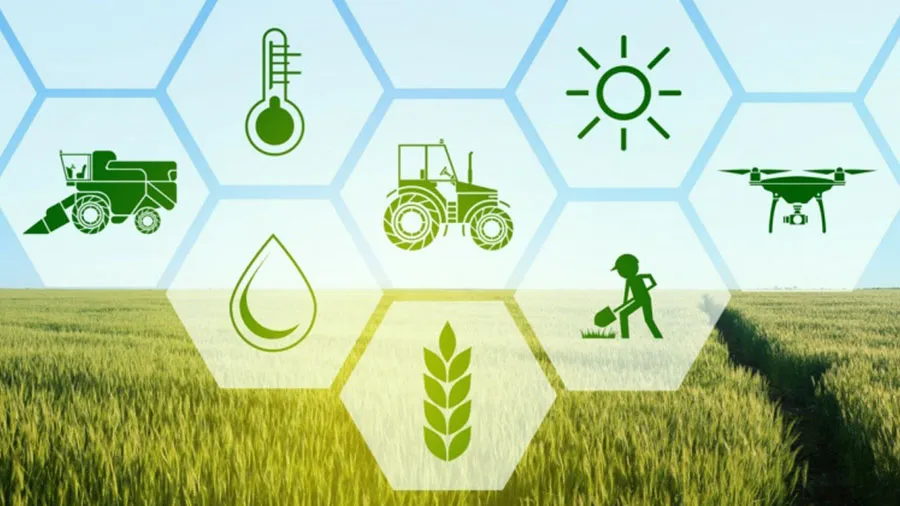
NITI Aayog has estimated that a fully developed agritech ecosystem has the potential to increase farmer incomes by 25 to 35 per cent and contribute $95 billion to India’s GDP through lower input costs, higher productivity, more affordable finance, and additional income sources. These are long-run projections contingent on systemic adoption at scale — not outcomes that have been realised yet. World Bank
The Technology Layer: Precision Farming, Advisory, and Supply Chain
Artificial intelligence is the fastest-growing sub-segment within agritech, expanding from approximately $900 million in 2025 toward a projected $5.6 billion by 2030. Adoption is concentrated in yield forecasting, water optimisation, credit underwriting, crop insurance, and price discovery — applications that improve predictability and decision-making in a sector characterised by volatility and thin margins. Press Information Bureau
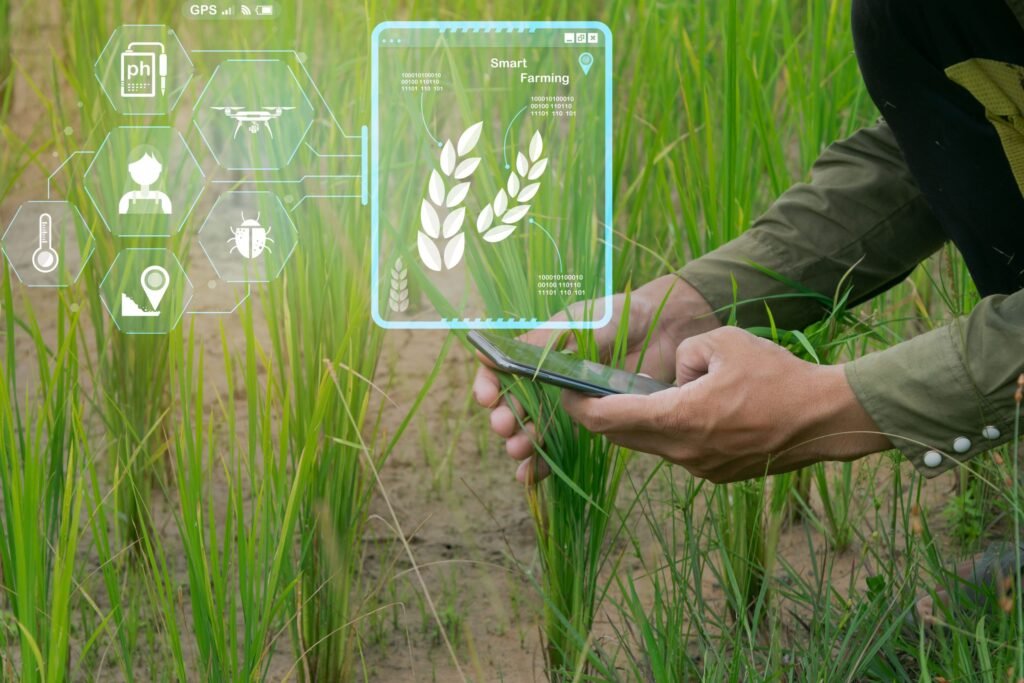
Market linkage is emerging as the single largest agritech value pool. Post-harvest infrastructure, logistics, and buyer-access platforms are expected to contribute approximately 45 per cent of total agritech value by 2030. Scaled platforms including StarAgri, DeHaat, Ninjacart, and Samunnati are consolidating positions across the seed-to-shelf value chain. Press Information Bureau These platforms reduce the number of intermediaries between farmer and end buyer, though independent verification of the claimed 25-40 per cent farmer income gains cited by platform operators requires caution — such figures typically reflect the experience of connected, tech-adopting farmers on organised supply chains, not the median smallholder.
The rural fintech segment is addressing a structural financing gap that has long constrained Indian agriculture. Startups in supply chain financing and agri-fintech have received maximum venture investment in recent years. Players including Samunnati and Jai Kisan are using farm-level data — geo-tagged land parcels, satellite crop imagery, and historical yield records — to build credit profiles for smallholder farmers who lack the formal documentation typically required by banks. This approach is enabling small-ticket loans at lower interest rates than informal moneylenders provide, and at faster disbursement timelines than bank branches can offer.
Namo Drone Didi: Drones as Rural Women’s Enterprise
The government’s most visible technology deployment in the agricultural grassroots is the Namo Drone Didi scheme, which transforms women’s Self-Help Groups from beneficiaries of government transfers into providers of agricultural services.
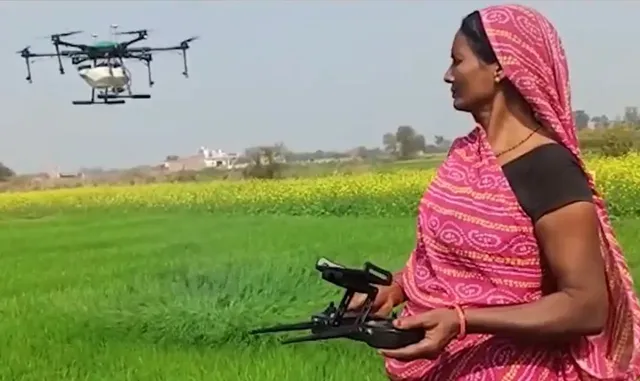
The Government of India has approved the Namo Drone Didi scheme as a Central Sector scheme with a budgeted outlay of ₹1,261 crore for the period from 2023-24 to 2025-26. The scheme targets the distribution of drones to 15,000 selected Women SHGs under the Deendayal Antyodaya Yojana — National Rural Livelihoods Mission framework.
Under the scheme, women SHGs receive a complete drone package — comprising the base drone, spray assembly, batteries, a pH meter, an anemometer, one year of warranty, two years of maintenance, and insurance — with 80 per cent of the cost up to ₹8 lakh covered by central financial assistance. The balance 20 per cent can be financed through National Agriculture Infrastructure Financing Facility loans at 3 per cent interest subvention. One member from each SHG undergoes a five-day drone pilot training and ten days of agricultural application training; a second member is trained for maintenance.
Each participating SHG is expected to service approximately 2,000 to 2,500 acres annually, generating an additional income of at least ₹1 lakh per year. The scheme is currently in its operational deployment phase across states, with Lead Fertilizer Companies acting as implementing agencies for drone procurement. An IT-based Drone Portal provides real-time monitoring of service delivery, fund disbursement, and drone operation.
The scheme addresses two objectives simultaneously: providing farmers with precision pesticide and fertiliser application services that reduce chemical waste and labour costs, and creating a tech-enabled livelihood stream for rural women who have not previously had access to high-skill occupational training.
The Digital Agriculture Stack: AgriStack and Bharat-VISTAAR
Beyond individual schemes, the government is building a foundational digital infrastructure for agriculture — a national farmer registry, land records database, and advisory platform — that is intended to underpin everything from targeted subsidy delivery to data-driven credit assessment.
The Digital Agriculture Mission includes the development of AgriStack — a digital public infrastructure that will assign each farmer a unique Farmer ID linked to land records, crop details, and entitlements — and Bharat-VISTAAR (Virtually Integrated System to Access Agricultural Resources), a multilingual AI platform delivering personalised advisory on soil health, weather, pest management, and market prices in local languages. The Digital Agriculture Mission is being piloted across states, with integration between the farmer registry and existing PM-Kisan beneficiary data under active implementation. Press Information Bureau
When operational at scale, the AgriStack is expected to reduce fraud and duplication in government subsidy programmes — a longstanding problem in schemes like fertiliser subsidies — by enabling programmable transfers linked to verified farmer identity and crop type, analogous to the programmable e-rupee applications being piloted in Gujarat’s G-SAFAL scheme.
The Structural Challenge
Early adoption of agritech has been strongest among farmers linked to Farmer Producer Organisations, organised supply chains, or platforms that bundle credit, procurement, and market access. For most smallholder farmers, a wrong technological decision is a livelihood risk, not an experiment. This is why agritech penetration, despite a decade of investment, remains concentrated among progressive, capital-ready farmers and organised institutions rather than broadly distributed across the 100 million-plus farming households that make up India’s agricultural economy. Press Information Bureau
The gap between the technology’s demonstrated potential and its current reach is not primarily a technology problem — it is a distribution, trust, and infrastructure problem. Connectivity remains inconsistent beyond major rural clusters. Digital literacy is improving but unevenly. Land fragmentation makes per-acre technology costs high relative to marginal gains for the smallest operators.
What the current phase of agritech development has established is that the infrastructure required for scale — aggregation platforms, cold chain networks, rural fintech rails, and a digital farmer identity — is being built concurrently with the technology itself. Whether these pieces converge into the system-level transformation that the sector’s projections anticipate will depend on execution over the next five years, not on the ambition evident in the current policy and startup landscape.