
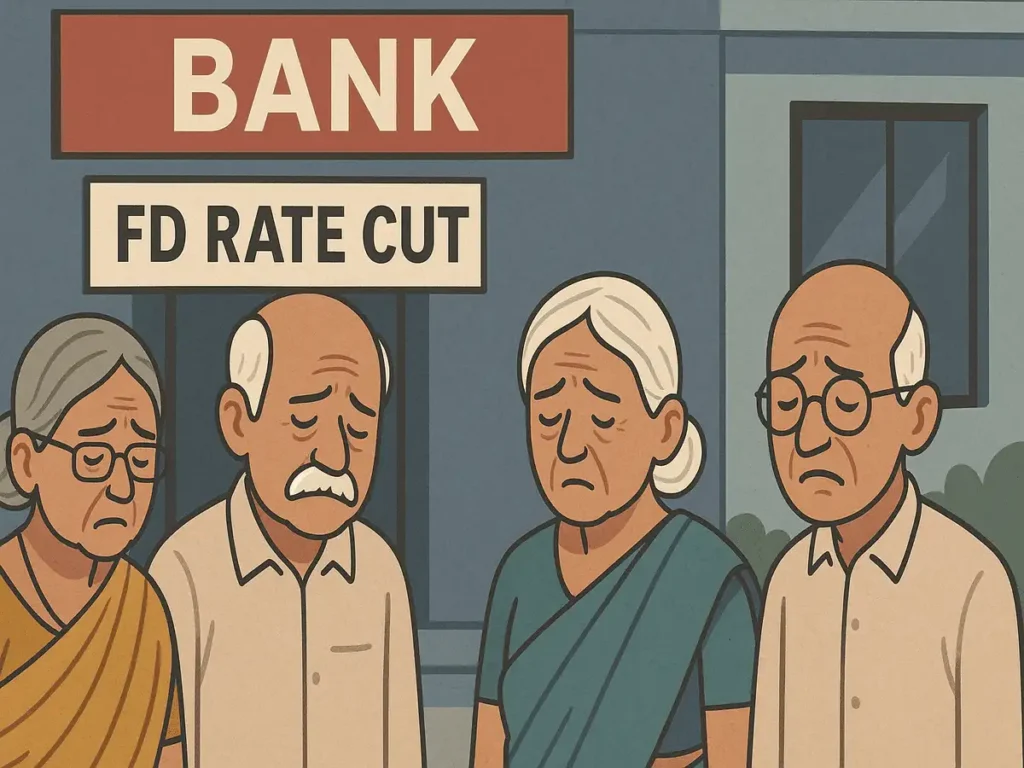
India’s fixed deposit landscape has been fundamentally repriced over the past twelve months. The Reserve Bank of India’s Monetary Policy Committee, which cut the repo rate by a cumulative 100 basis points across four meetings in calendar year 2025 before pausing in February 2026, has pushed deposit rates at major banks to levels not seen since 2019-20. For savers comparing fixed deposits against mutual funds, the interest rate environment has materially changed the calculus — not by making one instrument unambiguously superior, but by narrowing the real return gap in deposits and, in doing so, forcing a more careful assessment of what each instrument actually offers.
The Rate Environment: Where Things Stand
The repo rate currently stands at 5.25 per cent, following a 25 basis point cut to that level in December 2025 — the fourth reduction of the year. The RBI’s MPC held the rate unchanged at its February 2026 meeting, maintaining a neutral policy stance while indicating that future decisions will depend on evolving data. International Monetary Fund
The February 2026 cut, from 5.50 per cent to 5.25 per cent, triggered a repricing of floating-rate loan portfolios worth over ₹50 lakh crore. The same logic operates in reverse for deposits: as banks’ cost of borrowing from the RBI falls, the rates they offer depositors tend to follow. Worldbank
The transmission has been direct and measurable. Following the December 2025 rate cut, SBI set its one-year FD rate at 6.25 per cent. HDFC Bank offers 6.25 per cent for one-year tenures, rising to 6.45 per cent for two-year deposits. ICICI Bank offers 6.25 per cent for one year to under 18 months, with its highest general-public rate at 6.60 per cent for deposits between two years and one day and five years. The World Bank Senior citizens receive an additional 50 basis points at major banks, with ICICI offering up to 7.10 per cent and small finance banks such as Jana and Utkarsh offering up to 8.00 per cent for senior depositors.
The highest currently available rate across the scheduled banking system reaches approximately 8.10 per cent for general citizens and 8.60 per cent for senior citizens, concentrated in the small finance bank segment. HDFC Bank’s peak rate for general depositors stands at 6.50 per cent, while Axis Bank offers up to 6.45 per cent.
The Inflation Context: Real Returns Have Improved
India’s headline retail inflation, measured under the new CPI series with a 2024 base year introduced by MoSPI in January 2026, stood at 3.21 per cent in February 2026, up from 2.74 per cent in January. Rural inflation was recorded at 3.37 per cent and urban inflation at 3.02 per cent, according to MoSPI’s official data released on March 12.
The February reading marks the second data point under the revised CPI framework. MoSPI cautioned that direct year-on-year comparisons with pre-2026 figures are restricted because the basket weightages have been substantially revised, with food items now accounting for a smaller share of the index following the Household Consumption Expenditure Survey 2023-24. The CSR Journal
The practical significance for deposit investors is in the real return calculation. A one-year FD at 6.25 per cent, set against February 2026 headline inflation of 3.21 per cent, implies a pre-tax real return of approximately 3 percentage points — meaningfully better than the near-zero or negative real returns that prevailed during 2022-23 when the RBI was holding rates high against elevated inflation. However, the interest earned on FDs is taxed as income at the depositor’s applicable slab rate, which reduces the post-tax real return substantially for those in the 30 per cent bracket.
Fixed Deposits: What the Instrument Provides
Fixed deposits offer three features that no other widely available retail instrument replicates: contractually guaranteed principal, a pre-specified nominal return, and DICGC deposit insurance coverage of up to ₹5 lakh per depositor per bank. The uniform rate reduction across major banks following the RBI’s policy shift reflects market standardisation; rates at large public and private sector banks are now clustered in the 6.25 to 6.50 per cent range for general tenures under three years. The World Bank
The DICGC coverage ceiling is a material factor for depositors with balances above ₹5 lakh. The guarantee covers the principal and interest combined up to ₹5 lakh per depositor per bank. Depositors holding amounts above this threshold across a single bank are exposed to bank-specific risk for the excess amount — a consideration particularly relevant when comparing small finance banks, which offer higher rates but carry a different risk profile from large scheduled commercial banks.
Premature withdrawal is permitted at most banks but attracts a penalty — typically 0.5 to 1 per cent deducted from the applicable rate — which reduces effective returns and should factor into any decision to use FDs as a short-term parking instrument.
Mutual Funds: The Return-Risk Trade-off
Mutual fund categories span a wide range from near-deposit-equivalent short-duration debt funds to actively managed equity funds with historical returns significantly exceeding FD rates over long periods — but with commensurately different risk profiles and no capital guarantee.
Short-duration and low-duration debt mutual funds, which invest in instruments with maturities broadly comparable to one to three-year FDs, have historically generated returns in the 6.5 to 7.5 per cent range, with the added benefit of daily liquidity without premature withdrawal penalties. Their interest rate risk is limited because their underlying portfolios reprice relatively quickly when market rates change. Credit risk, however, varies by fund — funds holding lower-rated instruments in pursuit of higher yields carry default risk that FDs in scheduled commercial banks do not.
Equity mutual funds, covering large-cap, flexi-cap, and index-tracking categories, have historically delivered double-digit compound annual returns over five-year and longer holding periods based on Nifty 50 and broader market performance. These returns are neither guaranteed nor smooth: calendar year 2025 saw market-linked volatility, and equity fund NAVs can and do decline in the short term. The tax treatment differs from FDs: long-term capital gains on equity funds held for over one year are taxed at 12.5 per cent on gains exceeding ₹1.25 lakh, compared to FD interest being taxed at full slab rates.
The Horizon and Risk Framework
The decision between FDs and mutual funds is more accurately characterised as a function of investment horizon, risk tolerance, and tax position than as a simple comparison of headline returns.
For capital that must be available within one to two years without the possibility of any nominal loss — emergency reserves, near-term expenditure funds, or money belonging to investors with no tolerance for market volatility — FDs in scheduled commercial banks, covered within the DICGC limit, remain the instrument of choice. The current rate environment, with major bank FDs offering 6.25 to 6.50 per cent against inflation of 3.21 per cent, provides a positive real return that was absent during much of 2022-24.
For capital with a five-year or longer horizon and a tolerance for interim volatility, equity-oriented mutual funds have historically outperformed FDs on a post-tax, post-inflation basis, though this reflects historical experience and is not a prediction of future outcomes.
Analysts have noted that the RBI’s neutral stance leaves open the possibility of further rate cuts if inflation remains contained, which would likely compress FD rates further. Deposit investors who lock in at current rates for longer tenures may benefit if rates continue to fall, while short-tenor rollovers would face reinvestment risk at lower prevailing rates in that scenario. Business Today
What the current environment does not support is treating either instrument as uniformly superior. FDs and mutual funds solve different problems for different investors, and the appropriate allocation depends on personal financial circumstances that no published comparison can substitute for individual analysis.
Note to readers: This article provides factual information on fixed deposit rates, monetary policy, and mutual fund categories for informational purposes only. It does not constitute investment advice. Returns on mutual funds are based on historical data and past performance is not a guarantee of future results. Readers should consult a SEBI-registered investment advisor or certified financial planner before making investment decisions. Deposits above ₹5 lakh per depositor per bank are not covered by DICGC insurance.


