
India’s economy is growing at 7 per cent. Its stock markets reached record highs in 2024 and 2025. Its infrastructure spending is among the largest in the world. And yet, by the close of 2025, more than one in four Indian households — 26.8 per cent — were worse off economically than they had been a decade earlier. The number who had experienced downward income mobility had nearly doubled from 14 per cent in 2015. The two sets of facts do not contradict each other. They describe the same economy from different vantage points, and the distance between those vantage points is precisely what the World Inequality Report 2026 has quantified.
The Numbers That Define the Divide
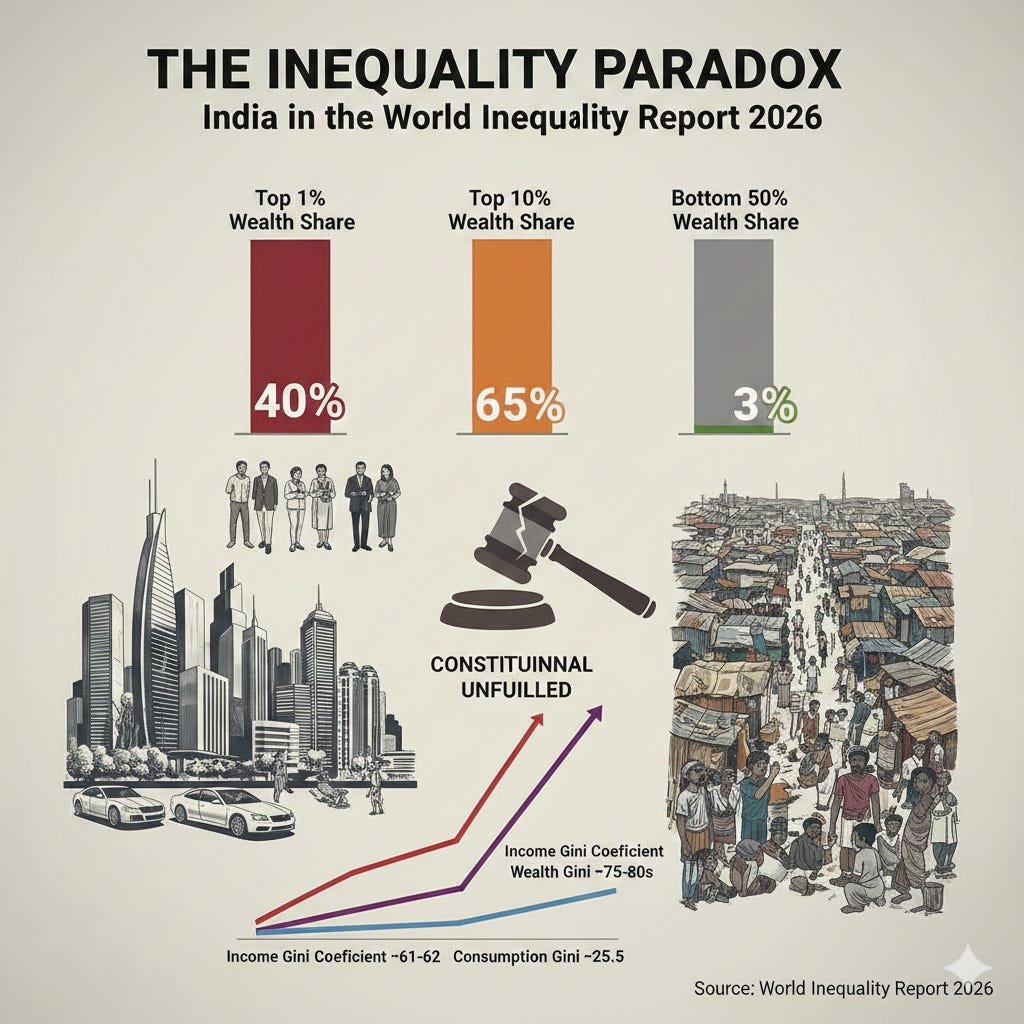
The World Inequality Report 2026, released on December 10, 2025 by the World Inequality Lab and edited by economists Lucas Chancel, Ricardo Gómez-Carrera, Rowaida Moshrif, and Thomas Piketty, identifies India as one of the most unequal economies in the world. The top 1 per cent of India’s population holds 40 per cent of the country’s total wealth. The richest 10 per cent hold approximately 65 per cent of total wealth and capture 58 per cent of national income. The bottom 50 per cent of the population receives 15 per cent of national income. CNBC
The income gap between the richest and poorest segments of Indian society has remained broadly stable at roughly 38 per cent between 2014 and 2024 — indicating that a decade of high-growth governance has not narrowed the structural divide. The report concludes that inequality in India is “deeply entrenched across income, wealth, and gender dimensions, highlighting persistent structural imbalances in the economy.”
One dimension that receives specific attention is female labour force participation, which stands at just 15.7 per cent in India — among the lowest for any major economy in the world, and a figure that has seen no meaningful improvement in the last decade. The report notes that women globally capture just 25 per cent of labour income, but India’s figure sits substantially below even that depressed global average.
The People Behind the Statistics: India’s Care Economy
Buried inside these aggregate figures is a specific category of worker who embodies the paradox most completely: the anganwadi worker. She typically wakes early, travels to her centre by 8 am, manages nutrition supplementation for children under six, tracks immunisation schedules, provides early childhood education, and maintains digital records on the Poshan Tracker app. She is, by the government’s own language in PIB communications, a “key partner in nation-building” and a “frontline functionary.” She is paid an honorarium, not a salary.
Community health workers including ASHA and anganwadi workers receive honoraria as low as ₹7,000 to ₹12,000 per month — a figure that often falls below the statutory minimum wage for unskilled labour in their respective states. They are classified as “honorary workers from the local community” under the Integrated Child Development Services scheme, a legal categorisation that excludes them from minimum wage protections, employee provident fund contributions, and the standard benefits framework available to formal sector government employees.
State-wise honorarium figures for 2025-26 show Rajasthan paying ₹10,000 to ₹11,000 per month for a full-time anganwadi worker and ₹5,000 to ₹5,500 for a helper. Delhi, following a revision, pays ₹11,220 for workers and ₹4,839 for helpers. Central government guidance has allowed states to move toward ₹13,500 per month in certain categories from late 2025 — a figure that remains below many state-level minimum wages for skilled workers, for a role that now includes digital reporting, educational delivery, and nutritional monitoring under expanded POSHAN responsibilities. Atlasinstitute
The legal and practical contradiction is not abstract. Workers and their unions have consistently pointed out that they perform essential, state-mandated functions — childcare, immunisation tracking, maternal health monitoring — that are classified as “part-time voluntary service” in official government categorisation, despite requiring daily full-time attendance at the centre. The demand for reclassification as formal civil service employees, with corresponding wage floors, has been raised through repeated strikes and court petitions and has not been met at the central government level as of March 2026. Seatrade Maritime
The Broader Workforce: Downward Mobility in a Growing Economy
The anganwadi worker’s situation is the sharpest illustration of a structural condition affecting the 85 per cent of India’s workforce employed in the informal sector. Income mobility data covering 2014 to 2025 shows that the share of Indian households experiencing downward mobility nearly doubled, jumping from 14 per cent in 2015 to 26.8 per cent in 2025. By the end of 2025, more than one in four Indian households was worse off than it had been in 2014. While upward mobility also increased — from 14.1 per cent to 23.5 per cent — it consistently trailed the rate of downward movement, meaning more families were sliding down the income ladder than were climbing it.
The breakdown by category is particularly revealing. Rural households were the most exposed: nearly 29 per cent of rural families slid down the income ladder relative to their 2014 position. The data also shows that downward mobility rose sharply among Other Backward Class and Scheduled Caste households specifically, with SC households experiencing “highly muted and uneven” upward mobility across the entire decade — contradicting claims of expanding economic opportunity for historically marginalised communities.
The report’s authors are explicit that this outcome is not inevitable. “Inequality is a political choice,” the World Inequality Report 2026 states. “It is the result of our policies, institutions, and governance structures.” For India specifically, the report identifies weak redistributive capacity and limited progressivity in taxation as contributing structural factors — noting that effective tax burdens on the very wealthy are often lower than those faced by middle-income households due to the structure of India’s capital income taxation.
The Silver Economy: A Crisis Being Marketed as an Opportunity
India’s demographic shift adds a further dimension to the care economy’s structural underinvestment. India’s transition to sub-replacement fertility creates an ageing population that will require significantly expanded eldercare infrastructure. Universal pension coverage for the unorganised sector and geriatric healthcare specialisation are identified as critical policy requirements for the coming decade, as the “silver economy” of eldercare services grows in commercial and social significance.
The government’s SAGE portal — a Ministry of Social Justice initiative promoting startups in the eldercare space — represents an attempt to channel commercial investment into a sector where public provision is inadequate. The limitation of that approach is visible in the inequality data: the commercial silver economy is accessible to families with discretionary income. For the estimated 54 per cent of elderly women who are widows without formal pension coverage, and for the broader informal sector workforce that has no retirement savings infrastructure, the silver economy’s commercial growth does not translate into support.
The Central Tension
The World Inequality Report 2026 opens with the observation from its lead author Ricardo Gómez-Carrera that inequality is “silent until it becomes scandalous.” India’s inequality numbers have been available for years. The downward mobility data has been accumulating for a decade. The anganwadi worker’s wage dispute has been running in the courts and on the streets for longer than many of the digital systems she now operates have existed.
What the convergence of the 2026 report, the mobility data, the care economy wage data, and the demographic projections describes is not an approaching crisis. It describes one that is already present, distributed unevenly enough that the aggregate GDP figure has been able to obscure it, and structural enough that no single policy intervention has dislodged it. The 7 per cent growth rate is real. So is the 26.8 per cent figure. Both are India, in 2026, at the same time.
All World Inequality Report 2026 statistics are sourced from the primary report released December 10, 2025, as reported by The Wire, Scroll.in, Deccan Herald, NewsGram, and Drishti IAS. Income mobility figures for 2014–2025 are sourced from Drishti IAS analysis published March 7, 2026. Anganwadi honorarium data is sourced from PIB (Ministry of Women and Child Development), the WhatIs.in state-wise salary analysis (November 2025), Outlook India’s anganwadi reporting, and Insights on India’s labour analysis (February 28, 2026). All figures represent the most recently available data as of March 10, 2026.


