
On the morning of March 8, 2026, Abhishek Sharma was a player whose tournament statistics would have justified dropping him. Three ducks in his first three matches. A bout of food poisoning that had disrupted his preparation mid-tournament. A total of 89 runs across seven innings before the final. The world’s number one ranked T20 batter — a distinction he had carried into the tournament — had produced almost none of the form that ranking implied.
Sunil Gavaskar, speaking before the final, had said aloud what many were thinking: that the time had come to replace him.
Gambhir disagreed. The team management stuck with the same playing XI, and Abhishek Sharma repaid their faith with the fastest half-century in any T20 World Cup knockout match in the history of the tournament.
The Innings: Sixteen Minutes That Changed Everything
New Zealand won the toss and chose to field at the Narendra Modi Stadium — a reasonable decision given the dew factor in Ahmedabad evening games, and an invitation that India, and Abhishek Sharma specifically, accepted with consequences the Black Caps had not fully modelled.
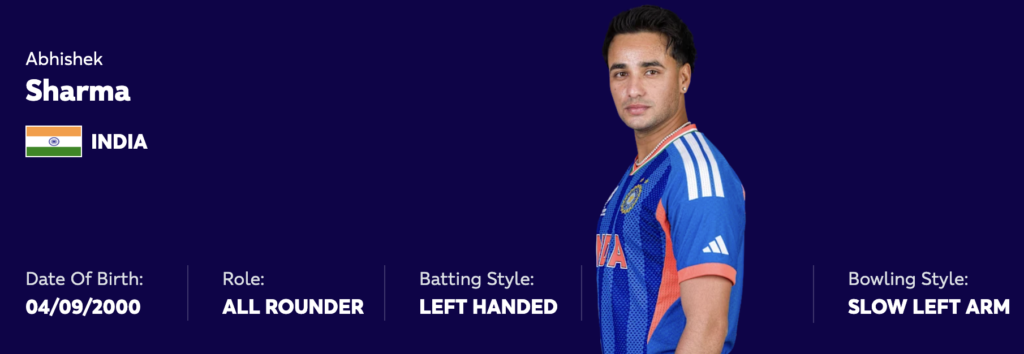
Abhishek started cautiously, taking a moment to settle before unleashing his firepower in the third over. He took down Jacob Duffy for two fours, then Lockie Ferguson for a four and six in the fourth over. After a six over long-off against Matt Henry, he returned to Duffy in the sixth over and hit three fours and a six to bring up his fifty off the fifth ball of the over. Business Standard
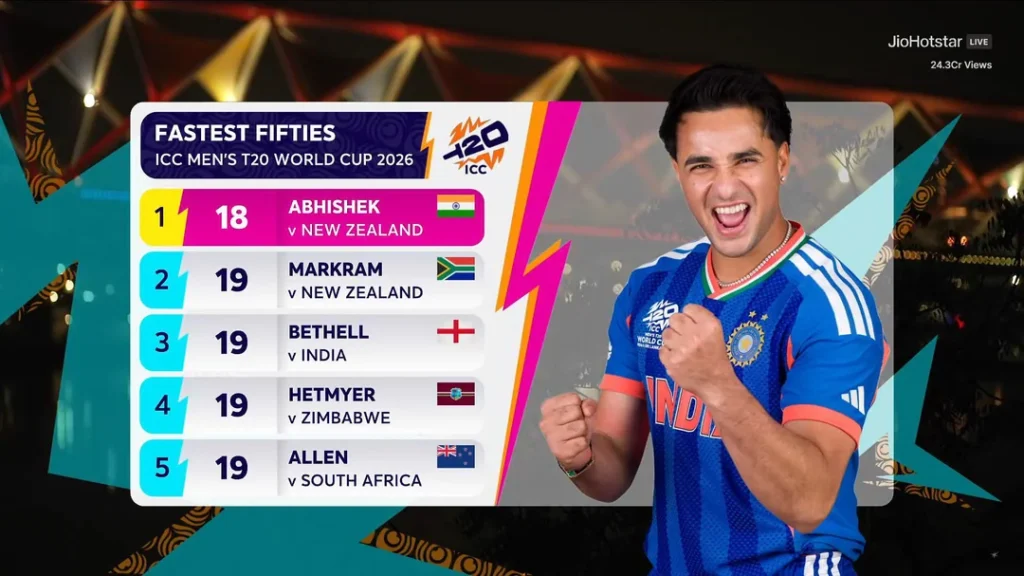
The fifty arrived in 18 balls. Jacob Duffy to Abhishek Sharma — four, and that is a half-century in a World Cup final. He had scored an 18-ball fifty, the fastest in the 2026 edition and the fastest by any batter in the knockout stage of any Men’s T20 World Cup. Business Standard
Abhishek’s 18-ball fifty was the joint-second fastest by an Indian batter in T20 World Cup history — equal to KL Rahul’s 18-ball fifty against Scotland in 2021 — and behind only Yuvraj Singh’s legendary 12-ball assault against England in 2007. He also went past Rohit Sharma’s 19-ball half-century against Australia in the 2024 edition. Business Standard
His dismissal, when it came at 21 balls and 52 runs, was almost its own small drama. Rachin Ravindra went full and wide outside off stump, a delivery that was a wide if Abhishek did not chase it. He did — chasing it hard off a wide line — and edged it to Tim Seifert behind the stumps. It was the one ball across his 22-delivery stay that his judgment deserted him. Swastika
By then, it did not matter. The 98-run opening stand between Abhishek and Sanju Samson was the first half-century partnership by an opening pair in the history of the T20 World Cup final. India had reached 92 for no loss at the end of the powerplay — the highest powerplay score in T20 World Cup history. ScanX
What the Statistics Obscure
The final line — 52 off 21, strike rate 247.62 — is clean and unambiguous. The context behind it requires more careful reading.
Abhishek Sharma had entered the tournament as the world’s number one ranked T20 batter. He started with three consecutive ducks and battled through a period of food poisoning that disrupted his rhythm and preparation. Across seven innings before the final, he had managed just 89 runs. NewsX In any other sport, that sequence would produce a change. In Indian cricket, where the gap between peer-level performers jostling for an XI spot is narrow and where form cycles in high-pressure tournaments can be brutally compressed, it produces calls for the player to be removed.
The calls came. Former India captain Sunil Gavaskar publicly suggested that Gambhir should consider dropping Abhishek and bringing Rinku Singh into the playing XI in his place. The sentiment was widely shared. The team management’s decision to hold firm was not universally welcomed at the time.
Abhishek finished the tournament with 141 runs from eight innings at an average of 17.62 and a strike rate of 158.42, with two fifties. NewsX The average and the total are modest. The strike rate and the timing of his two meaningful contributions — a fifty against Zimbabwe in the Super 8s, and then the record-breaking 52 in the final — tell a different story. He performed when India needed a platform, and he produced a platform unlike any that had been built in a T20 World Cup final before.
The Quote That Said Everything
Abhishek’s post-match reflection, characteristically brief, was: “The team wanted me to play and score.” NewsX
Six words. No reference to personal pressure, to Gavaskar’s comments, to the ducks, to the food poisoning, to the weeks of public scrutiny. The team wanted him to play and score. He played and scored. That is, in the framing of a 25-year-old who has absorbed Gambhir’s “milestones don’t matter” doctrine, the complete account.
The Mentor Who Watched From Outside
Yuvraj Singh — Abhishek’s mentor and one of the architects of India’s 2007 and 2011 World Cup victories — posted a reaction on Instagram after the knock that read: “Let the bat do the talking.” The words, accompanied by a screenshot of Abhishek’s batting in the powerplay, conveyed everything a mentor could communicate about the moment.
Sachin Tendulkar, Harbhajan Singh, and Irfan Pathan were among the former India players who publicly praised Abhishek’s knock, commending his fearless approach and the timing of his aggression on the biggest stage.
The Yuvraj connection runs deeper than Instagram posts. Yuvraj is the holder of the record that Abhishek nudged closer to on Sunday — a 12-ball fifty against England in 2007 that remains the fastest half-century in T20 World Cup history. For Abhishek’s 18-ball effort to be placed in the same conversation is a measure of how far he has come, and how much remains ahead of him.
India’s Powerplay: A Collective Record
The context of Abhishek’s innings extended beyond his individual performance. India became the first team in the history of any ICC limited-overs tournament to hit 100 sixes, ending the final with 106 — surpassing South Africa’s previous record of 99, set at the 2023 ODI World Cup. Abhishek’s three sixes in his 21 balls were a small but meaningful contribution to that aggregate.
The top three batters — Abhishek, Sanju Samson, and Ishan Kishan — all scored half-centuries in the final, the first time any team’s top three had each registered fifties in a knockout in T20 World Cup history.
What the Gambhir Decision Means
The decision to retain Abhishek Sharma through three ducks, food poisoning, and public criticism from a figure of Gavaskar’s stature is not simply a vindicated selection. It is a statement about the philosophy that now governs India’s team management.
Gambhir’s repeated insistence — in press conferences, in framing of team goals, in selection decisions — that India will back players who play without fear, even when the results do not immediately follow, produced a specific outcome on Sunday: a 25-year-old who had been asked whether he belonged in the XI answered the question in 21 balls at a strike rate of 247.62 in a World Cup final.
The critics who said he should have been dropped were not obviously wrong based on the evidence available to them before the final. What Gambhir understood, and what India’s retention of Abhishek ultimately demonstrated, is that form within a short tournament is a partial indicator of a player’s capability — and that a player ranked number one in the world does not lose that ability across three bad innings. Sometimes the ability is still there. It simply needs the occasion large enough to summon it.
Sunday in Ahmedabad was that occasion.
All statistics in this article are sourced from ESPNcricinfo (Tier 1), ANI/The Tribune (Tier 1 wire service), Asianet Newsable, Republic World, Crictoday, and Sportskeeda, based on data from the ICC Men’s T20 World Cup 2026 Final played on March 8, 2026. Yuvraj Singh’s Instagram post is reported via Sportskeeda with screenshot attribution. Sunil Gavaskar’s suggestion to drop Abhishek Sharma is sourced from Asianet Newsable. Abhishek Sharma’s post-match quote is sourced from ANI/The Tribune. All records are subject to official ICC ratification.


