
When Sanju Samson walked to the presentation stage at the Narendra Modi Stadium on Sunday night, Player of the Tournament trophy in hand, 35 years old and more than a decade into an international career that had spent most of its time on the edge of the conversation rather than at its centre, the applause from 86,000 people in Ahmedabad carried a particular weight. It was not merely the recognition of a great tournament. It was the recognition of what it had cost to get there.
In the 2024 T20 World Cup in the West Indies, Samson was part of the squad but spent the entire tournament on the bench. He returned to India a champion who had not faced a single ball. In January 2026, playing at home against New Zealand, he managed just 46 runs across five T20I innings before being dropped from the playing XI in favour of Ishan Kishan. Business Standard For a player who had been “talented but inconsistent” for so long that the phrase had become a label rather than an observation, those five innings felt like a closing door.
He had said it himself, with characteristic directness. In the tournament’s aftermath, Samson revealed that after the New Zealand series he felt as if his dream was over — that the window he had worked toward for years had shut before he could properly open it. Business Standard
It had not.
The Return: From Bench to Knockout Hero
Samson returned to the XI during the tournament — recalled due to Rinku Singh’s family tragedy and a tactical requirement for a right-handed batter at the top of the order — having initially played second-fiddle with scores of 22 off 8 balls against Namibia and 24 off 15 against Zimbabwe in the group stage and Super 8 matches. Business Standard Neither innings suggested what was coming.
What came was three consecutive half-centuries in three consecutive knockout matches — each one larger in context than the last.
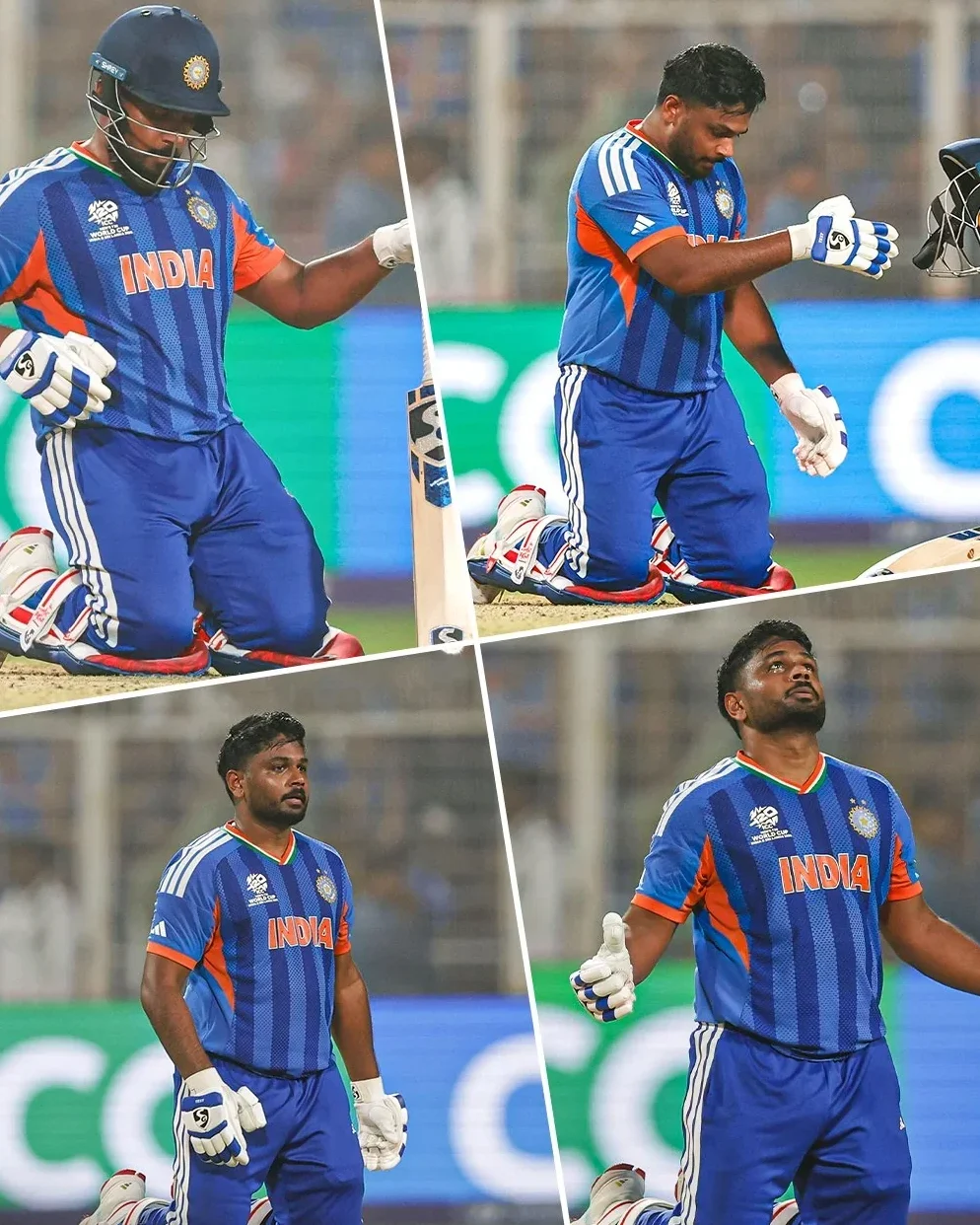
First came an unbeaten 97 against the West Indies in the virtual quarter-final, a do-or-die Super 8 match that India had to win to stay in the tournament. Then 89 against England in the semi-final at the Wankhede Stadium in Mumbai, a knock that laid the foundation of India’s 253 for 7 and a seven-run victory. Then 89 again against New Zealand in the final, his 46-ball innings forming the spine of India’s record 255 for 5.
Three knockout matches. Three times when the margin for error was zero. Three times Samson delivered. He is now one of only three batters in history to score half-centuries in both the semi-final and final of a Men’s T20 World Cup, joining Shahid Afridi, who achieved the feat in 2009, and Virat Kohli, who achieved it in 2014.
The Statistics That Define a Masterclass
Samson finished the tournament with 321 runs from five innings at an average of 80.25 and a strike rate of 199.37, with 27 fours and 24 sixes — the most sixes hit by any batter in the 2026 tournament. He was the third-highest run-scorer in the tournament overall.
In doing so, he surpassed Virat Kohli’s tally of 319 runs in the 2014 T20 World Cup to become the Indian batter with the most runs in a single edition of the tournament. Pakistan’s Sahibzada Farhan finished as the tournament’s leading run-getter with 383 runs at an average of 76.60 and a strike rate of 160.25, having contributed two centuries and two fifties across his team’s campaign.
Samson also joined Sri Lankan legend Mahela Jayawardene, Babar Azam, Virat Kohli, KL Rahul, Kusal Mendis, and Sahibzada as the only batters to score three successive half-centuries in T20 World Cup matches — a list that reflects the company this tournament has placed him in.
His 89 in the final carries its own individual record. It is the highest individual score in a T20 World Cup final, surpassing Marlon Samuels’ unbeaten 85 against England in 2016 and Kane Williamson’s 85 against Australia in 2021. It is also the highest score by an Indian batter in any T20 World Cup knockout match.
With the Player of the Tournament award, Samson became only the third Indian cricketer to receive the honour in the history of the T20 World Cup, joining Virat Kohli and Jasprit Bumrah.
The Sachin Connection
Samson’s own account of how he arrived at Sunday’s performance reaches beyond the batting crease. He spoke after the final about the 2024 World Cup experience in Barbados as a source of fuel rather than defeat: “This entire process started one-two years before. When I was with the 2024 World Cup-winning team in the West Indies, I couldn’t get a game. But I kept on dreaming, kept on visualising, kept on working. This is exactly what I wanted to do then.” Business Standard
In those months of doubt and the work that followed, he had found a mentor in Sachin Tendulkar. “I’ve been in constant touch with Sachin sir,” Samson said at the trophy ceremony. “When I was sitting outside in Australia, I wasn’t playing a game. I thought about what mindset is required. I reached out to sir and had huge conversations with him. Even yesterday night, he called me up to check how I am feeling.” Business Standard
What the call contained — what was said, what was given — was left to the imagination of everyone who heard him describe it. What Samson communicated was the thing that mattered: that someone who had navigated these same pressures for 24 years at the highest level had chosen to pick up the phone the night before a World Cup final, and that the gesture had been enough.
On receiving the award, Samson’s first words were: “Feels like a dream, actually. Very, very happy, very grateful. Out of words, out of emotions. I’m just going through it, so it feels a bit surreal.” Business Standard
What Kohli Said
The reaction of the man whose Indian record Samson had just surpassed was immediate and unstinting. Virat Kohli took to Instagram within hours of India’s victory, posting a story that read: “What a remarkable tournament from the most well-deserved Man of the Tournament @imsanjusamson. You performed when it mattered the most. Really happy for you, Chetta.”
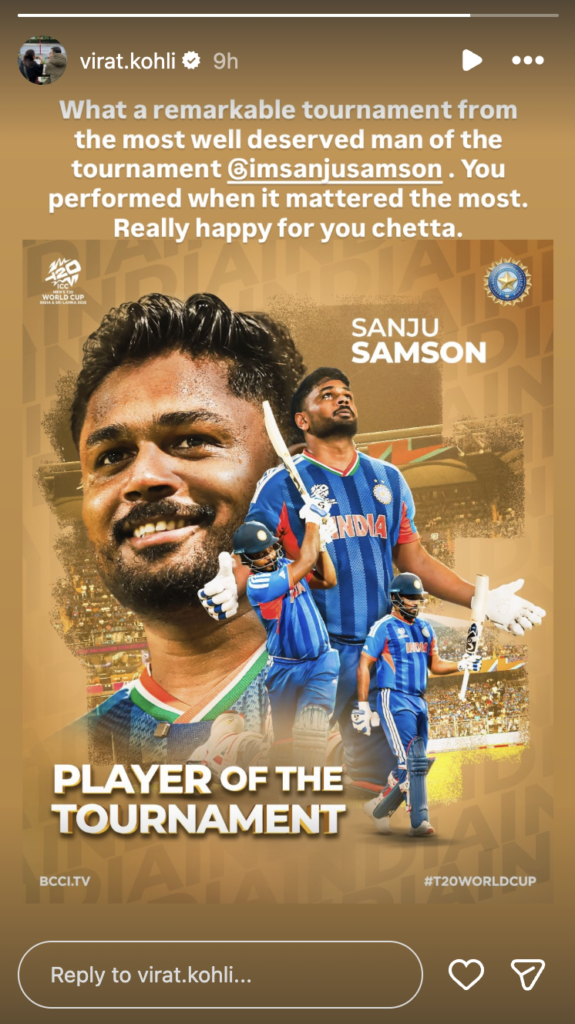
The word “Chetta” — an honorific in Malayalam meaning elder brother, commonly used as a term of affection in Kerala — is not a word that appears in Kohli’s usual vocabulary. Its use reflected something about how the dressing room had come to regard this particular player: with warmth, with respect, and with recognition that what Samson had done was not simply valuable to the team’s trophy count but to the idea that patience and persistence are not consolation prizes.
Captain Suryakumar Yadav, reflecting on his decision to back Samson through the difficult early matches of the tournament, said: “I think it’s really important to understand what they are capable of. And I knew they had the match winners in them. The timing was perfect. Sanju Samson, Abhishek Sharma — they are top players, and we knew they would do something special, and they did it in the final.”
What the Numbers Cannot Fully Capture
Statistics in cricket are always partial. They do not record the innings that were never played, the opportunities that were delayed, the years in which a player was considered at the margin of selection rather than at its centre. They do not record the five innings in January against New Zealand, or the nights in Barbados in 2024, or the “big conversations” with Sachin Tendulkar about mindset and what it takes to hold your nerve when everything is at stake.
What the record books will show, permanently, is that in the 11th Men’s T20 World Cup, played in India in 2026, the Player of the Tournament was a wicket-keeper batter from Kerala who made his three most important scores in the three most important matches of his career, at a strike rate that the game had rarely seen in contexts of that weight, and who did so after a period of difficulty that many observers had read as the end of his story rather than its turning point.
It was not the end. It was, by any reading, the beginning of the chapter that will be remembered longest.
All statistics in this article are sourced from ANI (citing ICC data), The Tribune, Asianet Newsable, and ProKerala. Virat Kohli’s Instagram post (March 9, 2026) and confirmed by multiple wire services including IANS. Sanju Samson’s direct quotes are drawn from post-match transcripts published by ESPNcricinfo and ANI following the ICC Men’s T20 World Cup 2026 Final.


