
There have been great nights at the Narendra Modi Stadium. There have been great nights in Indian cricket. But on Sunday, March 8, 2026, those two things coincided in a manner that will be recalled for as long as the game is played.
India became the first team to defend their T20 World Cup title, the first to triumph at a home championship, and the first to win three T20 World Cup crowns — all in the same evening, in a 96-run demolition of New Zealand that was as dominant as any result in the tournament’s 19-year history. Business Standard
The statistics that accumulated between Suryakumar Yadav walking out to the toss and Tilak Varma completing the catch that ended New Zealand’s innings in the 19th over are not merely impressive. They are structural — they redefine what is possible in the format India now indisputably owns.
India’s Third Title: Sole Ownership of the Summit
India became the first team in the history of the ICC Men’s T20 World Cup to win three titles, claiming sole custody of the record for the most successful team in the tournament’s history and surpassing two-time champions West Indies and England.
England’s titles came in 2010 and 2022. West Indies won in 2012 and 2016. India won the inaugural edition in 2007, then waited 17 years for the second in 2024 before defending it two years later — a sequence that no strategist at the 2007 inaugural edition in South Africa could have mapped out.
The symmetry matters. The 2007 title, won in South Africa under MS Dhoni with a team built around improvisation and instinct, defined an era. The 2024 title, won in the West Indies with a team that included players who had waited years for their opportunity, carried a different weight. This title — won at home, in the world’s largest cricket stadium, in front of 86,000 people who had watched India lose a 50-over World Cup final at the same venue less than three years earlier — carries the weight of all three.
The Score That Redefined What a Final Could Look Like
India’s 255 for 5 is the highest total ever recorded in a T20 World Cup final. No team had made a 200-plus total in a final previously. Their previous record in a final had been 176 for 7 in 2024. The jump from 176 to 255 is not incremental improvement. It is a categorical shift in the ceiling of T20 batting at the highest level.
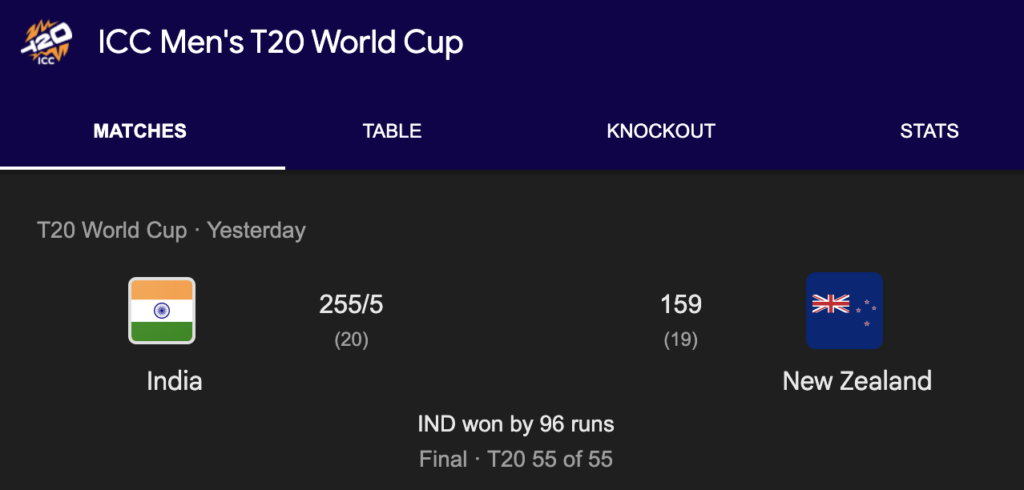
The 255 for 5 is also the highest total by any team in a T20 World Cup knockout match. India’s own 253 for 7 against England in the semi-final, played just days earlier, had been the previous highest. India posted the two highest scores in the history of T20 World Cup knockouts — in consecutive matches.
Sunday was also India’s seventh time crossing the 250-run mark in T20 Internationals — the most by any team in the format — and their fourth such total in the calendar year 2026, also the most by any team in a single year.
The Winning Margin: A Record That Stood for 14 Years
India’s 96-run victory is the largest margin of victory by runs in a T20 World Cup final, surpassing the West Indies’ 36-run win over Sri Lanka in 2012 — a record that had stood for 14 years. The previous record was not simply broken; it was more than doubled. That arithmetic speaks not to a close shave but to a team operating so far above the standards of the occasion that the contest was effectively settled by the midpoint of New Zealand’s chase.
The Opening Stand That History Will Record
The platform for that total was laid before New Zealand’s bowlers had found their footing. The 98-run opening partnership between Abhishek Sharma and Sanju Samson is the highest by an opening pair in a T20 World Cup final, bettering the previous highest of 48 runs — between Kamran Akmal and Shahzaib Hasan against Sri Lanka in 2009 — by exactly 50 runs.
India raced to 92 for 0 in the first six overs — the joint-highest powerplay score in T20 World Cup history, equalling West Indies’ 92 for 1 against Afghanistan in 2024. Swastika The difference was that India’s 92 came with all ten wickets intact. New Zealand had no foothold from which to devise a containing strategy.
Within that powerplay, Abhishek Sharma reached his half-century off just 18 balls — the fastest by any batter in a T20 World Cup knockout match. He is only the seventh batter to score a fifty inside the powerplay in Men’s T20 World Cups, and the only one to have done so four times in T20 Internationals — a record unto itself.
Sanju Samson: The Highest Score in a Final, Three Times Running
Samson’s 89 off 46 balls, which included eight sixes — the most maximums by any batter in a T20 World Cup final Business Standard — is not only the centrepiece of India’s innings. His 89 is the highest individual score ever made in a T20 World Cup final, surpassing the unbeaten 85 that Marlon Samuels made against England in 2016 and the 85 that Kane Williamson scored against Australia in 2021.
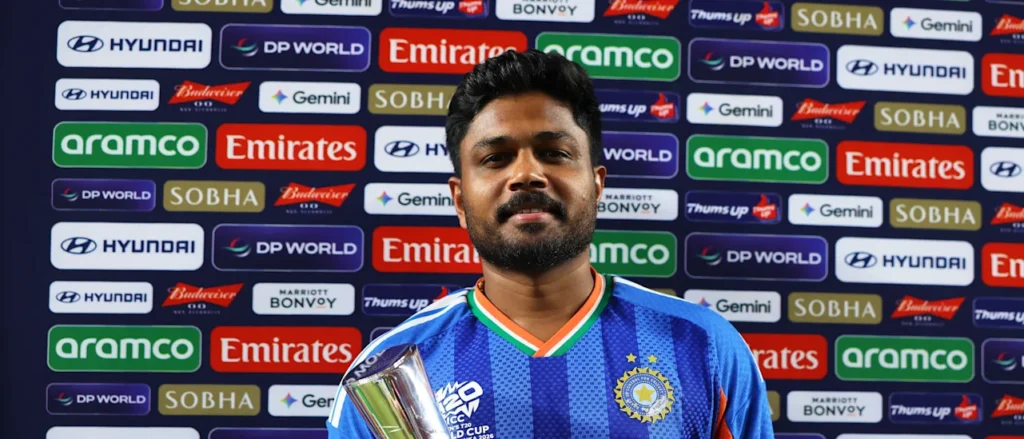
That record is made more remarkable by its context. Samson scored 80-plus in three consecutive knockout matches — 97 not out against West Indies in the Super 8s, 89 against England in the semi-final, and 89 against New Zealand in the final. He is only the third batter in history to score fifties in both the semi-final and final of a Men’s T20 World Cup, following Shahid Afridi in 2009 and Virat Kohli in 2014.
Captain Suryakumar Yadav, speaking about his team’s tournament innings, said: “When you work hard, try to be happy in others’ happiness, God gives you opportunities. This is a learning for the whole nation — that when you stay quiet and work hard, God gives you opportunities. I’m really proud of them.”
The ‘them’ in that sentence includes a wicket-keeper batter who sat out the 2024 World Cup entirely, who spoke openly of feeling his dreams had shattered after a difficult series in 2025, and who found his way back not through a change in technique but through conversations with Sachin Tendulkar and a capacity for the kind of quiet, unglamorous work that most people never see.
Bumrah: Four Wickets, Two Records, One Definitive Spell
Jasprit Bumrah’s 4 for 15 in four overs was his maiden four-wicket haul in T20 Internationals. He is only the second bowler to take a four-wicket haul in a Men’s T20 World Cup final — the first was Sri Lanka’s Ajantha Mendis, who took 4 for 12 against West Indies in 2012.
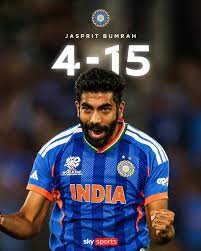
The wickets he took — Rachin Ravindra, Mitchell Santner, James Neesham, and Matt Henry — were not tail-end consolation scalps. They arrived in the middle overs and at the death, precisely when New Zealand needed partnerships to mount even a face-saving response. Each wicket was a structural blow to what remained of New Zealand’s mathematical chance.
Bumrah’s economy rate of 3.75 across his four-over spell in the final meant he conceded fewer runs per over on the night than the run rate New Zealand required to win. In the context of a 256-run chase, that economy was not caution — it was execution under pressure of the highest order.
The Symmetry of Venue
India exorcised the demons of 2023 at the very ground where those demons were created. The Narendra Modi Stadium in Ahmedabad hosted India’s 2023 ODI World Cup final defeat to Australia — and on Sunday, the same ground, the same 86,000-capacity structure, provided the setting for India’s most complete performance in a World Cup final.
Bumrah had spoken before the tournament about carrying the weight of that 2023 defeat. Samson had spoken about visualising this moment during the long nights when he was not in the playing XI. Gambhir had built his coaching philosophy around a principle he refused to abandon even after India lost to South Africa in the group stage. Every thread of the narrative pointed to this night — and every record that fell confirmed that what happened in Ahmedabad on March 8, 2026 was not fortune. It was design.
India have not merely won a third T20 World Cup. They have done so with records that will take years, perhaps decades, to dismantle — and with a team whose story, as ESPNcricinfo noted in its live commentary, qualifies them as “one of the greatest T20 sides ever to have lifted the World Cup.”
All statistics cited in this article are sourced from ESPNcricinfo, the official ICC website (icc-cricket.com), The Daily Star, Olympics.com, and Heavy.com, based on match data from the ICC Men’s T20 World Cup 2026 Final played on March 8, 2026 at Narendra Modi Stadium, Ahmedabad. Records are as reported immediately following the conclusion of the match and are subject to official ICC ratification.


