
India sealed an unprecedented third ICC Men’s T20 World Cup title on Sunday, crushing New Zealand by 96 runs at the Narendra Modi Stadium in Ahmedabad to write a new chapter in the history of the shortest international format.
India became the first team to successfully defend their T20 World Cup title, the first to triumph at a home championship, and the first to win three T20 World Cup crowns, while New Zealand suffered their fifth straight defeat in 11 years in the final of an ICC white-ball world event. Business Standard
India 255 for 5 beat New Zealand 159 all out in 19 overs by 96 runs, with Sanju Samson starring with 89 off 46 balls, Ishan Kishan contributing 54 off 25, and Abhishek Sharma smashing 52 off 21 as the platform was set for an enormous total. In response, Jasprit Bumrah’s figures of 4 for 15 and Axar Patel’s 3 for 27 ensured New Zealand never threatened the 256-run target.
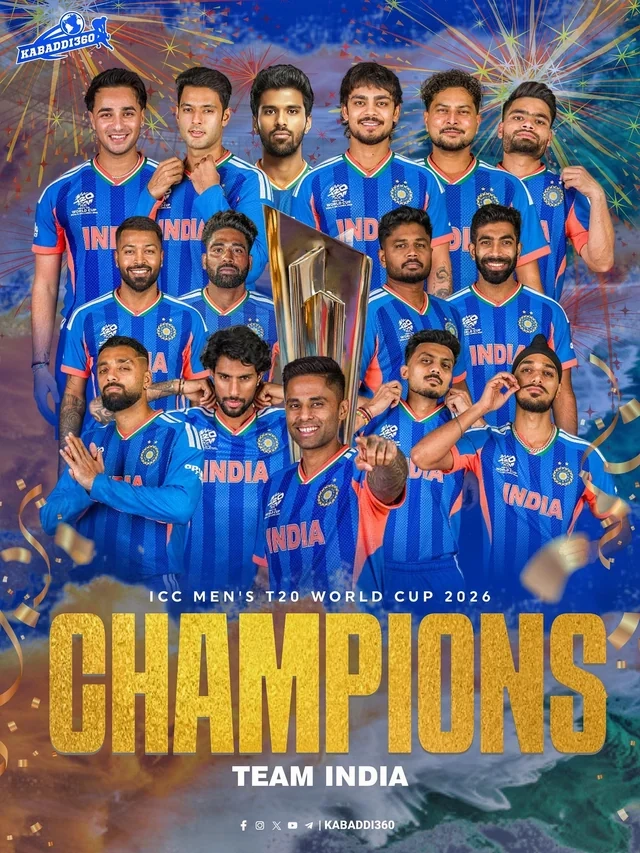
The victory exorcised memories of Ahmedabad’s most painful day in Indian cricket. It was at this same Narendra Modi Stadium that India had lost the 2023 ODI World Cup final to Australia, and India’s players were well aware of that history entering Sunday’s match. By the time Tilak Varma settled under a catch at long-on to dismiss New Zealand’s last wicket with an over to spare, the ghosts of that occasion had been firmly put to rest.
The Innings That Set the Stage
New Zealand’s decision to field after winning the toss — predictable given the ground’s heavy dew factor in evening games — handed India the chance to bat first, and the hosts wasted no time in demonstrating why they had been pre-tournament favourites.
Openers Abhishek Sharma and Sanju Samson raced to 92 for 0 in the first six overs — the joint-highest powerplay score in T20 World Cup history — with Abhishek racing to his fifty in just 18 balls, the quickest half-century by any player in the 2026 tournament. His blazing knock featured six fours and three sixes before Rachin Ravindra ended his innings in the eighth over. Samson and Ishan Kishan then added a century stand to take India past the 200-run mark in the 16th over, before James Neesham turned the tide with a devastating over that removed Samson, Kishan, and Suryakumar Yadav in quick succession, reducing India from 203 for 1 to 204 for 4. NewsX
The collapse threatened to limit India to a sub-par total. Shivam Dube rescued the innings in spectacular fashion, striking three fours and two sixes in the final over against Neesham to plunder 24 runs and take India past 250, finishing on 255 for 5 — the highest total in T20 World Cup final history. NewsX
In the chase, New Zealand’s innings unravelled against India’s bowlers with quiet efficiency. Axar Patel and Bumrah reduced the Black Caps to 72 for 5 before a brief 52-run partnership between captain Mitchell Santner (43 off 35 balls) and Daryl Mitchell offered a semblance of resistance. Once that stand was broken, New Zealand were bundled out for 159 in 19 overs. Federal Bank
Sanju Samson: From Benched in 2024 to Player of the Tournament in 2026
The award ceremony yielded one of the tournament’s most emotionally resonant moments when Sanju Samson stepped forward to collect the Player of the Tournament award, completing a redemption arc two years in the making.
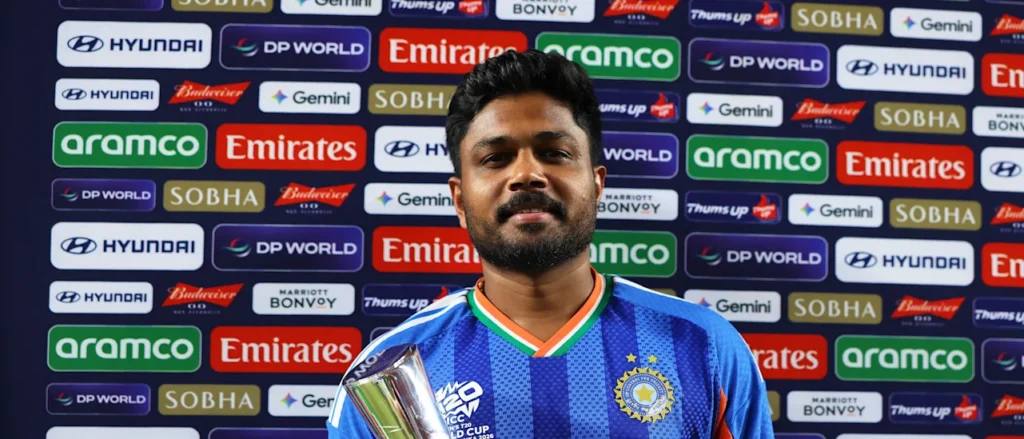
Samson felt his “dreams had shattered” after a poor T20I series against New Zealand just prior to the 2026 T20 World Cup, but conversations over the past two months with Sachin Tendulkar reassured him that a turnaround wasn’t far away. “To be honest, there has been a lot of guidance and suggestions from senior players,” he said. “A lot of former players have reached out to me and tried to help me out.” Business Standard
He credited his resurgence in significant part to Tendulkar: “I’ve been in constant touch with Sachin sir. When I was sitting outside in Australia, I wasn’t playing a game. I thought about what mindset is required. I reached out to sir and had huge conversations with him. Even yesterday night, he called me up to check how I am feeling.”
The journey that made those conversations possible began at the 2024 World Cup in the Caribbean, where Samson was part of the squad but never made it onto the field. Speaking at the trophy ceremony, he described how his recovery began in that silence: “This entire process started one-two years before. When I was with the 2024 World Cup-winning team in the West Indies, I couldn’t get a game. But I kept on dreaming, kept on visualising, kept on working. This is exactly what I wanted to do then.”
Samson finished as the leading run-scorer for India with 321 runs from five innings at an average of 80.25 and a strike rate of 199.37, producing decisive half-centuries in three consecutive knockout matches — against the West Indies, England, and New Zealand — when the tournament demanded India’s best. The award panel’s decision required no deliberation.
Gambhir’s Doctrine: High Risk, High Reward
The man in the coaching box offered the post-match press conference’s sharpest analysis of what India have become under his watch.
Coach Gautam Gambhir was categorical about the philosophy that drove two successive title wins: “The most important thing in the T20 format is that we didn’t want to be afraid of losing. Because if you are afraid of losing, you never win. I always believe that ‘high risk, high reward’ is a very important thing in this format. I would have been happier if we had been out at 110-120. But our target is always to make 250 runs. We did not want to play 160-170 cricket. I think for too long we played 160-170 cricket.”
The philosophy was tested early in the tournament. India lost to South Africa by a large margin — but Gambhir said that defeat changed nothing: “We lost to South Africa. But that ideology never changed. That mindset never changed. We never thought that we should play a little subdued. Obviously, if the captain and the coach are not on the same page, it can never be possible. The captain himself wanted to play ‘high risk, high reward’ cricket. And I think the credit needs to go to the captain as well.”
The result of that unwavering commitment was visible in the numbers: India posted totals of 255 for 5 in the final and 253 for 7 in the semi-final against England — two of the highest scores ever assembled at a T20 World Cup.
Gambhir became the first person in the history of the sport to win a Men’s T20 World Cup as both a player in 2007 and a head coach in 2026. He framed his own success in terms of the foundations others had built before him, dedicating the trophy to his predecessor.
His words after the final were generous in attribution: “I think first of all I should dedicate this trophy to Rahul Dravid bhai, and then to VVS Laxman bhai, because what Rahul bhai has done to keep Indian cricket in such good shape during his tenure, I have to thank him for everything. And then VVS Laxman for unconditionally doing so much for Indian cricket behind the doors, because the CoE remains the pipeline for Indian cricket. And third is obviously Ajit Agarkar.” He added that ICC Chairman Jay Shah had been “the only person who called me when I went through the lowest moments — whether it was after New Zealand, whether it was after South Africa.”
Bumrah: The Records That Define a Career
In the moment that settled the final, it was Jasprit Bumrah who delivered the unanswerable spell. Returning to bowl in the middle overs and the death, Bumrah dismissed Rachin Ravindra, Mitchell Santner, James Neesham, and Matt Henry to finish with 4 for 15 in four overs — becoming the first pacer in the history of the T20 World Cup to take a four-wicket haul in a knockout match.

By the end of the tournament, Bumrah had accumulated 14 wickets to finish as the joint-highest wicket-taker alongside Varun Chakravarthy. His career tally in the T20 World Cup now stands at 40 wickets across 26 matches at an average of 13.65 and an economy rate of 5.66 — figures that confirm his standing as the most successful pace bowler in the tournament’s history, surpassing Sri Lanka’s Lasith Malinga, who took 38 wickets in 31 matches. He is also India’s all-time leading wicket-taker in T20 World Cup cricket, having gone past Arshdeep Singh’s tally of 36.
Bumrah himself reflected on the weight of the venue: he had spoken before this tournament about the pain of 2023’s ODI World Cup final loss at the same ground in Ahmedabad. Sunday’s performance — in front of 86,000 fans singing Vande Mataram as the last wicket fell — was the answer he had been carrying for over two years.
Captain Suryakumar Yadav, who made no runs in the final but led his team with distinction through the campaign, paid tribute to his bowler. Suryakumar described Bumrah as a “national treasure,” words that prompted immediate and widespread agreement across Indian cricket’s vast following.
What Comes Next: IPL and the Road Ahead
With the T20 World Cup over, the Indian Premier League is set to begin on March 28, 2026, and run through May 31. Royal Challengers Bengaluru — the 2025 IPL champions — will enter as defending title-holders, with the opening match expected at the M. Chinnaswamy Stadium in Bengaluru. India’s T20 World Cup players will return to their franchises having just demonstrated that the IPL’s relentless production of attacking, fearless cricketers is no longer an aesthetic preference but a winning philosophy.
For Indian cricket, the broader context of this victory is unprecedented. No team has defended a T20 World Cup. No host nation had won the tournament at home. Both records fell on Sunday in Ahmedabad, in the same stadium that once hosted India’s heaviest defeat. That arithmetic is what sporting redemption looks like.
Match details, scorecards, and statistics in this article are sourced from ESPNcricinfo, the official ICC website (icc-cricket.com), and ANI. Player quotes are drawn from post-match transcripts published by ICC, ESPNcricinfo, and Outlook India. All wicket and career records are as reported immediately after the conclusion of the ICC Men’s T20 World Cup 2026 Final on March 8, 2026, and are subject to official ICC confirmation.


