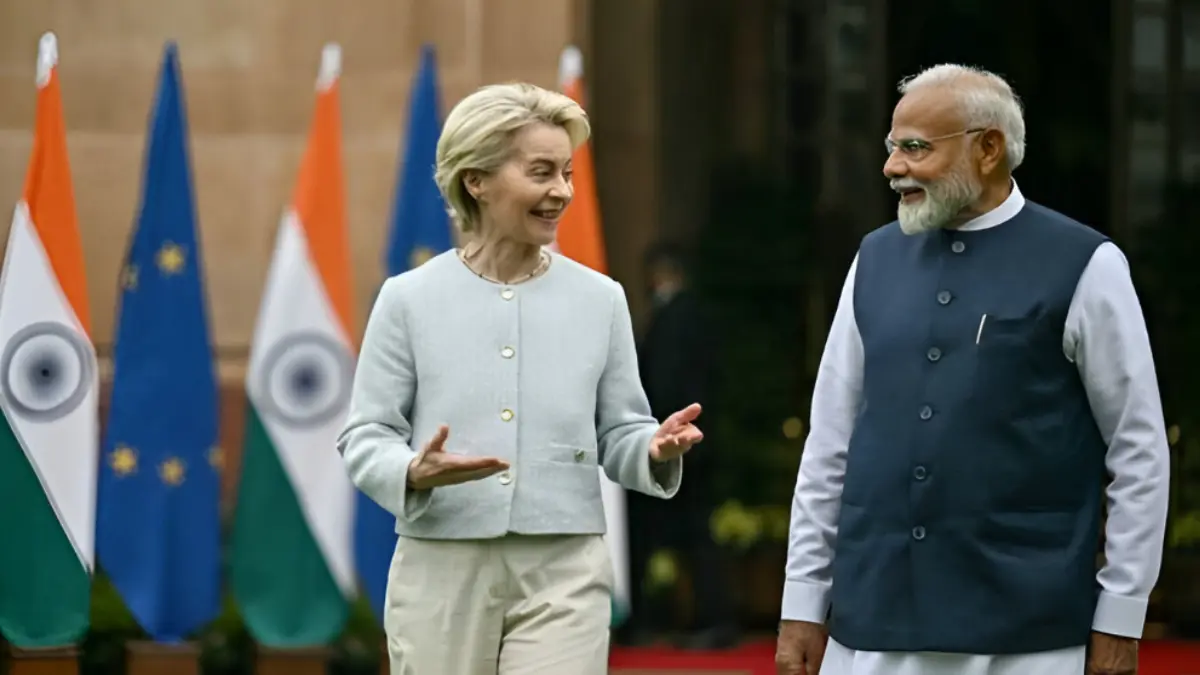


Ursula von der Leyen just announced Europe found its economic escape route from American chaos. It runs through New Delhi.
The European Commission President declared at Davos on Monday that the EU and India stand ready to finalize a “historic trade agreement” creating a unified market for 2 billion people representing nearly a quarter of global GDP. She dubbed it the “mother of all deals” and confirmed she’ll visit India January 25-27 alongside European Council President Antonio Costa to seal the pact.
The timing couldn’t be more pointed. Von der Leyen’s announcement came as Donald Trump threatened tariffs on eight European nations and froze EU-US trade negotiations over Greenland demands. India faces 50% American duties on its exports since August 2025. Both sides are racing toward each other while Washington pushes them away.
“This is about securing first mover advantage in one of the world’s fastest growing markets,” von der Leyen told the World Economic Forum audience. “While others create uncertainty, we’re creating opportunity.”
Negotiations relaunched in 2022 after stalling between 2007 and 2013 have advanced to 20 of 24 chapters agreed, according to Indian Commerce Secretary Rajesh Agarwal. That represents roughly 70% completion on a comprehensive free trade agreement covering goods, services, investment, and regulatory cooperation.
The potential Republic Day signing carries symbolic weight. January 26 marks India’s constitution adoption and hosts military parades attended by foreign dignitaries. Von der Leyen and Costa arriving as honored guests for the 16th EU-India Summit signals the strategic partnership’s elevation.
Indian Commerce Minister Piyush Goyal echoed readiness for closure. “We’re prepared to finalize this agreement during the European leaders’ visit,” he told reporters Tuesday. “The remaining issues are technical, not fundamental.”
The deal opens European markets to Indian textiles, footwear, gems, and jewelry—labor-intensive sectors employing millions. India gains access for its pharmaceutical and IT services exports while reducing tariff barriers that currently cost exporters billions annually.
Europe secures market access for automobiles, machinery, wine, and spirits in an economy projected to become the world’s third largest within years. The agreement diversifies European trade away from overdependence on China and volatile American policy shifts.
YouTube clips of von der Leyen’s announcement accumulated over 100,000 views across channels like DNA India, PTI News, and Business Standard within 24 hours. Her “mother of all deals” phrase trended on social media alongside #EUIndiaFTA hashtags.
The EU’s official India account posted video excerpts on X that generated thousands of likes and shares. Comments praised the timing as strategic masterstroke amid Trump’s transatlantic tensions. Indian business media covered the announcement extensively, contrasting European partnership with American confrontation.
LinkedIn discussions among trade professionals focused on specific sector opportunities. Textile manufacturers expressed optimism about European market access without the compliance burdens of American regulations. European automotive executives welcomed India’s growing middle class as customer base.
The numbers tell the story von der Leyen emphasized. Combined EU-India GDP exceeds $25 trillion. The population approaches 2 billion consumers. Bilateral trade currently runs around $120 billion annually but both sides project doubling within a decade under free trade terms.
India’s economy grew over 7% last year despite global headwinds. Its young population and expanding middle class make it the growth market European companies need as domestic economies stagnate. German manufacturers especially covet access after losing ground in China to local competitors.
Europe offers India something equally valuable—alternatives to Chinese supply chains and American technology platforms. Indian firms want to reduce dependence on both while accessing advanced European industrial equipment and green technology.
The agreement tackles regulatory barriers beyond simple tariffs. Mutual recognition of standards, streamlined customs procedures, and intellectual property protections matter as much as duty elimination for service industries and high-value manufacturing.
Geographic indications protecting European wines, cheeses, and other regional products get Indian recognition. Indian handicrafts, textiles, and agricultural specialties receive similar protection in European markets. Both sides benefit from preventing cheap counterfeits.
Investment provisions create legal certainty for European companies operating in India and Indian firms expanding to Europe. Dispute resolution mechanisms and regulatory cooperation reduce risks that previously discouraged cross-investment.
The four chapters still under negotiation involve sensitive agricultural products, government procurement access, and specific tariff schedules. Sources familiar with talks say none pose insurmountable obstacles, just details requiring final political sign-off.
Von der Leyen’s planned visit includes meetings with Prime Minister Narendra Modi and participation in Republic Day celebrations. The spectacle of European leaders watching India’s military parade while finalizing a major trade pact sends signals beyond economics.
It positions the EU-India relationship as strategic partnership, not just commercial arrangement. That matters for technology cooperation, climate initiatives, and geopolitical coordination as both navigate great power competition.
India’s Republic Day guest list traditionally reflects diplomatic priorities. Previous honorees included American, French, Russian, and Japanese leaders during periods of enhanced bilateral focus. Hosting both the Commission and Council Presidents simultaneously underscores European importance.
The symbolism works both directions. Europe treating India as priority partner validates New Delhi’s rising global status. For Modi’s government facing domestic economic pressures, landing a major FTA with the world’s second largest economy delivers political wins.
Trump’s tariffs accelerated deal momentum on both sides. When the American president imposed 50% duties on Indian exports last August, New Delhi intensified outreach to alternative markets. European negotiators seized the opening.
Similarly, Trump’s January tariff threats against eight EU members over Greenland froze American trade negotiations. Brussels redirected resources toward agreements with partners offering more predictable terms. India topped that list.
“We’re pivoting to growth centers in the Indo-Pacific,” von der Leyen said at Davos. “India represents the clearest opportunity for mutually beneficial partnership.”
That pivot reflects broader European strategy responding to American unreliability and Chinese assertiveness. Von der Leyen has championed diversifying trade relationships while maintaining principled positions on values and security.
The India deal fits that framework. Unlike agreements with authoritarian regimes, partnering with the world’s largest democracy aligns with European stated values. India’s market size and growth trajectory offer economic benefits rivaling China without the political complications.
Critics question whether India’s regulatory environment and infrastructure support the trade volumes both sides project. Foreign companies still face bureaucratic hurdles and inconsistent state-level implementation of central policies.
Indian officials counter that recent reforms streamlined business operations substantially. The Goods and Services Tax unified fragmented markets. Digital infrastructure enables customs clearance and regulatory compliance at scales impossible years ago.
European businesses already operating in India report improving conditions despite challenges. The FTA reduces remaining barriers while creating frameworks for addressing new issues through established channels rather than ad hoc negotiations.
For India, the agreement validates the “India is open for business” message Modi has promoted globally. Securing comprehensive FTA with Europe’s 450 million consumers demonstrates international confidence in Indian economic trajectory.
It also provides leverage in negotiations with other partners. If Europe accepts Indian terms on sensitive issues, other trading partners face pressure to match those concessions or risk losing access to an economy European firms are embracing.
The deal’s finalization during von der Leyen’s visit isn’t guaranteed despite optimistic rhetoric. Trade agreements often hit last-minute snags when negotiators brief political leaders on compromises required for closure.
Agricultural interests in both markets could balk at specific tariff reductions. European farmers worry about Indian agricultural imports despite India’s focus on textiles over farming. Indian dairy producers oppose European cheese and butter access.
Services liberalization raises questions about professional credential recognition and data flow regulations. Indian IT firms want easier European work permits for consultants. European financial services companies seek clearer market access rules.
Those issues explain why 20% of chapters remain incomplete despite years of negotiations. The final stretch requires political will to override domestic lobbies and accept compromises neither side considers perfect.
Von der Leyen and Costa’s January 25-27 visit provides that political push. Their presence in New Delhi forces both negotiating teams to present solvable options rather than remaining deadlocked on technical details.
If the deal closes as announced, signing ceremonies likely occur January 26 during Republic Day events. The spectacle would maximize media coverage and political credit for leaders on both sides.
Implementation timelines would stretch years as both sides ratify the agreement and phase in tariff reductions. Most comprehensive FTAs schedule duty cuts over 5-10 year periods, protecting sensitive industries while creating adjustment time.
But announcing the deal now, even before ratification begins, shifts market expectations. Companies make investment decisions based on anticipated access rather than waiting for every provision to take effect.
European automotive manufacturers might accelerate India plant construction betting on tariff-free imports of components from home factories. Indian textile firms could expand capacity anticipating European market growth.
Those investments create momentum toward implementing provisions smoothly. Businesses that committed capital based on FTA terms lobby governments to ensure promised access actually materializes.
The “mother of all deals” framing sets high expectations von der Leyen must eventually justify with concrete results. If the agreement disappoints or implementation lags, political costs follow.
For now, the announcement achieves its purpose. It positions Europe as proactive amid American trade chaos. It gives India major partnership win as Trump imposes punitive tariffs. It creates deadline pressure forcing negotiators toward closure.
Whether the deal delivers transformative economic integration matching the rhetoric remains to be seen. Trade agreements create frameworks for commerce, but businesses and consumers determine actual flows based on competitiveness and demand.
Von der Leyen gambles that India’s growth trajectory and Europe’s technological capabilities create natural complementarity an FTA unleashes. Indian officials make mirror calculations about accessing European markets while diversifying from American and Chinese dependence.
Both sides need wins. Europe needs growth markets as domestic economies struggle. India needs reliable partners as geopolitical tensions rise. The alignment of interests makes closure plausible despite remaining obstacles.
The January 25-27 visit will reveal whether “mother of all deals” represents reality or aspiration. For now, it offers both sides an alternative to trade wars and tariff threats.
While Trump demands territorial concessions and threatens economic punishment, von der Leyen extends partnership based on mutual benefit. The contrast couldn’t be starker or more intentional.
Republic Day ceremonies may feature more than military parades this year. They might witness the formal pivot of two major economies toward each other and away from American orbit.