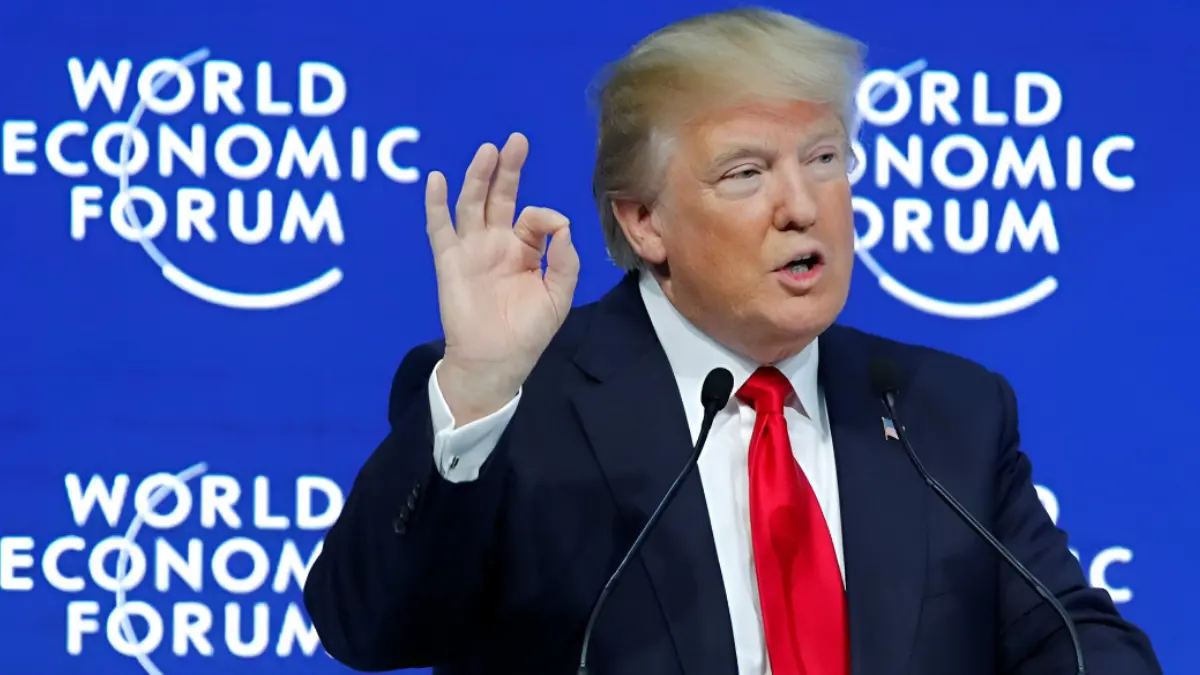


Donald Trump just told the world’s elite exactly what he thinks of them. They didn’t all like it.
The US President delivered a 70-minute keynote at the World Economic Forum in Davos on Tuesday afternoon, boasting about American economic growth while demanding Denmark hand over Greenland and slamming Europe as economically “stagnant.” The room’s reaction split down the middle, according to BBC economics editor Faisal Islam, who observed business leaders clapping enthusiastically while European officials sat in visible discomfort.
Trump called Denmark “ungrateful” for not returning Greenland to the United States after World War II. He ruled out using military force to seize the territory but insisted America must control it for national security reasons. That part of the speech didn’t generate much applause.
“We need Greenland for security purposes,” Trump told the audience at 2:30 PM Central European Time. “Denmark knows this. Everyone knows this.”
The remarks reignited controversy from 2019, when Trump first floated buying Greenland and Danish officials dismissed the idea as absurd. This time he framed it as a NATO necessity amid tensions with the European Union. French President Emmanuel Macron, speaking earlier at Davos, had vowed resistance to what he called “bullies” attempting to redraw borders.
Trump’s economic boasts landed better with the crowd. He touted low inflation, high growth rates, and trade deals covering 40% of US commerce. Business leaders applauded those claims, even as economists debate whether the data supports such optimistic assessments.
This marked Trump’s fourth appearance at Davos and his first since 2020. He arrived Monday with the largest US delegation in recent history, previewing a new housing initiative and signaling Greenland would dominate discussions. The White House billed the trip as a victory lap for “America First” policies.
First time Trump spoke at Davos, he told them to their face he rejects their totalitarian ‘climate change’ agenda “to dominate, transform and control every aspect of our lives.”
He’s going again to tell the WEF
their dream of a global government is OVER. pic.twitter.com/JQP82qg43X— ĐⱤØ₲Ø🇺🇸 (@KAGdrogo) January 11, 2026
The speech bounced between economic statistics and geopolitical jabs. Trump praised his relationship with Chinese President Xi Jinping while criticizing Switzerland, the very country hosting the forum, and calling the United Nations ineffective. The freewheeling style kept attendees guessing what would come next.
European officials in the room didn’t hide their reactions. When Trump criticized Europe’s economic performance, cameras caught several delegates staring straight ahead without clapping. The contrast with the standing ovations he received at past Davos appearances couldn’t be starker.
“The room was decidedly mixed,” Islam reported. Business executives seemed energized by talk of fast approvals and deregulation. Political leaders from EU member states looked less enthused.
Trump departed the White House Monday with an unusually large entourage of cabinet members and business advisors. Aides told reporters the President wanted to showcase American economic strength and counter what he views as globalist narratives that undermine national sovereignty.
The housing initiative he mentioned received minimal detail during the speech. Trump said his administration would streamline construction permits and reduce regulatory barriers, but specifics remained vague. Housing advocates watching the speech said they couldn’t evaluate a policy that hasn’t been fully outlined yet.
Greenland dominated post-speech analysis. Trump’s insistence that Denmark owes America for its World War II liberation struck many observers as historically dubious. The United States did maintain military bases in Greenland during the war, but characterizing Denmark as ungrateful for not ceding sovereign territory crosses diplomatic norms.
Danish officials haven’t formally responded to Tuesday’s remarks. Prime Minister Mette Frederiksen said in 2019 that Greenland isn’t for sale and belongs to Greenlanders, a position her government hasn’t publicly changed. Greenland has home rule within the Kingdom of Denmark, with locals controlling most domestic affairs.
The security argument Trump offered centers on Arctic shipping lanes and Chinese influence. As climate change opens new northern routes, major powers are jockeying for position. China has invested in Greenland’s mining sector, raising Western concerns about Beijing’s footprint near North America.
Military analysts say controlling Greenland would give the United States strategic advantages in monitoring Atlantic approaches and projecting power into the Arctic. But acquiring it through pressure tactics risks alienating NATO allies when alliance cohesion already faces strain over Ukraine and defense spending.
Trump’s comments about Europe drew sharp rebukes from officials beyond France. German economic minister Robert Habeck told reporters that Europe’s challenges stem partly from American protectionist policies that Trump himself implemented. Italian sources suggested the President was scapegoating allies to deflect from domestic problems.
The economic data Trump cited tells a complicated story. US inflation has fallen from pandemic highs, but prices remain elevated compared to pre-2020 levels. Growth exceeded many forecasts last year, yet polls show most Americans feel economically insecure. Trade deals he claimed credit for include revisions to existing agreements, not entirely new pacts.
Business leaders at Davos responded more positively to the regulatory promises. Executives from energy, finance, and technology sectors told reporters they appreciate the administration’s willingness to cut red tape. Several mentioned Trump’s pledge for fast approvals as potentially game-changing for major projects.
After the speech, Trump held bilateral meetings with leaders from Switzerland, Poland, and Egypt. The Swiss meeting carried particular irony given his earlier criticism of the host country. Polish discussions reportedly focused on defense cooperation and energy security. Egyptian talks centered on Middle East stability and investment opportunities.
Trump also oversaw a “Board of Peace” ceremony, though details about what that entails remain murky. White House staff described it as an initiative to promote conflict resolution through economic development, but offered no timeline or specifics.
Social media lit up with clips from the speech. YouTube channels sympathetic to Trump posted segments with titles like “Trump Destroys Davos Elite” and “Historic Takedown of Europe.” The “Denmark ungrateful” quote circulated widely on X, formerly Twitter, with users debating whether it constituted legitimate criticism or diplomatic recklessness.
European media emphasized Macron’s earlier “bullies” comment as a preemptive strike against Trump’s demands. Coverage in German and French outlets portrayed the speech as confirmation that transatlantic relations face serious turbulence. British commentators noted the irony of Trump attacking globalism at globalism’s signature event.
Business receptions following the speech drew strong attendance. Executives who met Trump told reporters they found him receptive to concerns about international taxation and supply chain regulations. Those private conversations painted a less confrontational picture than the public remarks.
The mixed reception at Davos reflects Trump’s broader challenge balancing domestic politics with international diplomacy. His supporters at home want to see him project strength and prioritize American interests. Foreign leaders need to maintain relationships while defending their own sovereignty and values.
Polls show American voters remain focused on economic issues despite Trump’s attention to territorial expansion. A recent survey found 68% of respondents prioritize inflation and wages over foreign policy. Trump’s Davos trip attempts to connect both themes by arguing American strength abroad supports prosperity at home.
Whether that message resonates depends partly on follow-through. Trump returns to Washington on Wednesday facing Congressional battles over spending and immigration. The housing initiative needs legislative support. Trade negotiations require partner cooperation. Greenland demands could complicate NATO discussions scheduled for next month.
WEF attendees will debate Trump’s speech for the remainder of the forum, which runs through Friday. Panel discussions on transatlantic cooperation and Arctic governance have taken on new urgency. Business leaders schedule meetings to assess how American policy shifts affect investment strategies.
The President’s ability to command attention remains undeniable. For 70 minutes Tuesday afternoon, the global elite listened to Trump’s vision of American primacy and European decline. Some applauded. Others sat silent. All understood the implications for an international order already under stress.
What happens next depends on actions beyond speeches. If Trump’s economic policies deliver results Americans can feel, Davos critiques won’t matter much to his political fortunes. If European allies find ways to resist pressure while maintaining necessary cooperation, the relationship survives. If Greenland tensions escalate, the consequences could reshape Arctic geopolitics.
For now, Trump made his positions clear. America comes first. Greenland matters. Europe needs fixing. The Davos crowd got the message, even if they didn’t all like hearing it.