


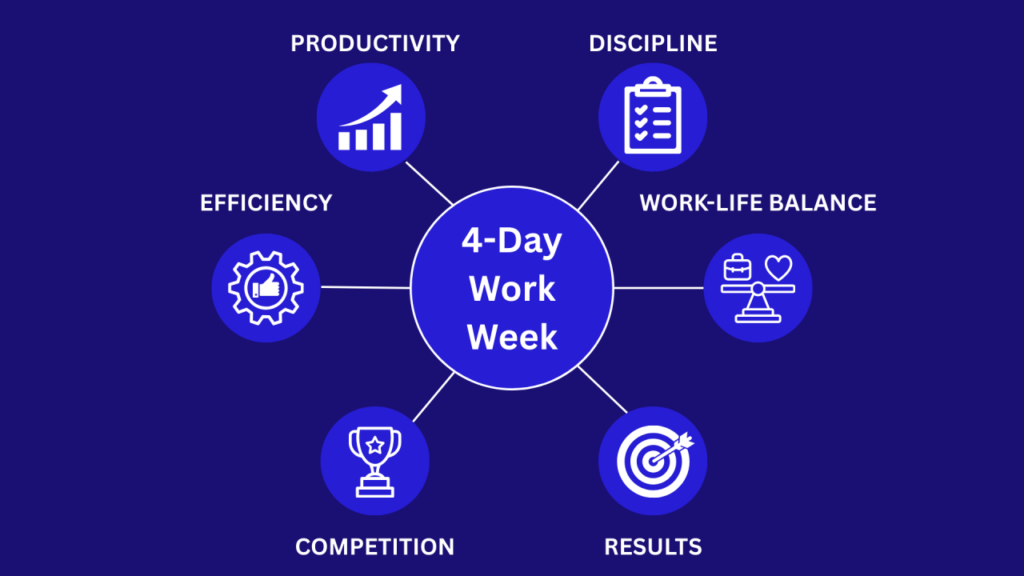
The four-day work week — the proposition that productivity sufficient for five days can be achieved in four, with one day returned to employees — has moved from a fringe concept to a subject of serious government-level piloting and corporate experimentation over the past several years. Technology is both an enabler and a driver of this shift: AI-powered tools that automate routine tasks, communication platforms that reduce meeting load, and asynchronous collaboration software that decouples presence from productivity have all changed the calculation of what a workday must contain. In 2026, the evidence base for four-day work arrangements has grown, even as the relationship between technology adoption and work hour reduction remains complex and contested.
What the Evidence Shows
The most frequently cited trial is the UK pilot conducted in 2022, in which 61 companies and approximately 2,900 workers participated in a coordinated switch to a four-day work week with no reduction in pay. The results, published by researchers at Cambridge and Boston College, found that revenue remained stable or increased during the trial period and that employee well-being measures improved substantially. Approximately 90% of the participating companies chose to continue the four-day arrangement after the trial concluded. This is a secondary source — the study was conducted by academics with organizational relationships to advocacy groups supporting four-day work, a fact that independent reviewers have noted as a potential limitation.
More recent government-level pilots in Germany and Belgium have produced mixed results. Belgium legislated a right for workers to request four-day weeks, but adoption has been slower than anticipated, partly because employers are not required to grant such requests. Several major technology companies including Bolt and Microsoft Japan have run internal four-day trials, with Microsoft Japan reporting a 40% productivity increase during its pilot — a figure that has been cited extensively but requires context: the pilot was conducted in August, when Japanese companies traditionally see lower workloads.
The Technology Connection
The specific technologies most cited in connection with four-day work feasibility are AI-powered productivity tools — writing assistants, automated scheduling, code generation tools, AI-assisted customer service — that can reduce the time required for routine cognitive tasks. If a software developer uses AI code completion to write code 30% faster, or a lawyer uses AI drafting tools to produce contract language in a fraction of the time, the argument is that the same output can be produced in fewer hours.
This argument has real substance but important limits. Not all jobs involve routine cognitive tasks that AI can accelerate. Physical labor, complex client relationships, teaching, and many service roles have different productivity determinants that technology changes less directly. The four-day work week as enabled by technology is primarily a phenomenon relevant to knowledge-economy jobs, at least in the near term.
There is also a counterargument: historically, productivity improvements from technology have not resulted in shorter working hours — they have typically been absorbed into higher output expectations. The 20th century saw enormous productivity gains from electrification, computing, and telecommunications, with little secular reduction in working hours for most workers. Whether AI-era productivity gains translate into shorter work weeks or simply into higher workloads and more output depends on choices made by employers, workers, and policymakers — not on the technology itself.
India’s Context
India’s relationship to the four-day work week debate is shaped by structural factors that distinguish it from the UK or Belgian experience. India’s labor laws vary significantly by state and sector, the informal economy employs the majority of workers, and the formal technology sector — the most likely site of four-day experiments — accounts for a relatively small share of total employment. Several major Indian IT companies have piloted hybrid and flexible work arrangements, but formal four-day work week implementations remain rare and publicly unverified as systematic programs.
The technology that makes four-day work feasible in knowledge-economy settings — AI productivity tools, robust digital collaboration infrastructure, asynchronous communication norms — is increasingly available in India’s technology sector. Whether Indian IT companies adopt four-day models as a competitive talent differentiator in coming years is an open question with no confirmed answer.