


India’s satellite internet market, long discussed in regulatory and industry circles, has crossed a decisive threshold in 2025 and early 2026. Three distinct players — SpaceX’s Starlink, Reliance Jio’s JioSpaceFiber, and Amazon’s newly rebranded Leo service — have either launched, secured regulatory approvals, or moved into active pre-commercial deployment phases in one of the world’s largest and most underserved broadband markets. For the hundreds of millions of Indians living in areas where conventional fiber and 4G infrastructure remain incomplete, satellite internet represents a potential leap over the infrastructure gap. But the competitive picture is more complex than a simple three-way race — regulatory conditions, spectrum allocation, pricing realities, and geography each shape what consumers can actually access and when.
Starlink: Licensed, But Still Awaiting Full Commercial Launch
SpaceX’s Starlink has been the most closely watched satellite internet story in India for several years, following a difficult regulatory journey. Starlink received final approval from IN-SPACe, the Indian National Space Promotion and Authorization Centre, to begin offering broadband services in the country in July 2025, becoming the third satellite internet operator to obtain all required regulatory clearances after Eutelsat OneWeb and the Reliance Jio–SES joint venture.
The approval, however, did not immediately translate into commercial service. Despite the regulatory clearance, Starlink still needed to acquire trial spectrum and meet national security compliance conditions set by the Department of Telecommunications before launching full-scale commercial operations. These steps are mandatory before any commercial service can begin.
Starlink has formed distribution partnerships with both Bharti Airtel and Reliance Jio to offer its broadband services to customers in India once it secures all permits. The company’s Gen 1 low-Earth orbit constellation includes 4,408 satellites with a total capacity of 600 Gbps across India. On pricing, multiple secondary reports have indicated expected monthly plans in the range of ₹3,000 to ₹4,200 for unlimited data, with a hardware kit — including satellite dish, Wi-Fi router, and mounting equipment — estimated at approximately ₹33,000. Neither Starlink nor the Department of Telecommunications has officially confirmed final retail pricing as of this writing. The Telecom Regulatory Authority of India has proposed a spectrum fee model based on 4% of adjusted gross revenue.
Union Communications Minister Jyotiraditya Scindia has publicly confirmed that Starlink has received its license and that a framework for spectrum allocation is in place for a smooth rollout. Commercial service is widely anticipated in the near term, though the exact launch date has not been officially announced.
JioSpaceFiber: India’s First Mover, Backed by SES
Jio’s JioSpaceFiber is the most operationally advanced satellite internet service currently available in India, having made its first deployments in October 2023. The service uses a different orbital architecture from Starlink’s low-Earth orbit constellation. Jio has partnered with SES, a Luxembourg-based satellite operator, to access medium earth orbit satellite technology — the O3b and O3b mPOWER constellations — which the companies claim can deliver gigabit, fiber-like services from space.
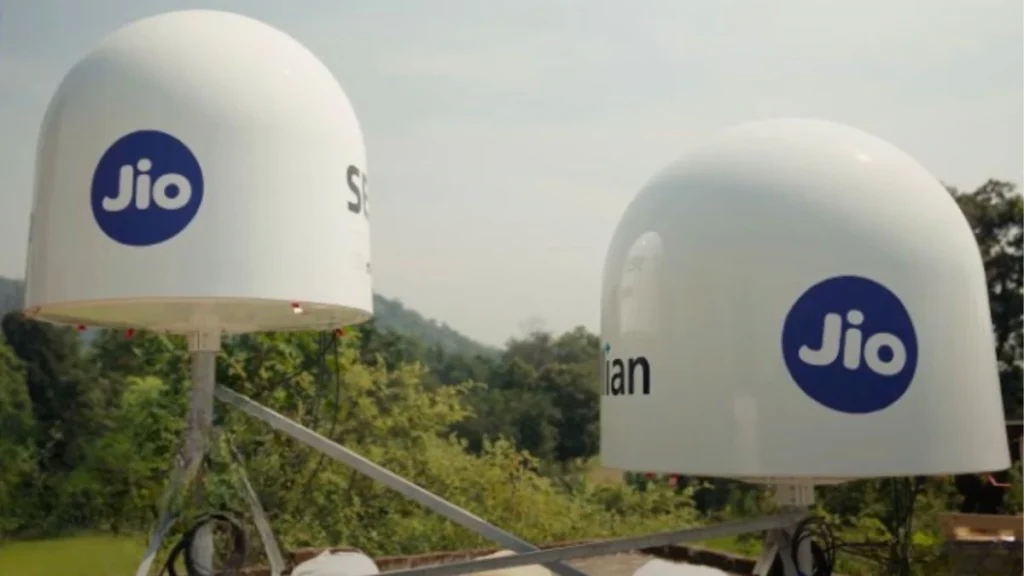
JioSpaceFiber has connected remote locations including Gir in Gujarat, Korba in Chhattisgarh, Nabarangpur in Odisha, and ONGC’s facility in Jorhat, Assam as part of its initial deployment. The service has since expanded to additional cities, though a full nationwide consumer rollout at mass-market scale has not yet been confirmed through primary sources.
JioSpaceFiber’s positioning is explicitly rural and enterprise-first. Reliance Jio chairman Akash Ambani described the service as an extension of Jio’s mission to connect users who remain outside the reach of its existing fiber and wireless broadband network. The company has not officially announced consumer pricing, though earlier statements indicated it would be offered at “highly affordable” rates consistent with Jio’s historical pricing strategy.
Amazon Leo: Global Build-Out in Progress, India Clearances Pending
Amazon’s satellite internet service, which was officially rebranded from Project Kuiper to Amazon Leo in November 2025, is the newest entrant globally and the furthest from commercial readiness in India specifically. Amazon has launched more than 150 satellites as part of its initial constellation, with plans to deploy a total of more than 3,200 satellites. The company is required under its Federal Communications Commission license to have 1,618 satellites in orbit and operational by July 2026.

Amazon Leo’s three customer terminal families offer progressively higher performance: the Leo Nano with speeds up to 100 Mbps, the Leo Pro at up to 400 Mbps, and the enterprise-grade Leo Ultra targeting up to 1 Gbps downstream. Initial service for select enterprise customers is expected to begin in 2026 as the satellite constellation grows.
In India, Amazon Leo faces a more complex regulatory path. As of mid-2025, Amazon Kuiper was still awaiting clearances from both the GMPCS licensing authority and IN-SPACe. Starlink has already partnered with Jio and Airtel, while Kuiper is expected to follow a similar distribution approach once it secures approvals. There is no confirmed timeline for Amazon Leo’s commercial launch in India.
The Competitive Landscape and What It Means for Users
Globally, Starlink has a commanding lead that no competitor has yet matched. As of May 2025, Starlink had operations in over 125 countries and claimed more than five million users worldwide. Its constellation had grown to over 6,000 satellites. Amazon Leo has the financial backing — the project carries a $10 billion investment commitment — and the AWS cloud integration that could make it appealing for enterprise customers, but it is years behind Starlink in operational scale.
For Indian consumers, the practical near-term choice is between Starlink — which is licensed but not yet fully launched — and JioSpaceFiber, which is operational but currently limited in geographic reach and consumer availability. The orbital difference between the two matters for latency: Starlink’s LEO satellites operate at approximately 550 km altitude, delivering lower latency than MEO systems like SES. JioSpaceFiber’s MEO satellites offer higher throughput per satellite but higher latency — relevant for applications like gaming or video calls where responsiveness matters.
The larger structural question is pricing relative to India’s existing broadband market. India has among the world’s cheapest mobile data rates, with terrestrial 5G plans available for well under ₹1,000 per month. A satellite service requiring a ₹33,000 upfront hardware investment and monthly fees in the ₹3,000 range targets a fundamentally different consumer segment than Jio or Airtel’s existing urban plans. The addressable market for satellite internet in India is primarily rural, enterprise, government, and mobile backhaul — segments where terrestrial broadband either doesn’t exist or is economically unviable to build.
The opening of India’s satellite broadband market to multiple licensed operators, after years of regulatory gridlock, marks a structural shift in the country’s connectivity architecture. The precise competitive dynamics will depend heavily on spectrum allocation decisions, national security clearance timelines, and whether any of the three players can achieve pricing that makes the technology accessible to rural Indian households at scale.