

After more than a decade of laboratory promises, broken timelines, and deferred launch dates, solid-state battery technology crossed a meaningful threshold in early 2026: the first commercially available electric vehicles equipped with the technology reached customers, debut demonstrations filled exhibition floors at CES 2026, and at least one major consumer electronics company confirmed it would begin mass production of solid-state cells for wearable devices within the year. The moment marks the end of solid-state batteries as a purely theoretical proposition. It does not, however, signal their imminent arrival in the electric cars and smartphones that most consumers use daily. The gap between early deployment and mass-market availability remains large, and the manufacturing challenges that have delayed the technology for years have not been resolved.
What Solid-State Batteries Actually Are
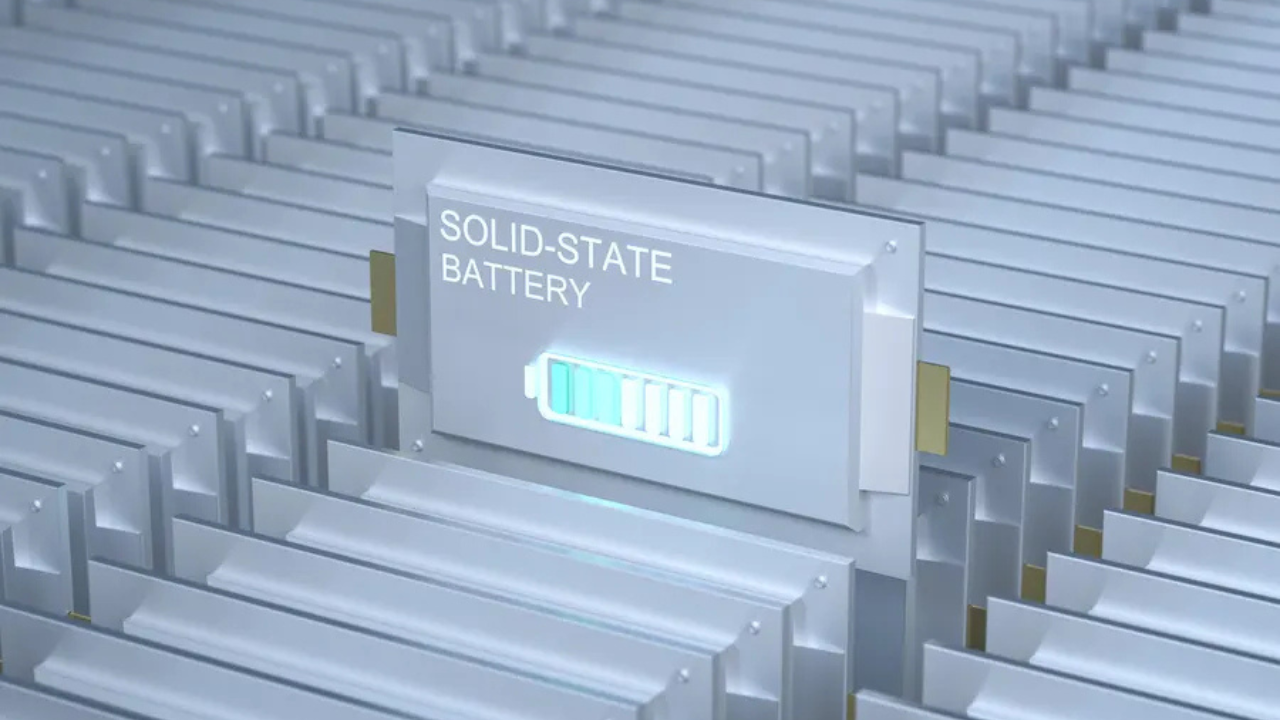
The fundamental distinction between solid-state and conventional lithium-ion batteries lies in a single component: the electrolyte. In standard batteries, ions travel between the anode and cathode through a liquid electrolyte — a flammable solution that limits energy density and introduces fire risk. Solid-state batteries replace that liquid with a solid material, typically ceramic, polymer, or sulfide-based compounds. The consequences of this substitution are significant: the elimination of flammable electrolyte substantially reduces fire and thermal runaway risk; solid electrolytes can accommodate lithium-metal anodes rather than graphite, enabling significantly higher energy density; and the absence of liquid degradation extends battery lifespan. Solid-state batteries are capable of lasting over 1,000 charge cycles compared to approximately 500 cycles in typical lithium-ion batteries, and their smaller footprint makes them suitable for use in electric vehicles, wearable electronics, medical devices, and aerospace applications.
The 2026 Status: What Has Actually Arrived
The most concrete real-world deployment as of early 2026 involves electric motorcycles, not passenger cars or smartphones. Verge Motorcycles, in partnership with Finnish startup Donut Lab, demonstrated an electric motorcycle equipped with an all-solid-state battery at CES 2026. The company claims the solid-state-equipped model can travel up to 372 miles on a single charge and reach 80% charge in ten minutes, compared to the standard model’s 200-mile range. The bike is priced at approximately $34,900. Industry observers have noted that Donut Lab has not yet provided third-party verified evidence of its full solid-state chemistry, and the company has faced pushback from parts of the battery research community regarding its claimed specifications.
In the consumer electronics segment, progress is more incremental. Samsung Electro-Mechanics is developing prototypes and conducting customer tests for compact all-solid-state batteries designed for wearable devices, with the company targeting market entry in that category by the end of 2026 through mass production. There is no current indication from Samsung of solid-state batteries coming to its flagship Galaxy smartphones. PhoneArena
At CES 2026, semi-solid-state batteries — a transitional technology using gel-like electrolytes that reduce but do not eliminate liquid content — were displayed in power banks and accessories. One company demonstrated a 5,000 mAh semi-solid-state power bank measuring just 6.7 mm thick. These semi-solid-state products represent a commercially available intermediate step rather than the fully solid-state technology that researchers and automakers have been developing.
The EV Timeline: Premium First, Mass Market Later
For electric vehicles, the established manufacturers with the most credible timelines are converging on a 2027-to-2028 window for initial deployment, restricted to premium models. Toyota, which once planned to have solid-state batteries in vehicles by 2020 before delaying that timeline multiple times, now says it is on track to launch the new cells in cars by 2027 or 2028. Factorial Energy, a US-based manufacturer, provided cells for a Mercedes test vehicle that drove over 745 miles on a single charge in a real-world test in September 2025, and the company says it plans to bring its technology to market as soon as 2027. MIT Technology Review
Stellantis and Massachusetts-based Factorial have validated a semi-solid-state battery cell claiming an energy density of 375 watt-hours per kilogram — higher than the typical 200 to 300 Wh/kg of traditional lithium-ion batteries. The company claims the cells can charge from 15 to 90 percent in 18 minutes. The battery is to be tested on a demo fleet of vehicles.
China, which dominates global battery manufacturing, is moving along a parallel but distinct track. CATL and BYD, which together account for more than 50% of the global EV battery market, both aim to begin producing solid-state batteries on a small scale around 2027, with mass production targeted toward the end of the decade. China has also issued the first national standard draft for solid-state EV batteries, classifying cells by electrolyte type and ion conductor.
Research firm BloombergNEF has projected that solid-state batteries will account for just 10% of global EV and battery storage demand by 2035, with the initial rollout concentrated in premium EVs. Chinese companies currently hold 83% of current or planned solid-state battery manufacturing capacity.
The Cost Barrier: Still Prohibitive at Scale
The central obstacle to mass-market deployment is not technical performance — laboratory demonstrations have satisfied researchers that solid-state batteries can work. The obstacle is manufacturing cost and scalability. Industry estimates place solid-state battery costs at approximately $400 to $800 per kilowatt-hour by 2026, compared to roughly $115 per kilowatt-hour for lithium-ion batteries. Current production costs remain five to ten times higher than conventional batteries, driven by expensive high-purity materials, complex processing requirements including high-temperature sintering, low manufacturing yields, and the absence of high-volume production infrastructure.
Manufacturing processes are complex and not yet scalable, leading to high costs. Precision engineering is required to develop high-quality components and ensure seamless integration, while safety challenges such as lithium dendrite formation can cause short circuits. Performance limitations at low temperatures and reduced cycle life under fast charging require further improvement. Recycling and end-of-life management also remain unresolved due to the unique materials used.
These challenges are well understood within the industry and have consistently caused scheduled timelines to slip. Toyota announced solid-state battery deployment targets for 2020, then 2025, and is now guiding toward 2027 to 2028. The pattern of deferred timelines does not mean the technology will not arrive — it means the transition will be slower and more expensive than promotional materials from manufacturers typically suggest.
Smartphones: The Furthest Horizon
For the device that most people interact with daily, solid-state batteries remain a more distant prospect than for EVs. Apple and Samsung have been notably slower than Chinese competitors to adopt even silicon-carbon battery technology in their flagship smartphones, with risk aversion regarding long-term reliability and physical safety cited as the primary reason. Samsung, in particular, has maintained a conservative approach to battery innovation in its handsets following the Galaxy Note 7 incidents. How-To Geek
Samsung’s stated near-term priority is wearables, not phones. Apple’s battery supplier TDK has reported a breakthrough in solid-state battery technology for small devices, but no timeline for iPhone integration has been publicly announced. The broader industry expectation, based on available reporting, is that solid-state smartphone batteries will appear first in premium flagship models no earlier than 2027, with widespread adoption more likely by 2030 or beyond.
What the Technology Means When It Arrives
The long-term implications of a successful solid-state transition are substantial for both the EV and consumer electronics industries. For electric vehicles, the combination of higher energy density and faster charging times would address the two most frequently cited consumer concerns about EV adoption: range anxiety and charging inconvenience. For smartphones, the technology would enable thinner devices, longer battery life, and virtually eliminated fire risk — while also freeing up internal space that could accommodate larger camera systems or additional processing hardware.
The trajectory is clear. Solid-state battery technology is entering real-world production in 2026, with major manufacturers racing to commercialize what could represent the most significant leap in energy storage since lithium-ion cells were invented. What is equally clear is that the transition will be phased, expensive, and initially confined to premium applications — and that consumers waiting for solid-state technology before purchasing an EV or smartphone should not expect to wait beyond this decade.