


There is a distinction that experienced international travelers consistently draw, and it is not about budget or duration. It is about orientation. A tourist moves through a destination as a consumer of its surface — landmarks, menus, photographs. A traveler who pursues genuine cultural immersion attempts something categorically different: to understand how the place actually functions from the inside, as the people who live in it experience it. The gap between those two approaches is not a matter of intention. It is a matter of specific, learnable behavior.
The demand for that second experience has become one of the most significant forces reshaping global travel. Research shows that 86% of travelers now prefer authentic, hands-on experiences over traditional sightseeing, while 93% of travel executives believe cultural offerings will be central to tourism within the next five years. Eighty-five percent of travelers want to visit places where they can deeply explore local culture, and 78% seek vacations that support local communities, according to the Hilton 2025 Travel Trends Report. The aspiration is nearly universal. The execution — the specific practices that convert the aspiration into genuine connection — is where most travelers fall short.
The Research Layer That Separates Respectful Visitors From Inadvertent Offenders
Cultural immersion begins before departure, not after arrival. The gap between a traveler who has researched a destination’s cultural norms and one who has not becomes visible within the first hour of interaction — and its consequences extend well beyond awkward moments.
Breaking cultural etiquette rules can result in offending locals and damaging relationships with hosts or service providers, but in some countries, cultural violations carry legal consequences — including fines and, in extreme cases, more serious outcomes. In Thailand, criticizing the monarchy is not merely taboo — it is illegal, and tourists have faced legal consequences for public comments about the Thai royal family. In Singapore, the sale of chewing gum is banned, and importing it into the country can result in legal trouble. In Rome and Florence, eating or drinking near churches and historic monuments is banned, with fines of up to €200 for violations.
The culturally specific behaviors that most commonly generate friction across destinations follow consistent patterns. In Japan, shoes must be removed before entering homes, traditional inns, and some restaurants. In Thailand, the head is considered the most sacred part of the body and should never be touched by another person — even children — while feet are considered the least pure, meaning pointing with feet or showing their soles while sitting is disrespectful. In Japan and South Korea, tipping is not customary and can be considered rude — good service is expected as a standard and does not require extra reward. In many conservative countries including India and much of the Middle East, public displays of affection are considered inappropriate and can attract legal attention.
Body language carries cultural meaning that transcends language barriers. In Thailand, pointing with the index finger is considered impolite, especially toward people or sacred objects — locals use an open palm or chin gesture instead. In Greece, the open-palm gesture known as the moutza is considered highly offensive. In Turkey, the thumbs-up gesture carries a meaning equivalent to an obscene gesture in Western cultures, and forming the OK sign with thumb and forefinger is similarly seen as an insult.
These are not obscure edge cases. They are the behavioral baseline of daily interaction in their respective cultures — and knowing them before arrival is the minimum preparation a traveler pursuing genuine cultural immersion should undertake.
Accommodation as the Primary Immersion Variable
Where a traveler stays determines the depth of cultural access available to them more directly than any other single decision. One of the best ways to immerse in the culture of a country is to stay with a homestay family. The day-to-day life of local individuals gives great insight into numerous aspects of life in a different culture — from sleeping arrangements and food preparation to conversations and local television — all normal, everyday routines that constitute an intimate way of getting to know a culture from the grassroots level.

The documented experiences of homestay participants are consistent across cultures and decades of exchange programs. Indian host families have invited traveling guests to attend intimate weddings and religious ceremonies that would never be accessible through tourism infrastructure. Ecuadorian host families have provided the daily conversational immersion that accelerates language learning more effectively than any classroom. Guatemalan host families have taught traditional food preparation that connects travelers to culinary heritage in a way that a cooking class for tourists cannot replicate.
The practical access points for homestay experiences have expanded significantly. Beyond formal exchange programs, travelers can connect with potential host families through local and foreign Facebook groups, platforms like Workaway, and community-based tourism initiatives — a growing industry that increasingly makes homestay access available outside formal student exchange frameworks. Workaway specifically offers a work-exchange model in which travelers contribute a defined number of hours of work per week in exchange for accommodation and meals — a structure that provides both financial accessibility and a built-in reason for genuine daily interaction with host families and local communities.
Before embarking on a homestay, researching the local culture and customs of the destination — including traditions, social norms, and common practices — smooths the transition. Learning at least a few basic phrases in the local language, even when the host family speaks English, demonstrates respect for the host culture and enhances the experience measurably.
Language: The Investment With the Highest Return in Cultural Immersion
Language is critical to communication. Investing time in learning the local language or mastering basic phrases — through language learning apps, online courses, or language exchange programs — provides opportunities to practice speaking and understanding that make daily interactions easier and more meaningful.
The return on even a minimal language investment is disproportionate to the effort required. A traveler who arrives in Japan knowing how to say thank you, excuse me, and the name of their destination in Japanese receives a qualitatively different response from locals than one who relies entirely on English. A traveler in Morocco who opens interactions with a greeting in Darija demonstrates a respect for local culture that immediately changes the social dynamic of the encounter.
Language exchange programs — in which a traveler practices the local language while offering their English skills in return — provide a structured mechanism for genuine connection that transcends the transactional nature of most tourist-local interaction. Most people are eager to learn some English, creating a natural mutual interest that language exchange programs formalize into a recurring meeting and conversation structure — one that builds relationships across multiple sessions rather than single encounters.
For travelers committed to extended stays in a single location, formal language school enrollment provides both structured learning and an immediate community of local teachers and fellow students. Contacting a language school at a destination — even without intending to formally study — often provides access to homestay placements through the school’s host family network, combining language exposure and cultural immersion in a single arrangement.
Food as the Most Direct Cultural Access Point
Connecting with a destination through food is one of the most effective ways to explore its history, heritage, and culture while enjoying a sensory experience that no other tourism format replicates. The specific food behaviors that signal genuine immersion — as opposed to tourist-track consumption — follow a consistent pattern across cultures.
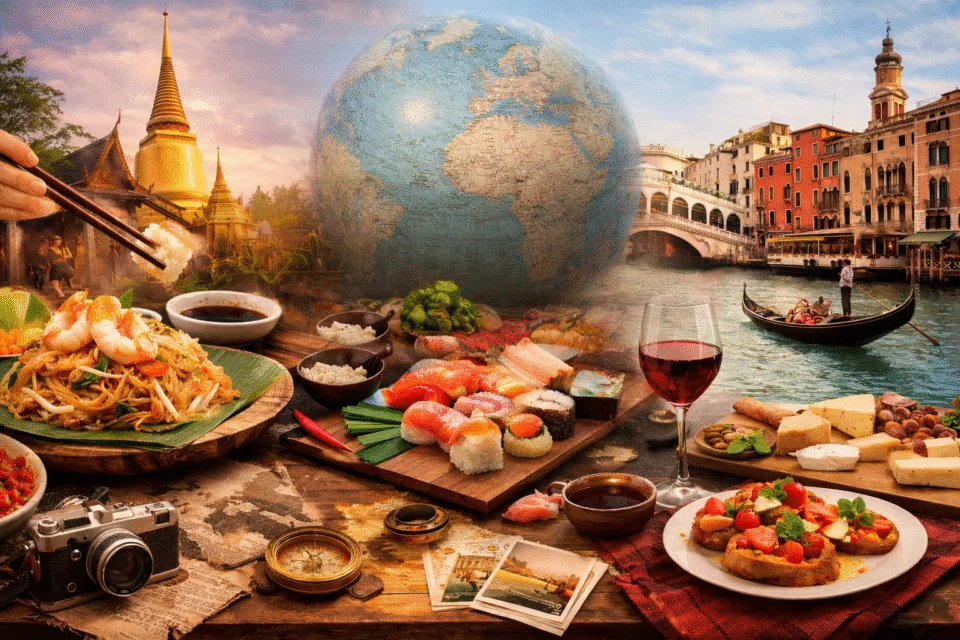
Eating where locals eat, rather than where tourists are directed, is the most reliable single indicator of authentic food access. The local market is usually the central hub of all activity, and the different smells, tastes, and products represent a sensory experience without equal — buying local products, trying unfamiliar local delicacies, and engaging with vendors provides cultural access that a restaurant designed for visitors cannot.
Learning to prepare local dishes — through a cooking class, through a homestay family’s kitchen, or through direct participation in food preparation at a market — connects a traveler to culinary heritage at a depth that eating alone does not provide. Signing up for a cooking class or asking a homestay family to teach a traditional recipe produces a skill that travels home and a relationship with the food culture that persists beyond the visit itself.
Dining etiquette carries the same cultural weight as gesture and dress. In Japan and China, leaving chopsticks standing upright in a bowl of rice resembles funeral offerings and is considered highly disrespectful — chopsticks should be placed on a rest or laid horizontally across the bowl when not in use. In India and across much of the Middle East and parts of Africa, the left hand is associated with personal hygiene and is considered unclean for eating or serving food — the right hand should always be used at the table. These are not arbitrary rules. They are expressions of values — cleanliness, respect for the dead, hospitality — that the food culture carries.
Community Integration: Beyond Tourism Infrastructure
The most sustained form of cultural immersion requires deliberate integration into community life that exists outside tourism infrastructure entirely. Joining local clubs, organizations, or volunteer initiatives provides a mechanism for meeting like-minded individuals, participating in meaningful activities, and contributing to the local community in ways that build authentic connections rather than the transactional relationships that tourism generates.
Local festivals — events designed for residents rather than visitors — provide access to how a culture actually celebrates, grieves, marks seasons, and expresses collective identity. Playing a local sport is a particularly effective integration mechanism because local people are typically passionate about their sport and welcoming to those who want to participate — providing both exercise and genuine community connection simultaneously.
Volunteering through verified, community-led initiatives provides the deepest integration available to short-term visitors. The qualification is important: true cultural immersion requires trust, time, and collaboration, and for tourism to be respectful and mutually beneficial, local communities must lead the way in creating and delivering experiences. The most meaningful cultural programs are those built with care, ensuring each element adds value to both the visitor and the people who call the destination home. Voluntourism programs that are externally designed and parachuted into communities without genuine local ownership do not provide cultural immersion — they provide a performance of it.
Photography: The Practice That Most Visibly Divides Respectful Travelers From Disrespectful Ones
Always asking for permission before taking photos of people, religious sites, or ceremonies is a non-negotiable baseline of respectful travel. In many regions, taking pictures without consent can be deeply disrespectful or even illegal. pproaching locals with courtesy and respecting their wishes if they decline to be photographed demonstrates respect for their privacy and cultural sensitivities — a simple act that the most sophisticated camera equipment cannot substitute for.
The specific contexts in which photography violations cause the most friction are consistent across cultures. Religious sites, temples, and historic landmarks should always be treated with respect — taking selfies in front of altars, climbing on ancient ruins, or being disruptive in a place of worship is offensive in virtually every cultural context that maintains active religious practice. In Sri Lanka, taking selfies with one’s back turned to a Buddha statue is considered deeply disrespectful, and wearing clothing with Buddhist iconography can cause offense across multiple Asian Buddhist cultures.
The Honest Accounting of What Cultural Immersion Actually Requires
Two-thirds of travelers say they are actively avoiding overcrowded hotspots in favor of community-led alternatives — a behavioral shift consistent with the broader movement toward cultural depth over landmark collection. Interaction with people from different cultural backgrounds creates cultural intelligence — developed through curiosity and genuine engagement with various cultural perspectives. It promotes cultural literacy through authentic local engagement.
What cultural immersion does not accommodate is the traveler who wants depth without discomfort — who wants to feel local without surrendering the convenience and predictability of tourist infrastructure. The homestay involves unfamiliar food, unfamiliar schedules, and unfamiliar social norms. The language exchange involves making mistakes in public. The local market involves navigating transactions in an unfamiliar language with unfamiliar currency. The community event involves being the only outsider in a room where nothing is designed for your comprehension.
The best way to learn about life in a foreign country is from the people who actually live there. And courtesy and understanding, as one study abroad student noted, is a language every culture recognizes — even when the verbal language is absent. The mistakes will come. The cultural misunderstandings will happen. What distinguishes the traveler who achieves genuine cultural connection from the one who merely passes through is not the absence of those moments, but the orientation that responds to them with curiosity rather than retreat.