


The fantasy exists in India just as powerfully as anywhere else — leaving the job, the commute, the quarterly appraisal cycle, and the WhatsApp group of colleagues, and instead spending weeks in the hills of Himachal Pradesh, the backwaters of Kerala, or the ancient temples of Southeast Asia. What makes the Indian version of this decision distinct from its Western equivalent is a specific constellation of structural realities: a passport that requires visas for most of the world, a family framework that treats career breaks as family events rather than individual ones, an EPF corpus that demands careful management, and a job market that has historically penalized gaps with a severity that has only recently begun to soften.
Understanding those realities — not around them, but through them — is what separates a plan that works from one that unravels six months after departure.
The Indian Passport Reality: Planning Around the Visa Architecture
The first structural reality every Indian long-term traveler must confront is the passport’s global standing. As of 2026, Indian citizens have visa-free or visa on arrival access to 56 countries and territories, ranking the Indian passport 75th in the world according to the Henley Passport Index. Indians have access to 25 visa-free, 48 visa-on-arrival, 66 e-visa, and 4 ETA countries and territories, ranking 68th globally in terms of travel freedom according to the Passport Index.
The practical consequence is that long-term travel planning for an Indian passport holder requires substantially more advance visa work than the equivalent journey for a European or American traveler. The Schengen visa — covering 27 European countries — requires a documented application process including bank statements, itinerary, accommodation bookings, and financial proof. The UK, US, Canada, and Australia require separate, demanding visa applications. As of 2025, Indians can visit up to 81 countries visa-free with a valid visa from the US, UK, Canada, or Schengen — meaning that securing one of these anchor visas first significantly expands accessible destinations.
This does not make long-term world travel inaccessible for Indian passport holders. It makes visa strategy the foundational planning step, not an afterthought. For budget-friendly visa-free travel, Indian citizens can visit Nepal and Bhutan, which are affordable and culturally rich. Other economical options include the Maldives and Mauritius. Popular visa-on-arrival destinations for Indians include Thailand, Indonesia, Sri Lanka, Jordan, and Kenya. A well-sequenced itinerary — beginning in visa-free or easy visa-on-arrival destinations while anchor visas are being built, then progressing to more complex destinations once travel history is established — is a structurally smarter approach than attempting to secure all visas simultaneously before departure.
The Savings Target: Building the Indian Number
Unlike the American framing where the average savings target cited was $287,731, the Indian calculus is fundamentally different because the rupee-to-dollar purchasing power gap makes certain destinations dramatically more accessible for Indian travelers than for their Western counterparts.
A budget traveler in Southeast Asia — Vietnam, Cambodia, Thailand, Laos — can live comfortably on ₹1,500 to ₹2,500 per day inclusive of accommodation, food, and local transport. Across 12 months in these regions, the in-country cost runs approximately ₹5.5 lakh to ₹9 lakh. India itself offers extraordinary long-term travel possibilities at even lower daily costs — the Himalayan states, the Northeast, Rajasthan, and the coastal circuits can be covered on ₹800 to ₹1,500 per day for a disciplined traveler.
The honest travel fund for a 12-month primarily Asia and India-focused trip, including return international flights, travel insurance, visa fees, pre-departure medical costs, and a 15% emergency buffer, sits between ₹8 lakh and ₹15 lakh for most budget travelers — a figure that is achievable for a mid-career professional willing to save aggressively for 18 to 24 months before departure.
The emergency fund should be held separately and treated as untouchable except in genuine crisis. Three to six months of home-country living expenses — the rent or EMI, family obligations, insurance premiums, and loan payments that continue regardless of where the traveler physically is — represent the minimum reserve before any departure should be considered.
The EPF Decision: What to Do With Your Provident Fund
For salaried Indian employees, the EPF corpus is often the largest single pool of savings available at the point of departure — and the rules governing it have changed significantly as of October 2025 in ways that directly affect career-break travelers.
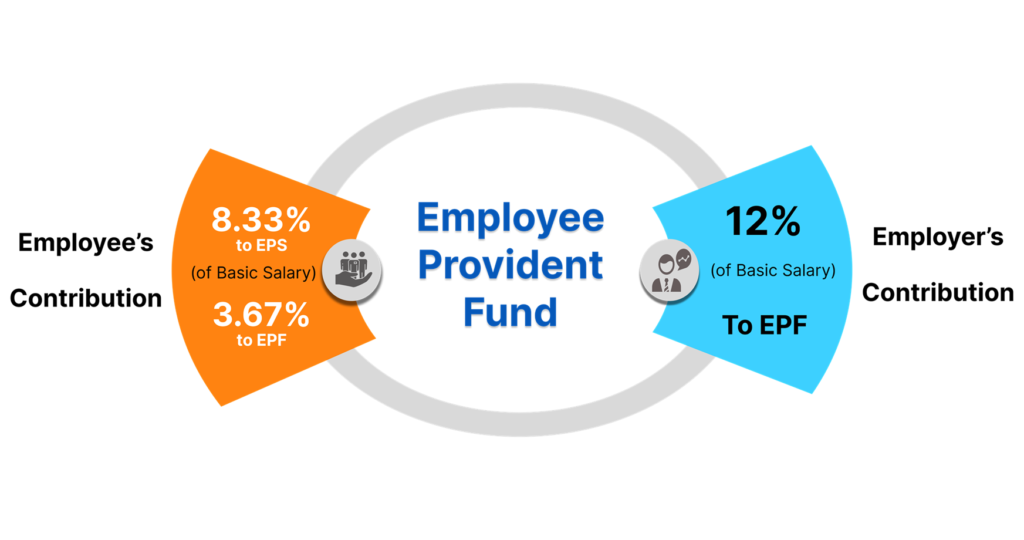
Under EPFO rules updated by the Central Board of Trustees on October 13, 2025, members can now withdraw up to 75% of their EPF balance immediately after job loss. If unemployment continues for two months or more, the entire balance becomes eligible for withdrawal. Members can also withdraw their entire PF amount if they are migrating permanently abroad.
The tax treatment of EPF withdrawals has a threshold that matters for travel planners. Withdrawal of funds after five years of service attracts no TDS, making EPF withdrawals tax-efficient for employees with sufficient service history. For employees with less than five years of service, TDS applies at 10% if PAN is submitted, and at 34.608% if PAN is not submitted.
However, the most important EPF guidance for travelers taking a career break — not a permanent departure — is this: do not withdraw EPF when you are on a career break. You can earn interest on your PF balance for up to three years without any contribution. However, the interest earned during this period is taxable. For travelers returning to employment within three years, leaving the EPF corpus intact — earning 8.25% annual interest — is almost always the financially superior decision over withdrawing and redeploying the funds elsewhere. The only exception is a traveler planning permanent relocation abroad, in which case the 25% retention rule does not apply for permanent settlement abroad, and 100% final settlement remains eligible.
The Career Stigma Reality: More Honest Than Most Guides Acknowledge
The stigma surrounding career breaks is still strong in India. A friend who bravely took a two-year break to start a startup but failed — even though he is now much better in product management — is still trying to get a job back at his previous position. This raises the question of whether Indians are working tirelessly towards jobs only to chase the dream of enjoying life after retirement.
In India, 80% of working women take career breaks, with 45% stating childcare and personal commitments as the reason, according to the Times of India in 2024. The dominant narrative around career breaks in India remains tied to caregiving obligations — a context in which most employers show understanding. A break for travel, by contrast, is still interpreted by a meaningful segment of Indian hiring managers as a signal of unclear professional commitment rather than intentional personal development.
This is changing, but it is not changed. According to a LinkedIn study, nearly 88% of professionals in India were thinking about changing jobs in 2024, with better work-life balance — at 42% — cited more frequently than compensation as a driver. The demand for balance over pure earnings signals a shifting cultural baseline around career expectations. U.S. Travel Association
The practical advice that experienced Indian career-break travelers consistently offer is sector-specific: IT, product management, design, content, consulting, and digital marketing roles are substantially more tolerant of gaps than banking, finance, government-sector adjacent roles, and traditional manufacturing. An IT professional returning from 14 months of travel with a portfolio of freelance projects or open-source contributions is in a fundamentally different re-entry position than one who returns with a gap and no professional documentation of the period.
The Sabbatical Option in the Indian Context
Formal sabbatical policies in Indian companies remain rare. Restructuring organizational hierarchies to embrace flatter, more flexible models and supporting career breaks to retain diverse talent — especially women — has emerged as a policy recommendation from Indian labor market analysts, but widespread formal adoption remains limited.
What exists in practice — particularly in larger IT services firms, MNCs operating in India, and startups with international founder influence — is the possibility of negotiating an informal unpaid leave arrangement for a defined period. Wipro’s ‘Begin Again’ program, launched to enrich its talent pool by bringing professionals back into the workforce after career breaks, represents one institutional acknowledgment that gaps do not permanently disqualify employees. For a high-performing employee with three or more years of tenure, a direct conversation with a manager about a defined unpaid leave — framed with a specific return date and a transition plan — carries more probability of success than most employees assume.
The advantage of the negotiated leave over resignation is significant in the Indian context specifically: it preserves the critical “currently employed” status that Indian families, loan providers, and future employers all weight heavily, and it eliminates the severance-to-re-entry gap that a resignation creates.
Family: The Structural Variable That Western Travel Guides Ignore Entirely
No Indian career-break guide is complete without an honest acknowledgment of the family dimension — because in the Indian context, the decision to quit a job and travel is rarely experienced as an individual choice. It is experienced as a family announcement, with the full weight of parental expectation, spouse or partner considerations, sibling opinions, and extended family interpretation all bearing on both the decision and its aftermath.

The financial dependency dimension is also real for a significant proportion of Indian professionals. A first-generation salaried employee who supports parents, contributes to a sibling’s education, or carries joint household obligations cannot model a career break on the same financial assumptions as someone with no dependents and no family financial obligations. The savings target must account for these obligations continuing uninterrupted throughout the travel period — not pausing because the earner has paused.
The cultural framing that has worked for Indian travelers who have navigated this successfully is to present the break around a documented purpose — a skill being developed, a business concept being tested, a health recovery being prioritized, a research project being conducted — rather than as open-ended wandering. The purpose need not be fabricated; most people who travel long-term genuinely develop skills, perspectives, and capabilities that have professional value. Documenting that process — in writing, through a blog, through freelance work, through courses taken during the journey — creates the evidence that makes the re-entry conversation substantively easier.
Health Insurance: The India-Specific Gap
Unlike the American context where losing employer-sponsored health insurance is a well-understood administrative event, Indian health coverage gaps are less discussed but equally consequential. Most Indian employer group health insurance ends with employment. Individual health insurance in India has waiting periods — typically two to four years — for pre-existing conditions, meaning a policy taken out on departure may not cover existing conditions for the first years of coverage.

For travelers staying within India, the Ayushman Bharat Pradhan Mantri Jan Arogya Yojana provides coverage for eligible beneficiaries. For international travel, a purpose-built international travel health insurance plan — separate from standard domestic individual health policies — is the appropriate product. SafetyWing’s Nomad Insurance, available to Indian citizens, provides rolling international medical coverage on a month-to-month basis and is widely used by Indian long-term travelers precisely because its monthly renewal model matches the uncertainty of open-ended travel plans.
The Return Plan: The Step Most Indian Travelers Leave Blank
The return from a career break in India carries a specific reputational management dimension that requires preparation before departure, not improvisation on return. The narrative of what was done, why it was done, and what it produced needs to be crafted during the trip — not reconstructed after the fact when a job application is already under review.
India ranks second globally in hiring intent for Q4 2025, with a net 40% of companies planning to increase staff, according to the India Skills Report 2026. The hiring environment is strong — the re-entry window for a well-prepared returnee is genuinely open. The India Skills Report 2026 notes that India now accounts for 16% of the world’s AI talent pool, and over 90% of employees across sectors use generative AI tools in their work. A traveler who spends their break period developing skills in AI tools, digital marketing, content creation, or product development — which can be done remotely and inexpensively — returns with capabilities that the current Indian job market specifically values.
The traveler who returns with only memories faces a harder re-entry than the one who returns with memories and a documented record of what they built, learned, or contributed during the time away. In the Indian professional context, where the gap is already carrying cultural weight, the documented record is not optional — it is the evidence that transforms a career break from an unexplained absence into a credible professional narrative.
The trip is real. The planning that makes it survivable — financially, professionally, and in the family context that Indian travelers navigate every day — is equally real, and equally worth the effort.